
Norway has one of Europe’s most advanced broadband markets, but selecting the best internet service provider in 2026 requires more than choosing the fastest advertised plan. With 96.3 percent of households able to access speeds of at least 1 Gbps, 99.3 percent covered by broadband of 100 Mbps or higher, and 99.8 percent covered by 5G, most Norwegian customers can choose between fiber, cable broadband and Fixed Wireless Access.
The right ISP depends on location, household size, Wi-Fi performance, contract pricing, customer support and the services included in the package. Leading providers include Altibox, Telenor, Telia Norge, GlobalConnect, NextGenTel and several regional fiber companies.
Check Which Network Is Available at Your Address
Customers should begin by checking the infrastructure available at their exact address. Broadband availability can vary significantly between neighbouring streets, apartment buildings and rural communities.
Fiber is generally the best option for customers who need high upload speeds, low latency and stable performance. It is particularly suitable for remote workers, gamers, content creators and households using several streaming services simultaneously.
Norway’s broadband rollout is nearing completion, with gigabit availability increasing by only 0.1 percentage points during 2025. However, rural coverage continues improving. Gigabit availability outside densely populated areas rose from 70.4 percent in 2022 to 82.9 percent by the end of 2025.
The Norwegian government allocated NOK 159 million in March 2026 to strengthen broadband and mobile connectivity in underserved areas. Norway aims to provide 1 Gbps broadband to every household and business by 2030.
Choose Speed Based on Household Usage
Many households pay for more speed than they need. Customers should select broadband based on simultaneous usage rather than the maximum speed available.
A 100-150 Mbps plan is normally sufficient for small households using video streaming, social media, online shopping and remote work. Plans in this category generally cost NOK 699-799 per month.
A 500 Mbps connection, typically priced between NOK 899 and NOK 1,049, is better for families with several users, multiple 4K televisions, gaming consoles and smart home devices.
A 1 Gbps plan costs approximately NOK 999-1,199 per month and is suitable for large households, demanding remote workers and customers transferring large files.
Multi-gigabit services are best reserved for highly connected homes and specialist users. Telia Norge offers up to 2,500 Mbps download and 1,000 Mbps upload, priced at NOK 1,249 during the promotional period, rising to NOK 1,399.
Norway’s median fixed broadband performance reached approximately 276 Mbps download, 182 Mbps upload and 9 milliseconds latency during the first quarter of 2026. Customers should therefore compare real-world speed and latency rather than relying only on advertised maximums.
Compare Full Prices After Promotions End
Promotional broadband pricing can appear attractive, but customers should calculate the total cost after introductory discounts expire.
Telia’s 750 Mbps fiber package starts at NOK 1,049 per month before increasing to NOK 1,199. Its wireless broadband packages range from NOK 590 to NOK 990 during promotional periods and later rise to NOK 728-1,138, depending on speed.
Customers should check installation fees, router charges, binding periods, cancellation conditions and annual price adjustments. Unlimited data is standard across most Norwegian fiber plans, so the main pricing differences usually involve speed, equipment and bundled services.
Evaluate Wi-Fi Quality, Not Only Broadband Speed
A fast fiber connection will not solve poor indoor Wi-Fi coverage. The average Nordic household connects between 20 and 30 internet-enabled devices, including smartphones, televisions, security cameras, laptops and gaming equipment.
Customers living in large houses or properties with thick walls should prioritise providers offering mesh Wi-Fi and intelligent network management.
Telenor provides WiFi Ruter+ and Mesh Wi-Fi with traffic optimization, parental controls, guest networking and SafeZone cybersecurity. Telia’s Smart WiFi supports automatic channel selection, device steering, Wi-Fi 6, cloud storage and F-Secure Total. Altibox WiFi Pluss combines Wi-Fi 6 mesh equipment with cloud-based optimization, seamless roaming and app-based diagnostics.
Customers should confirm whether advanced routers and mesh units are included or charged separately.
Consider Fiber, 5G FWA and Satellite Carefully
Fiber remains the preferred option where available because it delivers consistent speeds and low latency. However, 5G Fixed Wireless Access is a practical alternative in rural areas and homes awaiting fiber installation.
Supported by 99.8 percent household 5G coverage, Norwegian operators offer wireless broadband speeds from 25 Mbps to 500 Mbps. Telenor and Telia both use their 5G networks to serve areas where fiber construction is difficult.
Telia also offers 100 Mbps wireless broadband for holiday homes from NOK 500 per month, increasing to NOK 648 after the introductory period.
For extremely remote areas, offshore locations or Svalbard, Starlink offers speeds of approximately 100-300 Mbps, uploads of 15-30 Mbps, and latency of 20-40 milliseconds. Its residential package costs around NOK 499 per month, while the equipment costs approximately NOK 3,499.
Match the Provider to Your Priorities
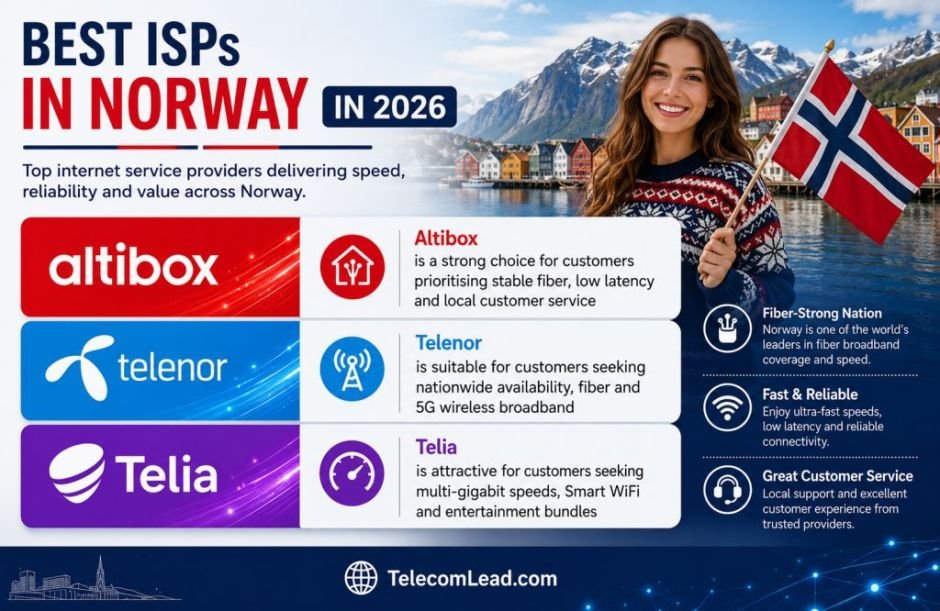
Altibox is a strong choice for customers prioritising stable fiber, low latency and local customer service. It led Norway’s fixed broadband market with an estimated 35.7 percent share during the first half of 2025.
Telenor, with a 27.3 percent share, is suitable for customers seeking nationwide availability, fiber and 5G wireless broadband. It had 707,000 Norwegian fixed broadband subscribers at the end of 2025, up from 697,000 a year earlier.
GlobalConnect held 10.4 percent of subscriptions, Telia 9.5 percent, and NextGenTel 2.8 percent. Other providers represented 14.3 percent. Together, the five largest providers controlled approximately 86 percent of the market.
Telia is particularly attractive for customers seeking multi-gigabit speeds, Smart WiFi and entertainment bundles. GlobalConnect and NextGenTel can be competitive where their networks and promotional offers are available.
Select the ISP That Delivers the Best Overall Value
The best ISP in Norway is not automatically the provider offering the highest speed. Customers should compare address-level coverage, normal monthly pricing, upload speed, latency, router quality, customer support and contract conditions.
A reliable 500 Mbps connection with strong mesh Wi-Fi may deliver a better experience than a 1 Gbps plan using poor equipment. Customers should also review complaints related to billing, promotional price increases, installation delays and contract termination.
With near-universal gigabit and 5G coverage, Norway’s broadband competition in 2026 is increasingly about real-world performance, intelligent Wi-Fi and customer experience. Choosing the right provider means paying for the connectivity the household genuinely needs rather than simply buying the fastest available plan.
FASNA SHABEER

