Finland remains one of Europe’s most advanced broadband markets in 2026, supported by rapid fiber deployment, extensive 5G coverage, unlimited mobile data adoption and growing demand for AI-powered home networking. Leading ISPs including Elisa, DNA and Telia Finland are competing through gigabit fiber, 5G home broadband, intelligent Wi-Fi systems, flexible pricing and improved customer experiences.
By the end of September 2025, fiber networks covered 80 percent of Finnish households, representing nearly 2.3 million homes. Gigabit-capable fixed broadband networks offering speeds of at least 1 Gbps were also available to 80 percent of households, according to Traficom (Finnish Transport and Communications Agency).
Fiber availability increased by 12 percentage points year-on-year, reflecting continued investment by national telecom operators, regional fiber companies and local broadband providers.
Elisa, DNA and Telia Lead Finland’s ISP Market
Finland’s broadband market is led by Elisa, DNA and Telia Finland, which provide fiber broadband, mobile services, 5G Fixed Wireless Access and bundled digital connectivity.
Elisa offers fiber broadband, unlimited mobile internet and its 5G Kotinetti home broadband service. The operator is combining fixed and wireless infrastructure with advanced Wi-Fi equipment, digital customer support and smart connectivity services.
DNA competes through fiber, cable broadband and aggressive 5G home internet offers. Fixed Wireless Access allows DNA to serve households where direct fiber deployment may be difficult or expensive.
Telia Finland provides fiber, 5G home broadband, enterprise connectivity and bundled digital services. Its strategy focuses on higher broadband speeds, wider coverage and integrated fixed-mobile connectivity.
Finland Broadband Offers in 2026
Finnish customers can select from entry-level fiber connections, gigabit broadband and high-speed 5G home internet packages.
Entry-level 100 Mbps fiber plans generally start at around €25 per month. Premium 1 Gbps fiber packages typically cost between €40 and €50 per month. Promotional campaigns can reduce the price of selected 100 Mbps services to approximately €13 per month for limited periods.
DNA’s promotional 5G home broadband offers include approximately:
400 Mbps for €33.99 per month
600 Mbps for €37.99 per month
1 Gbps for €49.99 per month
Telia Finland’s promotional broadband pricing includes approximately:
400 Mbps for €34.99 per month
600 Mbps for €38.99 per month
1 Gbps for €48.99 per month
2 Gbps for €58.99 per month
Broadband competition is increasingly moving beyond monthly prices. Finnish customers are comparing providers based on real-world speeds, reliability, upload performance, Wi-Fi coverage, security features and customer support, according to a report from Ookla Speedtest Global Index – Finland Broadband and Mobile Network Performance.
Fiber Accounts for 85 Percent of Fixed Broadband Connections
Finland has one of Europe’s highest rates of high-speed broadband adoption.
By the end of 2025, the country had more than 1.8 million fiber broadband subscriptions. Fiber represented approximately 85 percent of all fixed broadband connections.
More than 54 percent of household fixed broadband subscriptions offered download speeds of at least 100 Mbps, while connections below 10 Mbps accounted for less than 1 percent.
DNA reported approximately 2.79 million mobile subscriptions and around 709,000 fixed broadband customers in early 2026. Elisa also continued expanding its broadband customer base through growing demand for fiber and 5G home internet.
The strong adoption of high-speed broadband reflects Finland’s reliance on remote work, cloud services, video streaming, online gaming and connected home applications.
Finland Records 9 Million Mobile Subscriptions
Finland had approximately 9 million mobile subscriptions by the end of 2025, equal to around 1.6 subscriptions per person.
Unlimited mobile data remained a major feature of the Finnish telecom market, with approximately 89 percent of mobile subscriptions including unlimited data.
Around 43 percent of data-enabled mobile subscriptions supported 5G connectivity, while approximately 38 percent of mobile data traffic was carried over 5G networks.
These figures show how rapidly Finnish consumers are migrating from 4G to next-generation mobile broadband.
Fiber Coverage Reaches Nearly 2.3 Million Homes
Fiber has become the foundation of Finland’s fixed broadband transformation.
Approximately 80 percent of Finnish households had access to fiber by 2025, equal to nearly 2.3 million homes. Gigabit-capable fixed networks reached a similar proportion of households.
Fiber coverage varies by region. Availability reached:
94 percent in Åland
92 percent in North Ostrobothnia
88 percent in Uusimaa
Around 130 companies own or operate fiber networks across Finland, including national telecom groups, municipal operators, regional utilities and local broadband organizations.
Fiber deployment is also narrowing the connectivity gap between cities and rural areas. However, remote communities in eastern and northern Finland continue to face higher network construction costs because of low population density and difficult terrain.
Gigabit and Multi-Gigabit Broadband Expand
Approximately 80 percent of Finnish households could access fixed broadband speeds of 1 Gbps or higher by 2025.
Elisa, DNA and Telia Finland offer broadband packages ranging from 100 Mbps to 300 Mbps, 600 Mbps, 1 Gbps and, in selected areas, 2 Gbps.
Fiber enables reliable high-capacity connections for 4K and 8K video, cloud applications, gaming, remote work, artificial intelligence applications and large file transfers.
High-speed 5G coverage reached approximately 93 percent of Finnish households, while advanced 4G networks covered around 96 percent.
The combination of fiber and mobile broadband allows Finnish customers to choose between fixed, wireless and hybrid connectivity solutions.
AI-Powered Wi-Fi Improves Home Broadband
As gigabit connections become widely available, Finnish ISPs are focusing more heavily on the in-home Wi-Fi experience.
AI-powered routers and mesh Wi-Fi systems can automatically optimize bandwidth, select better wireless channels, identify weak coverage areas and manage connected devices.
Finnish homes increasingly use smart televisions, smartphones, laptops, gaming consoles, security cameras, appliances and Internet of Things devices. Faster broadband alone cannot guarantee good performance if indoor Wi-Fi coverage is poor.
Elisa, DNA and Telia Finland are integrating intelligent network management tools that enable remote diagnostics, automated troubleshooting and predictive maintenance.
These systems can help operators detect problems before customers report them, reduce service interruptions and improve support response times.
5G Fixed Wireless Access Expands Rural Connectivity
Fixed Wireless Access is becoming an important broadband alternative in rural locations, holiday homes and areas where fiber rollout remains difficult.
Finnish operators use 4G and 5G networks to deliver home broadband speeds ranging from 100 Mbps to 1 Gbps without requiring a direct fiber connection.
Elisa’s 5G Kotinetti, DNA’s 5G home broadband and Telia Finland’s wireless internet services provide customers with faster installation and greater flexibility.
FWA benefits from Finland’s 93 percent high-speed 5G household coverage and 96 percent high-speed 4G coverage.
Fiber remains the preferred option for customers requiring consistent capacity and low latency, but 5G FWA provides an effective alternative where fixed infrastructure is unavailable.
Starlink Expands Satellite Broadband Options
Satellite broadband provides connectivity for remote Finnish homes, islands, rural businesses and locations where terrestrial networks are difficult to deploy.
Starlink typically delivers download speeds between 50 Mbps and 250 Mbps, although some users may receive speeds above 300 Mbps. Latency generally ranges from 25 milliseconds to 60 milliseconds.
Starlink residential services in Finland cost approximately €40-€50 per month, while user terminals generally cost around €300-€400.
Amazon Kuiper is expected to increase competition through a planned constellation of more than 3,000 satellites. Eutelsat OneWeb mainly targets enterprise, aviation, government and remote connectivity customers.
Satellite services are unlikely to replace fiber or 5G in Finnish cities, but they remain valuable for underserved locations.
Customer Experience Shapes ISP Competition
Finnish broadband customers generally benefit from reliable networks, high speeds and extensive coverage. However, satisfaction increasingly depends on commercial transparency and customer service.
Common complaints include promotional price increases, fiber installation delays, unclear contract conditions and differences between advertised and actual speeds.
AI-based customer support, automated diagnostics and predictive network monitoring are becoming important tools for reducing complaints and resolving connectivity issues faster.
Operators that combine reliable broadband with transparent pricing, easy installation and responsive support are likely to gain a competitive advantage.
Finland Broadband Pricing Trends
Typical 100 Mbps fiber plans cost around €25 per month, while gigabit and multi-gigabit services generally range from €50 to €60 per month.
Unlimited 4G mobile broadband packages are available from around €20 per month. Most 5G broadband plans cost between €30 and €50 per month.
Starlink satellite broadband costs approximately €40-€50 per month, excluding the €300-€400 equipment charge.
As broadband speeds become more widely available, competition is shifting from low-cost connectivity toward premium services that include better Wi-Fi, cybersecurity, smart home integration and digital support.
Finland’s Best ISPs in 2026
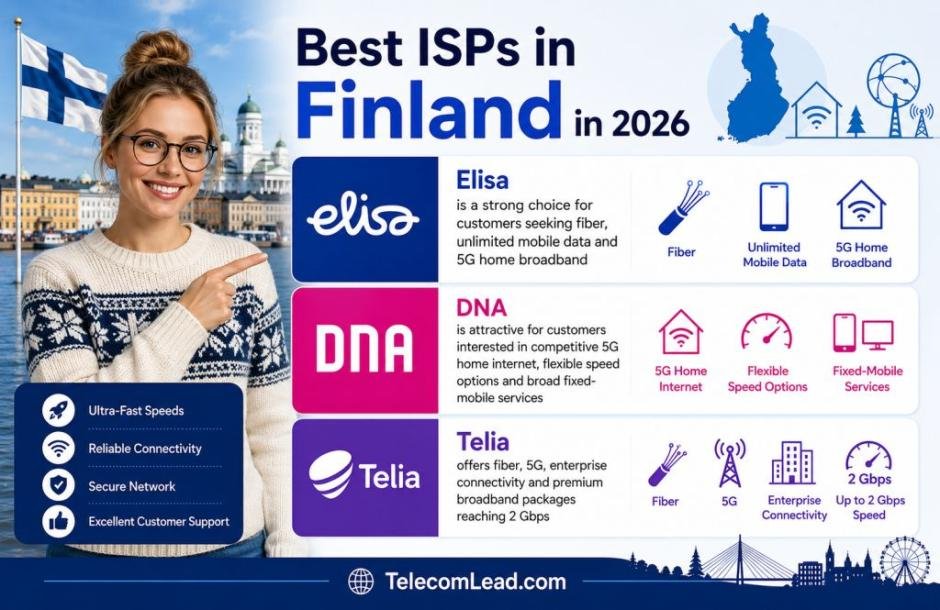
Elisa remains a strong choice for customers seeking fiber, unlimited mobile data and 5G home broadband through an integrated connectivity provider.
DNA is attractive for customers interested in competitive 5G home internet, flexible speed options and broad fixed-mobile services.
Telia Finland offers fiber, 5G, enterprise connectivity and premium broadband packages reaching 2 Gbps in selected areas.
The best provider ultimately depends on location, network availability, required speeds, pricing and customer service expectations.
Outlook for Finland’s Broadband Market
Finland’s broadband market in 2026 demonstrates how fiber and 5G can work together to provide widespread high-speed connectivity.
The country has 80 percent household fiber coverage, nearly 2.3 million homes covered by gigabit-capable fixed networks, more than 1.8 million fiber subscriptions, 9 million mobile subscriptions and 93 percent high-speed 5G household coverage.
Around 89 percent of mobile subscriptions include unlimited data, 43 percent of data-enabled subscriptions support 5G, and 38 percent of mobile data traffic already travels over 5G networks.
The next stage of ISP competition will focus on AI-powered network management, intelligent Wi-Fi, multi-gigabit broadband, rural FWA coverage, transparent pricing and personalized customer experiences.
FASNA SHABEER