Denmark remains one of Europe’s most advanced broadband markets in 2026, combining near-universal internet adoption, extensive fiber deployment, nationwide 5G availability, and strong competition among internet service providers (ISPs). Operators are differentiating through gigabit fiber, AI-powered Wi-Fi, smart home networking, and premium digital services.
According to Ookla’s latest Speedtest Global Index, fixed broadband ISPs in Denmark offer download speed of 373.37 Mbps and upload speed of 296.06 Mbps. Telecom operators offers Mobile Internet download speed of 274.44 Mbps and upload speed of 34.74 Mbps.
Leading broadband providers including YouSee, Norlys, TDC NET, GlobalConnect, Hiper, Fastspeed, Waoo, Telenor Denmark, and Telia Denmark are competing on network quality, pricing, customer experience, and next-generation connectivity.
Denmark’s Digital Infrastructure Sets European Benchmark
Denmark continues to outperform most European broadband markets.
By 2025, 97.74 percent of Danish households had access to Fixed Very High-Capacity Networks (VHCN), well above the European Union average of 85.54 percent. Fibre-to-the-Premises (FTTP) coverage reached 90.25 percent of households compared with the EU average of 74.13 percent.
The country also achieved 100 percent basic 5G coverage, while 87.5 percent of households were covered by 5G services operating in the 3.4-3.8 GHz spectrum band.
Affordable Gigabit Fiber Drives Competition
Gigabit broadband has become a mainstream offering across Denmark.
Most ISPs now provide broadband plans ranging from 100 Mbps entry-level services to 1 Gbps fiber connections, with competition increasingly focused on network reliability, upload performance, Wi-Fi quality, and bundled services rather than basic internet access.
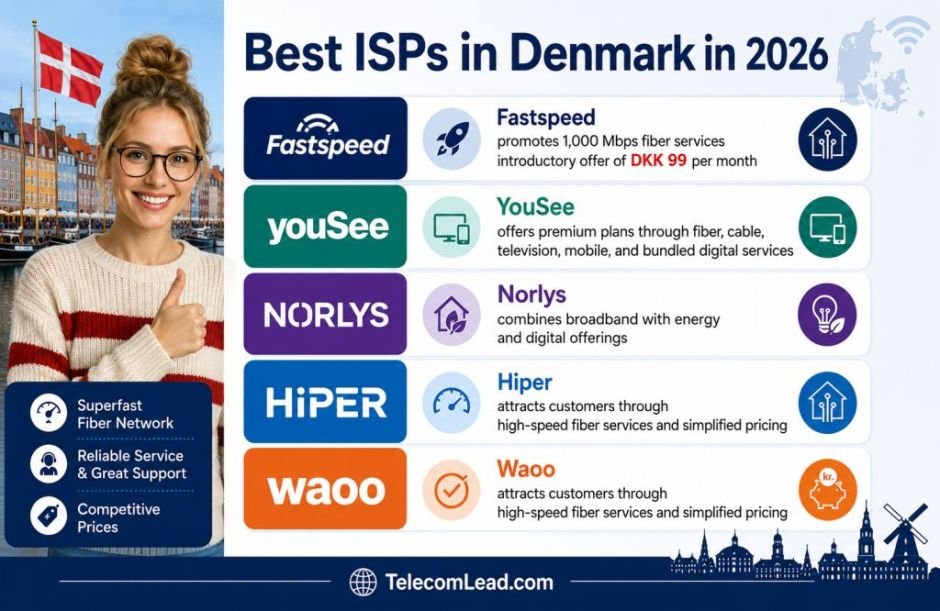
Fastspeed has emerged as one of Denmark’s fastest-growing challengers, promoting 1,000 Mbps fiber services across infrastructure provided by TDC NET and GlobalConnect. Introductory offers have reached approximately DKK 99 per month, with regular pricing generally increasing to around DKK 299 per month, depending on package conditions.
YouSee continues targeting premium households through fiber, cable, television, mobile, and bundled digital services.
Norlys combines broadband with energy and digital offerings, while Hiper and Waoo continue attracting customers through high-speed fiber services and simplified pricing.
Broadband Adoption Nears Universal Coverage
Denmark remains one of the world’s most connected countries.
The country recorded approximately 5.95 million internet users during 2025, representing an internet penetration rate of around 99 percent.
Broadband availability is also approaching nationwide coverage. Approximately 99.1 percent of homes and businesses had access to broadband services delivering at least 100 Mbps download and 30 Mbps upload speeds.
Fiber deployment added approximately 125,000 new fiber-enabled addresses during 2025, increasing availability to around 91 percent of homes and businesses.
Fiber has now become Denmark’s dominant fixed broadband technology, accounting for approximately 51 percent of fixed broadband subscriptions.
High-speed adoption continues accelerating, with 36.42 percent of broadband subscriptions operating at 1 Gbps or higher, significantly above the EU average of 26.97 percent.
Fiber Expansion Continues Across Denmark
Fiber remains the foundation of Denmark’s broadband strategy.
FTTP coverage reached 90.25 percent of households during 2025, while Fixed Very High-Capacity Network (VHCN) coverage climbed to 97.74 percent.
Rural connectivity also continues improving. Rural FTTP coverage increased from 91.52 percent in 2024 to 92.73 percent during 2025.
Infrastructure operators including TDC NET, GlobalConnect, Norlys, and regional fiber companies continue expanding fiber networks while replacing legacy copper infrastructure.
Denmark aims to increase gigabit-capable broadband coverage from approximately 97 percent of homes and businesses by mid-2024 to around 99 percent by 2027.
Denmark Delivers Some of Europe’s Fastest Broadband
Fiber expansion continues improving broadband performance nationwide.
Average fixed broadband download speeds have reached approximately 220-230 Mbps, while upload speeds average around 80-90 Mbps.
Leading providers including YouSee, Fastspeed, Hiper, and Waoo offer symmetrical 1 Gbps fiber services, enabling faster cloud applications, 4K streaming, remote work, online gaming, AI workloads, and business collaboration.
AI-Powered Wi-Fi Becomes a Key Differentiator
As connected homes become increasingly complex, ISPs are investing heavily in intelligent networking.
Typical Danish households now operate between 15 and 25 connected devices, including smartphones, laptops, smart televisions, gaming consoles, security cameras, and IoT equipment.
Providers are introducing advanced routers supporting Wi-Fi 6, Wi-Fi 6E, and increasingly Wi-Fi 7.
Wi-Fi 7 can theoretically deliver speeds exceeding 30 Gbps, compared with approximately 9.6 Gbps for Wi-Fi 6, while improving latency, capacity, and efficiency.
AI-powered networking automatically optimizes bandwidth allocation, improves indoor coverage, identifies connectivity issues, and reduces technical support requirements.
Smart home applications including connected energy management, security systems, entertainment platforms, and cloud services continue driving demand for intelligent Wi-Fi.
5G Fixed Wireless Access Expands Consumer Choice
Fixed Wireless Access (FWA) is becoming an important complementary broadband technology.
Supported by 100 percent nationwide basic 5G coverage and 87.5 percent household coverage in the 3.4-3.8 GHz band, Danish operators can deliver wireless broadband speeds ranging from 100 Mbps to more than 1 Gbps, depending on spectrum availability and network conditions.
Operators including Telenor Denmark, Telia Denmark, 3 Denmark, and Norlys continue evaluating FWA opportunities for rural communities, temporary installations, and rapid broadband deployment.
However, fiber remains the preferred long-term solution because of its superior capacity, reliability, and lower latency.
Satellite Broadband Supports Remote Connectivity
Satellite broadband remains a specialized connectivity option.
Starlink currently leads Denmark’s Low Earth Orbit satellite broadband market, operating more than 7,000 satellites globally while serving more than 6 million customers.
Typical Danish users experience download speeds ranging from 50 Mbps to more than 200 Mbps, with latency between 25 milliseconds and 60 milliseconds.
Residential services generally cost around DKK 400-500 per month, making satellite broadband most attractive for rural homes, offshore operations, maritime users, and locations beyond terrestrial infrastructure.
Future competition is expected from Amazon Project Kuiper, targeting more than 3,200 satellites, and Eutelsat OneWeb, which operates a constellation exceeding 600 satellites.
Customer Experience Becomes More Important
As broadband infrastructure matures, Danish consumers increasingly evaluate providers on customer experience.
Complaints have shifted away from network availability toward promotional pricing, billing transparency, installation scheduling, contract conditions, and customer service.
Digital-first providers such as Hiper and Fastspeed have strengthened their positions through straightforward pricing and competitive broadband packages.
Larger providers including YouSee and Norlys continue emphasizing reliability, bundled services, and comprehensive customer support.
AI-driven diagnostics, automated troubleshooting, and intelligent Wi-Fi management are helping reduce technical issues while improving service quality.
Broadband Pricing Remains Competitive
Competition among fiber providers continues improving value for consumers.
Standard broadband plans generally range between DKK 250 and DKK 400 per month, depending on speed and bundled services.
Promotional gigabit fiber offers can start at approximately DKK 99 per month, making premium broadband increasingly affordable.
The narrowing price difference between 100 Mbps and 1 Gbps plans is encouraging households to migrate toward faster services.
Consumers increasingly compare providers based on Wi-Fi quality, cybersecurity features, smart home integration, digital services, and customer support rather than monthly pricing alone.
Outlook
Denmark’s broadband market remains one of Europe’s strongest, supported by 99 percent internet adoption, 90.25 percent FTTP coverage, 97.74 percent VHCN availability, 100 percent basic 5G coverage, and rapidly growing gigabit adoption.
Leading ISPs including YouSee, Norlys, TDC NET, GlobalConnect, Hiper, Fastspeed, Waoo, Telenor Denmark, and Telia Denmark are increasingly competing through AI-powered networking, Wi-Fi 7, fiber expansion, converged digital services, and customer experience rather than broadband speed alone.
As Denmark moves toward 99 percent gigabit-capable broadband coverage by 2027, consumers are expected to benefit from faster connectivity, smarter home networking, lower latency, and increasingly intelligent broadband services.
FASNA SHABEER