Austria’s broadband market is becoming increasingly competitive as Internet Service Providers (ISPs) accelerate fiber deployment, expand gigabit broadband, introduce AI-powered home networking, and strengthen 5G Fixed Wireless Access (FWA) services.
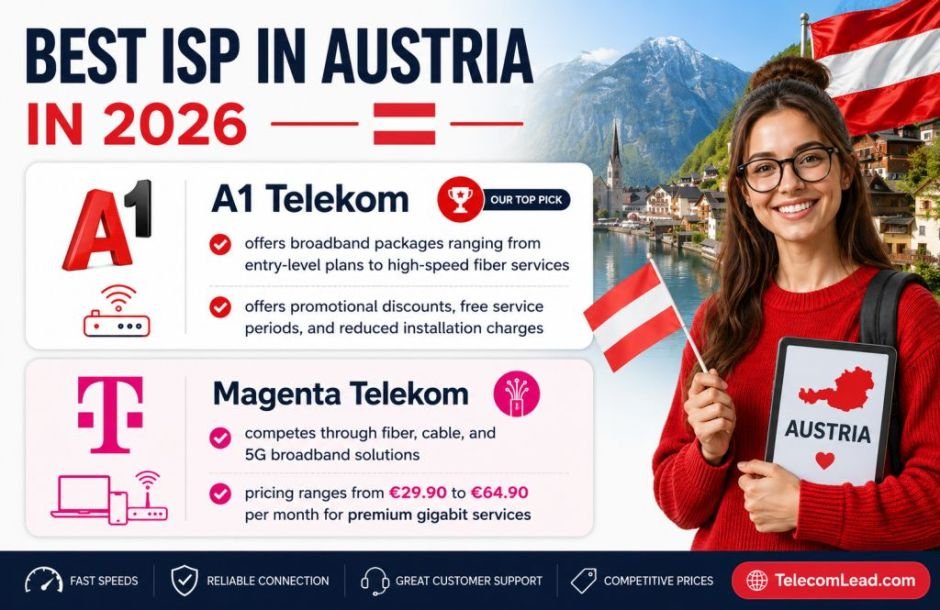
For internet customers, selecting the right ISP in 2026 is no longer just about price. Coverage, broadband speed, Wi-Fi quality, customer support, and future-ready technologies are becoming equally important.
Leading providers including A1 Telekom Austria, Magenta Telekom Austria, and regional fiber operators are investing heavily to offer faster, more reliable internet services as households consume more data than ever before.
Austria broadband market continues to grow
According to Austria’s telecom regulator RTR report, broadband data usage reached 12,693 petabytes in 2025, representing a 9 percent increase compared with 2024. Fixed broadband generated 7,173 petabytes of traffic, while mobile broadband accounted for 5,520 petabytes, highlighting the growing importance of both wired and wireless connectivity.
Austria recorded approximately 14.88 million broadband connections during the second quarter of 2025, representing 1.6 percent year-on-year growth. Mobile broadband continues to dominate with more than 80 percent of all broadband connections, while fixed broadband represents nearly one-fifth of total subscriptions.
The country’s migration toward faster internet is also accelerating. Austria now has around 1.5 million fixed broadband connections delivering speeds of 100 Mbps or higher, reflecting 14 percent annual growth. Broadband connections between 30 Mbps and 100 Mbps reached approximately 1.06 million, also increasing by more than 14 percent, while slower connections below 30 Mbps continue to decline as customers upgrade.
How internet customers should select the best ISP
Internet customers should begin by checking whether fiber connectivity is available at their address. Fiber-to-the-Home (FTTH) offers the most reliable long-term solution with consistent speeds, low latency, and greater scalability than traditional DSL or cable.
Customers should also evaluate actual speed requirements instead of automatically choosing the fastest package. Entry-level users focused on browsing and streaming can comfortably select plans between 100 Mbps and 250 Mbps, while families using multiple connected devices, cloud applications, gaming, and 4K streaming should consider 500 Mbps, 1 Gbps, or even 2 Gbps services where available.
Monthly pricing is another important factor. Austria’s broadband market remains competitive, with entry-level plans generally costing between €25 and €35 per month. Mid-tier 250 Mbps to 500 Mbps packages typically range from €35 to €55 per month, while premium 1 Gbps broadband usually costs between €50 and €70 per month, depending on contract duration, bundled services, and installation offers.
Consumers should also compare installation fees, promotional discounts, Wi-Fi equipment, contract flexibility, customer support quality, and bundled television or mobile services before making a decision.
A1 Telekom Austria focuses on nationwide fiber expansion
A1 Telekom Austria remains one of Austria’s largest broadband providers with plans ranging from entry-level broadband to premium fiber services delivering 250 Mbps, 500 Mbps, and 1 Gbps. The company continues expanding its fiber infrastructure while offering promotional discounts, free service periods, and lower installation costs on selected packages.
A1 plans to exceed 1 million fiber connections by 2026, upgrading legacy copper infrastructure while extending Fiber-to-the-Home availability across both urban and rural regions.
Magenta Telekom Austria competes with 2 Gbps broadband
Magenta Telekom Austria continues expanding its fiber, cable, and 5G broadband portfolio. Residential broadband packages range from 200 Mbps and 600 Mbps plans to premium services delivering 2 Gbps.
Residential pricing generally starts around €29.90 per month for entry-level broadband and rises to approximately €64.90 per month for premium gigabit offerings. The operator leverages both fiber and its hybrid fiber-coaxial (HFC) network to provide high-speed broadband nationwide.
Fiber rollout strengthens Austria’s digital infrastructure
Austria’s Broadband Austria 2030 initiative is accelerating nationwide gigabit connectivity through expanded Fiber-to-the-Home (FTTH) and Fiber-to-the-Building (FTTB) deployments.
Fiber availability has improved significantly from approximately 36 percent of households in 2022 to around 50 percent by 2025. Regional fiber operators continue expanding open-access fiber infrastructure, particularly across rural communities where broadband competition has historically been limited.
Consumer migration toward ultra-fast broadband is also visible in subscription trends. The share of fixed broadband connections delivering 1 Gbps or higher increased from 1.16 percent in 2024 to 2.23 percent in 2025, almost doubling within one year.
Broadband speeds continue to improve
Austria’s average fixed broadband download speeds now approach 90 Mbps to 100 Mbps, while many urban households have access to 500 Mbps, 1 Gbps, and 2 Gbps services.
Gigabit adoption is accelerating rapidly, with broadband subscriptions above 1 Gbps growing by 92.8 percent during 2025. Higher-speed services support demanding applications including cloud computing, online gaming, remote work, 4K video streaming, and connected smart homes.
AI-powered Wi-Fi becomes a competitive advantage
Broadband providers are increasingly differentiating themselves through intelligent home networking rather than raw download speeds alone.
With European households now using more than 10 connected devices on average, ISPs are deploying Wi-Fi 6, Wi-Fi 6E, and early Wi-Fi 7 technologies alongside AI-powered optimization tools.
A1 Telekom Austria and Magenta Telekom Austria are introducing smart Wi-Fi systems that automatically optimize wireless performance, detect interference, prioritize high-priority applications, and improve whole-home coverage. AI-powered customer support also enables automated troubleshooting, proactive network monitoring, and reduced technician visits.
5G Fixed Wireless Access expands broadband options
Fixed Wireless Access is becoming an attractive alternative where fiber deployment remains difficult, particularly across Austria’s mountainous and rural regions.
Using 4G LTE and 5G infrastructure, operators deliver broadband services ranging from 50 Mbps to several hundred Mbps, while premium locations can achieve 500 Mbps or higher. Future 5G Standalone (5G SA) deployments combined with advanced antennas could eventually support wireless broadband exceeding 1 Gbps in selected areas.
Both A1 Telekom Austria and Magenta Telekom Austria continue expanding 5G Home Internet alongside their fiber investments.
Satellite broadband serves remote communities
Satellite broadband remains an important solution for farms, tourism businesses, remote homes, and isolated communities beyond traditional broadband coverage.
Starlink currently operates the largest Low Earth Orbit (LEO) satellite network, supported by more than 8,000 operational satellites worldwide. Austrian users typically receive download speeds between 50 Mbps and 250 Mbps, with latency ranging from 25 milliseconds to 60 milliseconds.
Residential Starlink subscriptions generally cost between €50 and €65 per month, while hardware costs approximately €349.
Competition is expected to increase as Amazon’s Project Kuiper plans to deploy more than 3,200 satellites, while Eutelsat OneWeb serves enterprise, aviation, government, and remote connectivity markets using more than 600 satellites.
Customer support and reliability influence buying decisions
Internet customers increasingly expect consistent broadband performance, transparent billing, rapid installation, and responsive customer support alongside higher download speeds.
The most common complaints remain inconsistent speeds, poor Wi-Fi coverage, installation delays, billing issues, and slower customer service responses. Operators are addressing these challenges through fiber expansion, AI-powered network monitoring, automated diagnostics, and improved digital support platforms.
As more than 1.5 million Austrian households now subscribe to fixed broadband services above 100 Mbps, expectations continue shifting toward premium broadband quality rather than simply internet availability.
FASNA SHABEER