Verizon Communications delivered a strong second quarter in 2026 as its customer-focused strategy accelerated growth across fiber broadband, fixed wireless access (FWA), mobility services and subscriber additions.
The telecom operator has strengthened its position in the broadband market by expanding its fiber customer base, improving profitability across both Consumer and Business segments, and maintaining disciplined investments in network infrastructure.
Chief Executive Officer Dan Schulman said Verizon’s customer-first strategy, supported by its new Simplicity plans, Verizon One converged offerings and loyalty program, is helping the company attract new subscribers and improve long-term customer retention through value rather than device subsidies.
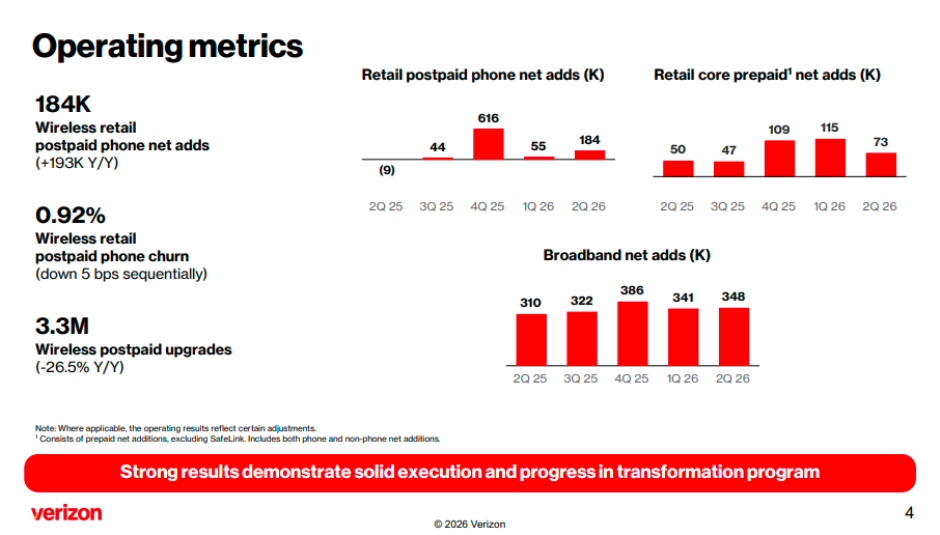
Mobility and broadband service revenue increased 2.8 percent to approximately $23.4 billion during the quarter. Verizon added 184,000 postpaid phone subscribers, delivering its strongest Consumer second-quarter postpaid phone performance in five years. Core prepaid additions reached 73,000, marking the eighth consecutive quarter of positive prepaid subscriber growth.
Broadband remained one of Verizon’s strongest growth engines. The company added 348,000 broadband subscribers during the second quarter, representing a 12.3 percent increase. These additions included 193,000 Fixed Wireless Access (FWA) subscribers and 155,000 fiber broadband customers, bringing Verizon’s combined FWA and fiber broadband base to approximately 17.1 million connections.
Verizon fiber broadband subscribers surpass 10.9 million
Fiber continued to be the key driver of Verizon’s fixed-network expansion. Fiber broadband connections increased to 10.913 million at the end of Q2 2026 from 10.757 million in Q1 2026, 7.741 million at the end of Q4 2025 and 7.613 million a year earlier.
Quarterly fiber broadband net additions reached 155,000, improving significantly from 127,000 in Q1 2026, 67,000 in Q4 2025 and 32,000 in Q2 2025. Fiber alone contributed nearly half of Verizon’s total broadband additions during the quarter, highlighting continued demand for high-speed fiber connectivity.
Total broadband connections increased to 17.121 million from 16.763 million in the previous quarter. The combination of 155,000 fiber additions and 193,000 FWA additions reflects Verizon’s dual-network broadband strategy aimed at expanding coverage while maximizing network efficiency.
Consumer and Business fiber revenue continues to improve
Consumer Mobility and Broadband service revenue, which includes Fios Internet and other fiber-based services, increased to $19.637 billion in Q2 2026 from $19.180 billion in Q1 2026 and $19.002 billion in Q2 2025.
Consumer operating income improved to $8.032 billion, while operating margin expanded to 30.6 percent from 28.7 percent a year earlier. Consumer segment EBITDA increased to $11.819 billion, lifting EBITDA margin to 45.0 percent.
The Business segment also benefited from higher fiber-based connectivity demand. Mobility and Broadband service revenue rose to $3.728 billion from $3.688 billion in Q1 2026, compared with $3.733 billion a year ago.
Business operating income increased to $991 million, while operating margin improved to 13.9 percent. Segment EBITDA climbed to $2.082 billion, with EBITDA margin expanding to 29.1 percent, reflecting stronger profitability from enterprise connectivity services.
Revenue impacted by lower device upgrades
Verizon reported total operating revenue of $34.3 billion, down 0.7 percent year over year. The decline was primarily driven by a nearly 20 percent, or more than $1.2 billion, reduction in wireless equipment revenue.
The lower equipment revenue reflected significantly weaker device upgrade volumes as customers continued extending smartphone replacement cycles. Verizon also maintained its disciplined strategy of reducing spending on device subsidies, reinforcing its shift toward a more sustainable and profitable operating model.
Net income declined 22.9 percent to $3.9 billion, primarily due to $1.8 billion in pre-tax special items. These included a $746 million loss related to the disposition of Verizon’s international wireline connectivity and managed network business, $258 million in asset rationalization charges and $397 million in severance expenses.
Verizon maintains network investment and 2026 outlook
Capital expenditures reached $8.2 billion through the first half of 2026 as Verizon continued investing in mobility, fiber broadband and network infrastructure to support long-term growth opportunities.
For full-year 2026, Verizon expects total retail postpaid phone net additions to finish in the upper half of its 750,000 to 1.0 million guidance range, approximately 2 to 3 times the level reported in 2025. The company also reaffirmed capital expenditure guidance of $16.0 billion to $16.5 billion, reflecting continued investment in expanding broadband coverage, strengthening fiber infrastructure and enhancing network performance.
BABURAJAN KIZHAKEDATH