The global semiconductor manufacturing equipment market is entering an unprecedented growth cycle as artificial intelligence (AI) drives massive investments in advanced chip production.
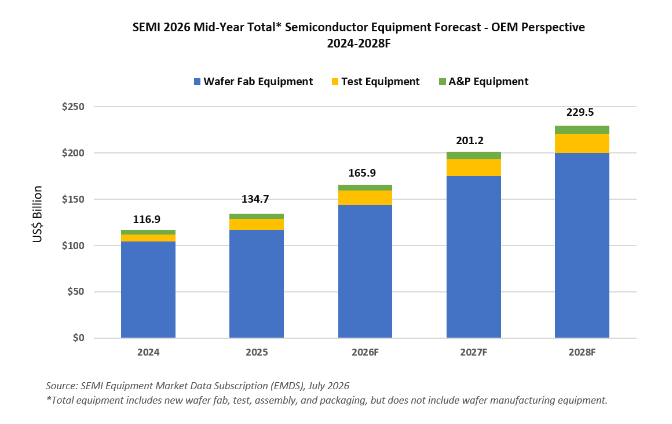
According to SEMI’s Mid-Year Total Semiconductor Equipment Forecast – OEM Perspective, global sales of semiconductor manufacturing equipment by original equipment manufacturers (OEMs) are expected to reach a record $165.9 billion in 2026, representing a 23.2 percent increase from the previous year.
The strong momentum is forecast to continue through 2028, when global semiconductor equipment sales are projected to reach an all-time high of $229.5 billion, marking five consecutive years of growth. The expansion is being driven by accelerating investments in AI infrastructure, advanced logic chips, high-bandwidth memory (HBM), next-generation packaging technologies, and increasingly complex semiconductor architectures.
Wafer Fab Equipment to Cross $200 bn by 2028
The Wafer Fab Equipment (WFE) segment remains the largest contributor to semiconductor capital spending.
After generating a record $116.9 billion in equipment sales in 2025, WFE spending is forecast to increase 23.1 percent to $143.9 billion in 2026. The stronger-than-expected outlook reflects rising investments in advanced memory manufacturing, particularly HBM-related DRAM production, as well as leading-edge logic fabs supporting AI processors.
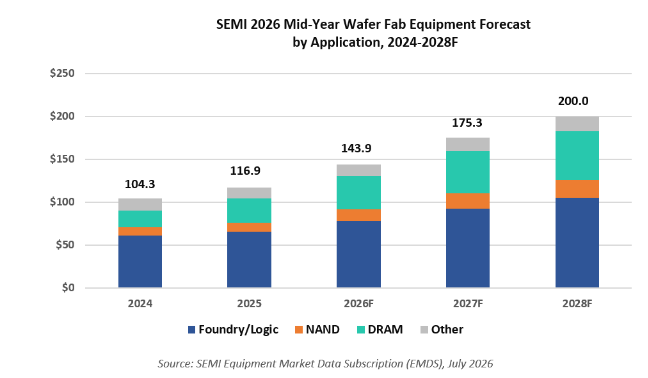
SEMI expects WFE sales to expand another 21.8 percent in 2027 and 14.1 percent in 2028, pushing annual spending beyond the $200 billion milestone as chipmakers continue expanding manufacturing capacity for AI workloads.
AI Boosts Semiconductor Test and Packaging Equipment
AI chip complexity is also driving strong demand for semiconductor back-end manufacturing equipment.
Following 55.3 percent growth in 2025, semiconductor test equipment sales are forecast to rise another 31.0 percent to $15.3 billion in 2026. Continued investments are expected to lift the market to $20.8 billion by 2028.
Meanwhile, assembly and packaging equipment sales, which increased 20.8 percent in 2025, are projected to grow 9.6 percent to $6.7 billion in 2026. The market is forecast to reach $8.6 billion by 2028 as advanced packaging, heterogeneous integration, AI processors, and HBM technologies require increasingly sophisticated manufacturing and reliability testing.
Foundry and Logic Equipment Spending Accelerates
Equipment spending for foundry and logic manufacturing is projected to increase 18.9 percent year over year to $78.0 billion in 2026.
The growth is fueled by new capacity investments for AI accelerators, high-performance computing (HPC) processors, and premium smartphone chipsets.
The segment is expected to expand 18.1 percent in 2027 and 13.6 percent in 2028, reaching $104.7 billion as semiconductor manufacturers ramp production using advanced 2nm gate-all-around (GAA) process technology.
DRAM and NAND Equipment Investment Surges
Memory manufacturing is becoming one of the fastest-growing investment areas due to soaring AI server demand.
DRAM equipment spending is forecast to jump 39.0 percent to $38.8 billion in 2026. Growth is expected to continue with 27.4 percent expansion in 2027 and 15.0 percent in 2028, taking annual spending to $56.9 billion.
Investment in NAND equipment is also expected to remain strong, rising 30.7 percent to $13.9 billion in 2026. Spending is projected to increase another 31.1 percent in 2027 and 14.5 percent in 2028, reaching $20.8 billion. Growth is being supported by migration to higher-layer 3D NAND technologies and higher-density memory architectures.
China, Taiwan and Korea Continue to Lead Equipment Spending
China, Taiwan and South Korea are expected to remain the world’s three largest semiconductor equipment markets through 2028.
China is projected to retain its leading position despite slower growth in 2026 following several years of exceptionally high investment. Taiwan continues to benefit from aggressive expansion of leading-edge foundry capacity supporting AI processors and high-performance computing applications. South Korea’s semiconductor equipment spending remains driven by advanced memory production, particularly HBM technologies used in AI servers.
SEMI also expects semiconductor equipment spending across other regions to accelerate during 2027 and 2028, supported by semiconductor regionalization strategies, government incentive programs, and investments in specialized chip manufacturing capacity.
BABURAJAN KIZHAKEDATH