Telecom operators are entering a new fiber investment cycle as AI data centers, cloud computing, 5G, streaming and enterprise traffic put pressure on metro, long-haul and international networks.
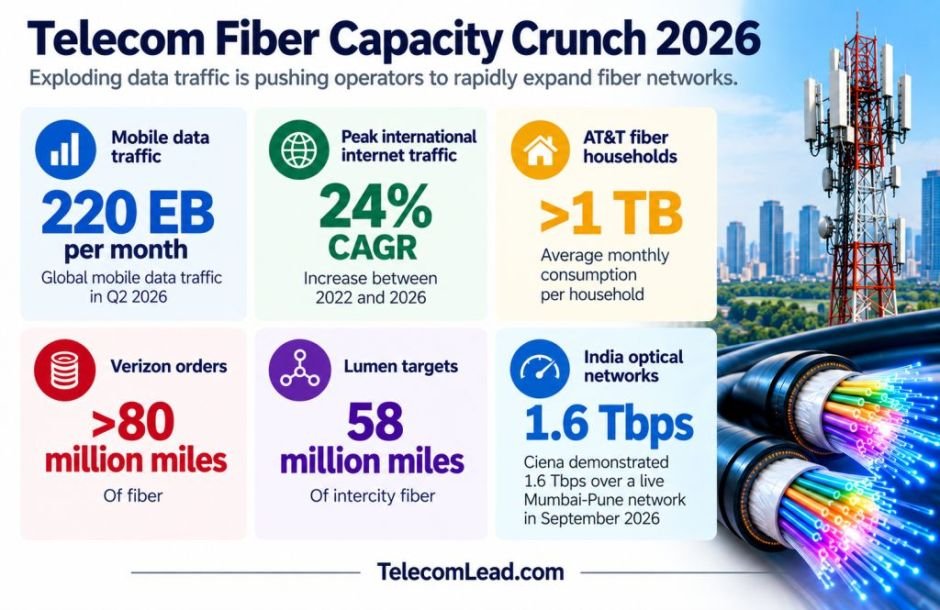
The issue is no longer simply how many homes can be passed with fiber. Operators increasingly need more capacity per route, more fiber pairs, additional wavelengths, higher-speed optical equipment and greater route diversity.
Global mobile data traffic exceeded 220 exabytes per month in Q2 2026, increasing 23 percent year over year. International internet bandwidth reached 2,259 Tbps in 2026, also up 23 percent.
Average and peak international internet traffic increased at a 24 percent CAGR between 2022 and 2026.
The fiber challenge in 2026 is therefore shifting from coverage toward capacity, utilization and cost per bit.
Mobile Data Traffic Exceeds 220 EB per Month
The underlying traffic numbers explain why fiber capacity is becoming strategically important.
Ericsson reported that global mobile network data traffic exceeded 220 EB per month during Q2 2026, up 23 percent year over year and around 6 percent from Q1.
India and North America were major contributors to the increase. Video represented around 75 percent of mobile data traffic at the end of 2025.
Every additional gigabyte consumed on smartphones eventually places demand on transport networks connecting cell sites, aggregation networks, data centers and internet gateways.
The Ericsson mobile traffic data therefore highlights an important point: wireless traffic growth ultimately becomes a fiber transport requirement.
AT&T Fiber Households Already Consume More Than 1 TB
AT&T provides one of the clearest examples of the change in fixed-network consumption.
The average AT&T Fiber household now uses more than 1 TB per month, five times the level in 2016. AT&T expects usage could reach 2-2.5 TB per month by 2030 as streaming, gaming, cloud applications, video communications and AI increase demand.
AT&T reached 38.6 million fiber locations by June 2026 and expects to exceed 40 million by year-end and 60 million by 2030.
The scale of its supply commitments shows how much physical infrastructure this expansion requires.
AT&T and Corning announced a multi-year agreement worth more than $3 billion in September 2026 covering fiber and cable required for AT&T’s network expansion.
AT&T added 367,000 fiber customers in Q2 2026, alongside 279,000 fixed-wireless additions.
For AT&T, the fiber build is therefore simultaneously a broadband expansion, wireless-backhaul and future capacity strategy.
Verizon Orders More Than 80 Million Miles of Fiber
Verizon is making an even larger physical-fiber commitment.
Its new multi-year agreement with Corning covers more than 80 million miles of high-density optical fiber and connectivity products between 2027 and 2032.
The infrastructure will serve two major demand pools: broadband expansion for homes and businesses and long-haul connectivity between AI hyperscalers and data centers.
The Verizon-Corning fiber agreement demonstrates how residential broadband and AI infrastructure are increasingly sharing the same strategic fiber investment cycle.
The implication for operators is significant. Network planning must account not only for gradual household traffic growth but potentially much larger flows between GPU clusters, cloud regions and data centers.
Lumen Targets 58 Million Intercity Fiber Miles
Lumen represents perhaps the clearest example of fiber investment being driven directly by AI.
The company had deployed 17 million intercity fiber miles by the end of 2025. It plans to reach 47 million miles by the end of 2028 and approximately 58 million by 2031.
That represents more than a threefold expansion from its year-end 2025 position.
Lumen has secured nearly $13 billion in Private Connectivity Fabric contracts, including demand from hyperscalers and AI companies.
Anthropic selected Lumen to expand high-capacity fiber infrastructure supporting its AI activities.
The Lumen AI network expansion illustrates an important shift: intercity fiber is increasingly being designed around data-center-to-data-center traffic rather than traditional telecom demand alone.
India Pushes Optical Networks to 1.6 Tbps
Operators can increase capacity without immediately installing another physical fiber route.
Higher-performance optical equipment can transmit more bits over existing fiber.
India is becoming an important testing ground.
Constl and Ciena demonstrated a 1.6 Tbps wavelength over a live Mumbai-Pune network in September 2026. The achievement followed a 1 Tbps milestone in 2025 and supports services including 800GE.
Vodafone Idea and Ciena have also demonstrated 1.6 Tbps transmission over a single optical channel across Vi’s data-center interconnect network.
The technology is designed to support hyperscalers, cloud providers, enterprises and data centers requiring hundreds of gigabits of capacity.
Moving from 400G and 800G toward 1.2 Tbps and 1.6 Tbps wavelengths can postpone the need for new fiber construction on some routes by extracting more capacity from installed infrastructure.
Europe’s Fiber Challenge Moves from Coverage to Utilization
Europe continues to expand FTTH, but the next challenge is increasingly about making those networks capable of carrying much larger traffic volumes.
Deutsche Telekom reported 21 million fiber-optic-based lines in Germany at June 30, 2026, while 13.6 million homes and businesses could subscribe to its fiber network.
Telefonica had 74.9 million FTTH premises passed at Q1 2026 and 14 million FTTH accesses, up 8.6 percent.
Orange spent €3.2 billion on eCAPEX during H1 2026, equivalent to 15.2 percent of revenue, and exceeded 3 million fiber customers in Europe.
As penetration rises, investment priorities gradually move toward aggregation, metro capacity, backbone links and interconnection with cloud infrastructure.
India Reaches 47.4 Million Fixed Wired Broadband Connections
India faces capacity pressure from both mobile and fixed networks.
The country had approximately 1.08 billion broadband subscribers in May 2026, including 47.4 million fixed wired broadband connections.
Reliance Jio led the fixed-wired market with 14.47 million subscribers, followed by Bharti Airtel at 10.98 million and BSNL at 4.50 million.
At the same time, India’s rapid expansion of data centers and cloud infrastructure is increasing traffic between cities and major digital hubs such as Mumbai, Chennai, Hyderabad, Bengaluru and Delhi-NCR.
The combination of consumer broadband, 5G backhaul and data-center interconnection makes high-capacity national fiber routes increasingly valuable.
Submarine Networks Face the Same Capacity Challenge
Fiber constraints do not stop at national borders.
International internet bandwidth reached 2,259 Tbps in 2026, increasing 23 percent in one year and more than doubling since 2022.
Africa recorded the fastest regional international-bandwidth growth, with a 35 percent CAGR between 2022 and 2026, followed by Oceania at 25 percent.
The TeleGeography international bandwidth analysis shows that average and peak international traffic both expanded at approximately 24 percent annually during 2022-2026.
Submarine technology is consequently evolving as well.
NTT announced a 192-core submarine cable system using four-core multicore fiber in 2026. The company says the architecture could deliver four times the capacity of conventional systems without increasing the number of optical fibers in the cable, with practical deployment targeted around 2029.
Where Is the Fiber Capacity Pressure Greatest?
The 2026 capacity problem is concentrated in several areas.
AI data-center corridors need extremely high bandwidth between GPU clusters and cloud regions.
Metro networks must aggregate traffic from homes, enterprises, mobile sites and data centers.
Mobile backhaul and fronthaul face growing requirements as 5G traffic rises.
Long-haul networks must connect increasingly distributed data-center campuses.
And submarine cables need to accommodate international cloud and internet traffic growing at more than 20 percent annually.
Operators therefore have several choices: light additional wavelengths, upgrade optical equipment, activate unused fiber, lease capacity, deploy additional fiber pairs or construct entirely new routes.
Telecom Fiber Strategy Shifts from Coverage to Capacity
The numbers point to a fundamental change in telecom infrastructure strategy.
AT&T is targeting 60 million-plus fiber locations, Verizon has committed to more than 80 million miles of fiber, and Lumen plans to increase its intercity network from 17 million fiber miles to 58 million by 2031.
At the technology level, networks are progressing toward 1.6 Tbps optical channels, while submarine developers are exploring multicore fiber to multiply capacity.
The winners will therefore not necessarily be operators with the most fiber route miles.
The competitive advantage will increasingly belong to networks that can deliver more bits per fiber, more capacity per route and lower cost per transmitted bit while maintaining sufficient headroom for unpredictable AI, cloud, 5G and data-center demand.
In 2026, the telecom fiber problem is becoming less about whether fiber exists and more about whether the right fiber capacity exists in the right place when traffic arrives.
FASNA SHABEER