Huawei dominated the global book-type foldable smartphone market in the first half of 2026 (1H26), capturing a 57 percent market share, according to Omdia. Samsung ranked second with 18 percent, meaning Huawei and Samsung together controlled 75 percent of worldwide book-type foldable shipments.
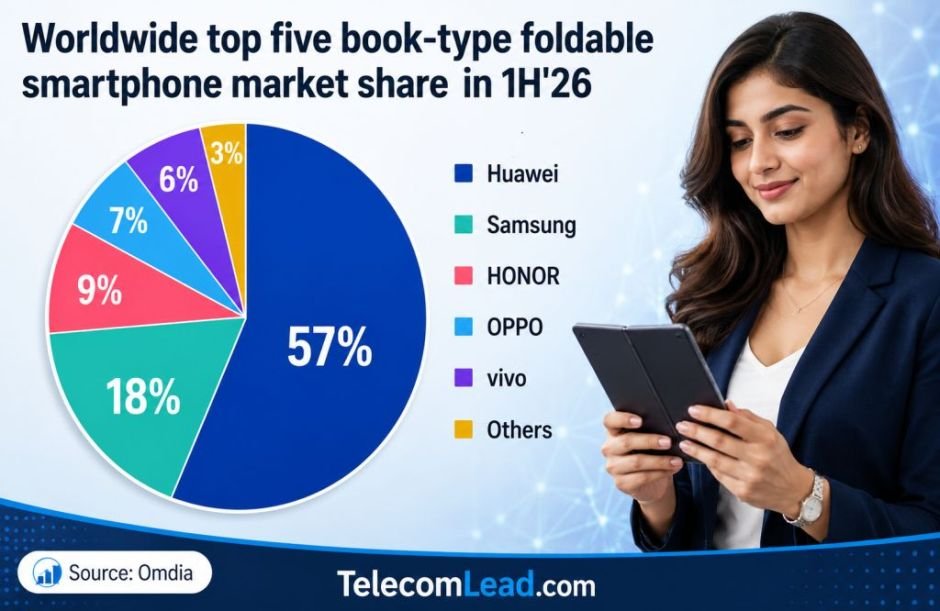
The latest Omdia report indicated that HONOR secured third position with a 9 percent share, followed by OPPO at 7 percent and vivo at 6 percent. Other smartphone vendors collectively represented the remaining 3 percent of the market.
The figures highlight Huawei’s substantial lead in book-type foldables, with its 57 percent share more than three times Samsung’s 18 percent. The top five vendors — Huawei, Samsung, HONOR, OPPO and vivo—collectively accounted for 97 percent of the global book-type foldable smartphone market in 1H26, leaving only 3 percent for other brands.
Foldable Smartphone Shipments to Hit 36 Million by 2028
The global foldable smartphone market is poised for a strong recovery, with shipments expected to grow by more than 20 percent annually through 2028 and reach 36 million units, according to Omdia’s Smartphone Feature Forecast. The growth in the foldable smartphone market will be driven by new wide-format foldable designs, increased production by major smartphone vendors and broader adoption across Android brands.
The 2028 shipment forecast represents nearly double the 18.2 million foldable smartphones shipped globally in 2025. Omdia expects the market to maintain longer-term momentum, with shipments reaching 45 million units by 2030, although foldables will still account for less than 3 percent of total global smartphone shipments.
Foldable Smartphone Market Set for 22% Growth in 2026
Global foldable smartphone shipments reached 18.2 million units in 2025, increasing just 6 percent year on year, the lowest growth rate recorded in recent years.
Market conditions weakened further during the first half of 2026. Shipments fell 21.6 percent year on year to 5.1 million units, reflecting particularly weak demand for flip-style devices.
Despite the difficult first half, Omdia expects a sharp rebound during the remainder of the year. Worldwide foldable smartphone shipments are forecast to exceed 22 million units in 2026, representing growth of more than 22 percent year on year.
The introduction of new form factors and higher production targets among leading vendors is expected to underpin this recovery.
Flip Foldables Drop 47% as Book-Type Models Dominate
The performance gap between foldable form factors widened substantially during the first half of 2026.
Shipments of flip-type foldable smartphones plunged 47 percent compared with the first half of 2025, while book-type foldable shipments remained broadly flat.
Book-type devices consequently increased their importance within the overall foldable market, accounting for 69 percent of global foldable smartphone shipments in the first half of 2026.
Huawei and Samsung strengthened their leadership in this segment, jointly controlling 75 percent of worldwide book-type foldable smartphone shipments during the period.
The changing market mix indicates that consumers are increasingly gravitating toward larger foldable devices offering productivity, entertainment and multitasking capabilities rather than compact flip-style models.
Huawei and Samsung Push New Wide-Format Foldable Design
A new generation of wide-format book-type foldable smartphones is emerging as a major catalyst for the next phase of market growth.
Huawei introduced the new wide-format concept with the Pura X Max in May 2026, followed by Samsung with the Galaxy Z Fold 8 in August 2026. Other major smartphone vendors are expected to introduce comparable products in the coming months.
Unlike conventional book-style foldables, the new design uses a shorter and wider aspect ratio. When unfolded, the smartphone provides a more tablet-like viewing experience, while its wider external display can show more horizontal content during conventional smartphone use.
The form factor can also reduce overall device volume and weight while providing more usable screen area. These characteristics could make wide-format foldables attractive for multitasking, productivity applications, video consumption and other content-intensive activities.
Leading smartphone manufacturers have already raised their 2026 production targets for wide-format foldable devices, while additional Android smartphone brands are expected to adopt similar designs during 2027.
Greater participation by vendors should increase production volumes and establish the wide-format category as an important contributor to the projected 20 percent-plus annual foldable market growth through 2028.
Foldable Smartphone Shipments Forecast to Reach 45 Million by 2030
Omdia expects the market recovery to extend beyond the current product cycle.
From more than 22 million units in 2026, worldwide foldable smartphone shipments are forecast to reach 36 million units in 2028 and 45 million units by 2030.
Despite this growth trajectory, foldable devices are expected to remain a premium segment rather than becoming a mainstream replacement for conventional smartphones. Even at 45 million units in 2030, foldables are forecast to represent less than 3 percent of global smartphone shipments.
That outlook reflects persistent pricing and manufacturing challenges associated with foldable technology.
High Component Costs Keep Foldable Smartphones in Premium Segment
Foldable smartphones require expensive components including large flexible displays, sophisticated hinge mechanisms and specialized glass. These components keep bill-of-materials costs significantly higher than those of conventional smartphones and limit vendors’ ability to push foldables aggressively into mass-market price segments.
Manufacturers are therefore prioritizing premium positioning and profitability rather than pursuing shipment volumes through substantial price reductions.
Consumers also face trade-offs beyond the initial purchase price. Foldable smartphones can carry higher repair costs, while buyers may have to balance the benefits of larger flexible displays against areas such as camera performance and overall ownership costs.
The challenge for smartphone vendors will be demonstrating benefits that extend beyond hardware novelty. Services and applications optimized specifically for larger foldable displays could improve the value proposition for productivity, multitasking and entertainment.
Strategic partnerships that lower ownership and repair costs could also help manufacturers expand the addressable market beyond early adopters.
With shipments projected to rise from 18.2 million units in 2025 to 36 million in 2028 and 45 million by 2030, wide-format designs are giving the foldable smartphone industry a new growth engine. However, with market penetration remaining below 3 percent even by 2030, reducing costs and establishing compelling foldable-specific use cases will be critical to turning rapid shipment growth into broader consumer adoption.
BABURAJAN KIZHAKEDATH