Nokia has retained the No. 1 position for mobile core portfolio competitiveness for the second consecutive year in Omdia’s “Market Landscape: Core Vendors 2026” report, highlighting intensifying competition among Ericsson, Huawei, Nokia, ZTE and other vendors as operators accelerate their transition toward cloud-native and 5G core networks.
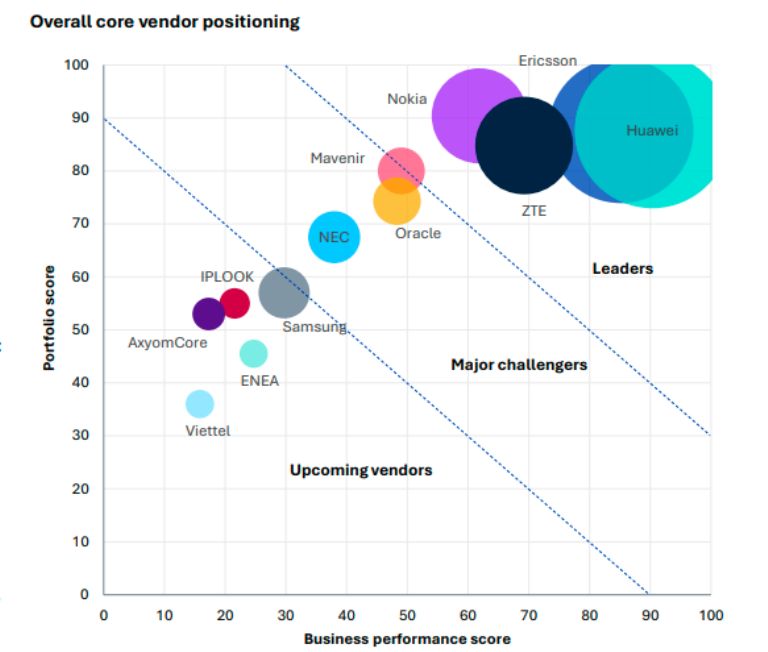
Omdia assessed 12 mobile core vendors across business performance and portfolio strength, dividing them into three groups: market leaders, major challengers and upcoming vendors. The competitive positions remained broadly stable from the 2025 edition, with every assessed vendor remaining in the same group in 2026.
The mobile core market remains highly concentrated. The five largest vendors controlled a combined 86.1 percent of the 4G and 5G core market in 2025, although their share declined from 87.4 percent in 2024. The top three vendors generated 70.9 percent of total market revenue, demonstrating the scale advantage enjoyed by the largest suppliers as competition increasingly shifts toward next-generation 5G core infrastructure.
Nokia Ranks No. 1 in Mobile Core Portfolio
Nokia achieved the highest overall portfolio score in Omdia’s 2026 assessment and was identified as a leader across all seven portfolio competitiveness categories evaluated by the research firm.
These categories cover core portfolio breadth, cloud-native maturity, signaling, automation, core as a service, AI/ML and analytics, and implementations of other network functions.
The result gives Nokia the top portfolio position for the second consecutive year, reflecting its competitive standing across cloud-native mobile core technologies, automation and AI-driven network capabilities.
Huawei Leads Mobile Core Business Performance
Huawei secured first place in business performance and second place for portfolio strength, giving the Chinese telecom equipment supplier one of the strongest overall positions among the 12 vendors assessed.
Ericsson ranked second in both business performance and portfolio, demonstrating a comparatively balanced position across commercial execution and technology capabilities.
ZTE secured third place in both dimensions, placing it behind Huawei, Nokia and Ericsson across Omdia’s overall competitive assessment.
Together, Ericsson, Huawei, Nokia and ZTE make up Omdia’s four mobile core market leaders in 2026.
Mavenir Moves Closer to Mobile Core Market Leaders
The next competitive tier consists of Mavenir, NEC and Oracle, which Omdia classified as major challengers.
While the three vendors remained in the same category as in the 2025 report, their relative competitive positions changed. Mavenir moved closer to the market-leader group, strengthening its position relative to its challenger peers.
In contrast, the positions of NEC and Oracle diminished slightly, moving both companies further away from the four market leaders. The changes demonstrate how quickly competitive positioning can shift as vendors expand cloud-native capabilities, network functions, automation and commercial deployments.
Samsung Electronics and AxyomCore Among Upcoming Vendors
Samsung Electronics and four other players, including new participant AxyomCore, were placed in Omdia’s upcoming vendors category.
Omdia cautioned against making direct comparisons between these suppliers and the largest mobile core vendors because upcoming players generally develop fewer network functions and have smaller market reach.
The inclusion of AxyomCore as a new participant nevertheless illustrates how the mobile core vendor ecosystem is continuing to expand as software-based, cloud-native network architectures create opportunities for newer suppliers.
5G Core Competition Shifts Toward Cloud, Automation and AI
The 2026 rankings underline how mobile core competition is moving beyond conventional 4G and 5G network functions. Vendors increasingly need competitive capabilities spanning cloud-native architecture, signaling, automation, core as a service, AI/ML and analytics to differentiate their platforms.
With the five largest suppliers still controlling 86.1 percent of the market and the top three accounting for 70.9 percent of revenue, gaining significant market share remains challenging for smaller vendors. However, the decline in the top five’s combined share from 87.4 percent in 2024 to 86.1 percent in 2025 indicates a modest shift in the competitive landscape.
BABURAJAN KIZHAKEDATH