Huawei maintained its leadership in the global mobile core network market in 2025, ahead of Ericsson, ZTE, Nokia, NEC and Samsung Electronics, as competition intensified around 5G core contracts, new operator wins and emerging-market expansion.
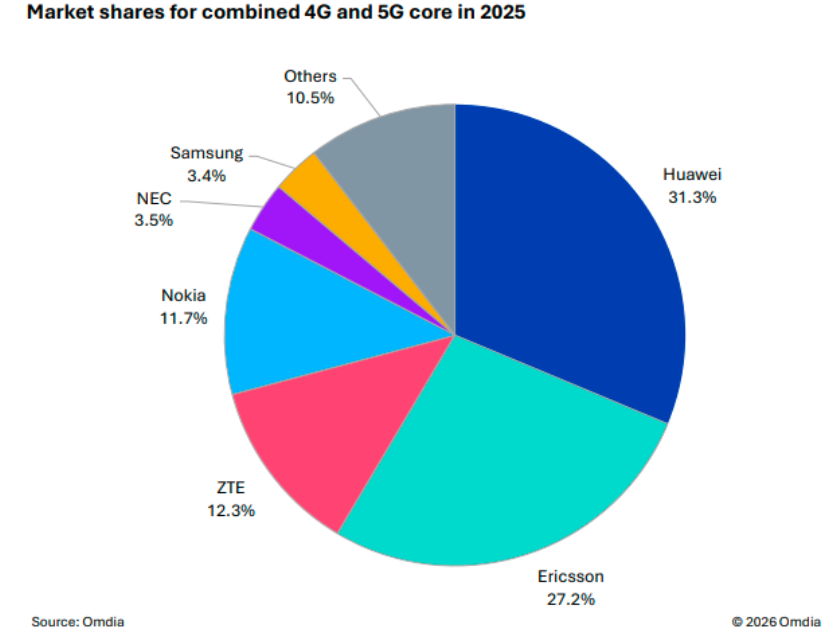
Market concentration among the largest suppliers remained high, although smaller and emerging vendors continued to make inroads. Ericsson, Huawei and ZTE together accounted for 70.9 percent of global core revenue in 2025, increasing from 68.3 percent in 2024.
Adding Nokia and NEC took the combined share of the top five vendors to 86.1 percent in 2025. However, that was down from 87.4 percent in 2024 and considerably below the 95.4 percent share recorded in 2020, indicating that emerging and challenger vendors are collectively capturing a larger portion of the market.
Huawei Gains 5 Percentage Points in Core Network Market Share
Huawei was the standout share gainer among the major core network suppliers in 2025, increasing its market share by 5.0 percentage points. The improvement reflected a more favorable geographic mix as well as stronger performance in emerging markets.
In contrast, Ericsson, ZTE and Nokia lost market share during the year. The competitive shifts illustrate how vendors are adopting different strategies across regions and projects.
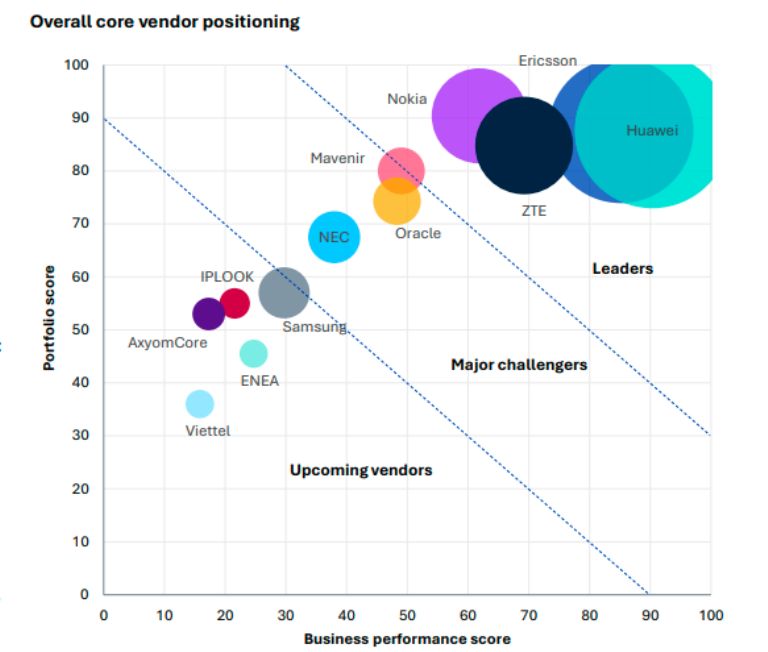
Some suppliers are prepared to sacrifice short-term margins and use competitive pricing to expand market share and secure new contracts, particularly in the strategically important 5G core market. Others are placing greater emphasis on protecting profitability, even when that means accepting slower revenue growth or lower market share.
Vendors can also combine these approaches, pursuing aggressive share gains in selected countries or projects while prioritizing margins elsewhere.
Omdia’s assessment of 4G and 5G core revenue excludes communications service provider spending on network function virtualization infrastructure, servers and management software, keeping the market measurement focused on core network functions.
ZTE, Huawei, Ericsson, Nokia and Oracle Exceed 100 5G Deals
The competitive landscape becomes even more significant when measured by commercial 5G contracts. ZTE, Huawei, Ericsson, Nokia and Oracle each secured more than 100 5G deals in 2025, highlighting the scale of deployment activity among leading suppliers.
Their geographical strengths differ considerably. ZTE continues to expand across Asia & Oceania, Europe and Africa, while Huawei maintains a particularly strong presence across Asia & Oceania, the Middle East & Africa, and Latin America & the Caribbean.
Ericsson, Nokia and Oracle have a strong focus on Europe. The region’s diverse and fragmented telecom market, combined with its large number of operators, creates substantial opportunities for vendors competing for 5G core contracts.
Ericsson, IPLOOK, Mavenir and ZTE Win 10 or More New 5G Logos
New-logo wins provide another important indicator of competitive momentum because they show when a supplier gains 5G business from an incumbent competitor or participates in a greenfield 5G deployment.
Ericsson, IPLOOK, Mavenir and ZTE each recorded 10 or more new logos, demonstrating that the market for 5G core networks extends beyond the traditional vendor relationships inherited from previous mobile generations.
Winning a new logo can be particularly significant in a 5G non-standalone (NSA) deployment. Most operators deploying NSA 5G initially rely on their existing 4G Evolved Packet Core (EPC) supplier because of the close technical relationship between 4G and 5G networks.
When an operator selects a different supplier for 5G, it can represent a significant endorsement of the new vendor. The CSP may need to replace an incumbent 4G platform with a more advanced cloud-native system supporting both 4G and 5G, or manage interoperability between core solutions supplied by different vendors.
AxyomCore and Mavenir Target Multi-Vendor 5G Core Opportunities
Growing operator interest in multi-vendor core architectures is creating openings for challengers including AxyomCore and Mavenir. These suppliers can gain new operator logos even when their contracts cover only selected 5G core network functions rather than an entire core portfolio.
The trend does not exclusively benefit smaller vendors. Ericsson and Nokia are also securing contracts to provide one or more groups of core network functions, reflecting a broader move toward modular procurement rather than relying on a single supplier for every component.
The expanding supplier ecosystem means the competitive field now includes Huawei, Ericsson, ZTE, Nokia, NEC, Samsung Electronics, Oracle, IPLOOK, Mavenir and AxyomCore, with vendors competing through different combinations of geographic reach, pricing, cloud-native technology and network-function portfolios.
5G Core Becomes Strategic for Monetization and Digital Sovereignty
Competition is intensifying because the 5G core is considered more strategically important than previous generations of mobile core infrastructure. Beyond handling network traffic, 5G core platforms enable advanced network functions and new monetization models while becoming increasingly connected with national digital-sovereignty objectives.
Geopolitical and security considerations are therefore influencing vendor selection. Non-Chinese vendors have benefited from policy-driven procurement conditions in some markets, particularly across the Five Eyes alliance — Australia, Canada, New Zealand, the UK and the US — as well as parts of Europe.
Chinese suppliers, however, continue to gain significant 5G core contracts across emerging markets. In some cases, those wins have come at the expense of Western competitors. The longer-term competitive picture is consequently becoming more diverse. Although the top five vendors still controlled 86.1 percent of global core revenue in 2025, their share has fallen substantially from 95.4 percent in 2020. Combined with more than 100 5G deals each for ZTE, Huawei, Ericsson, Nokia and Oracle, and 10 or more new logos each for Ericsson, IPLOOK, Mavenir and ZTE, the figures point to a global 5G core market where established leaders remain dominant but challengers are steadily creating new competitive pressure.
BABURAJAN KIZHAKEDATH