Competition in the global 4G and 5G mobile core market is intensifying as Huawei, Ericsson, Nokia and ZTE defend their leadership positions while Mavenir, Oracle, NEC, Samsung, IPLOOK, AxyomCore, ENEA and Viettel expand their capabilities and commercial footprints.
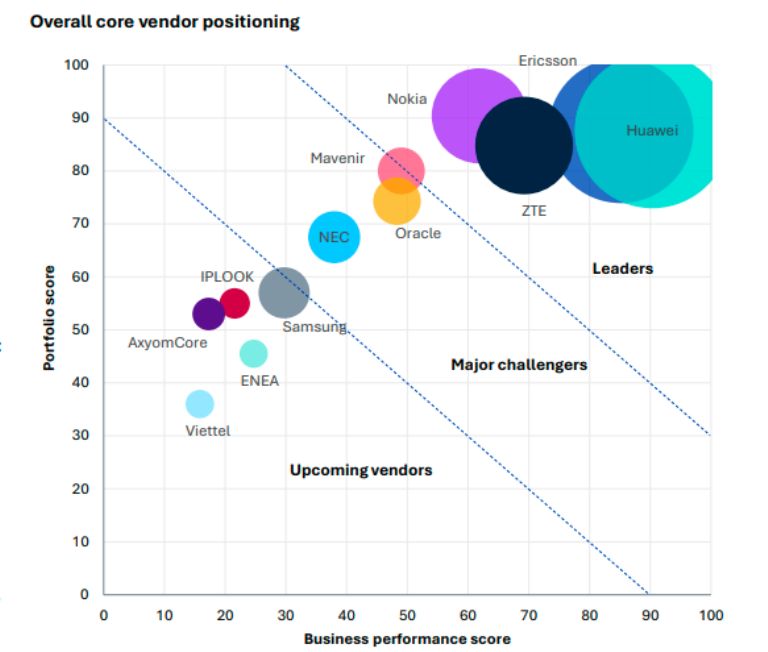
Omdia’s Market Landscape: Core Vendors 2026 evaluates suppliers across two main dimensions — business performance and portfolio strength — while examining their progress in 5G core deals, market share, new customer wins, cloud-native technology, automation, signaling, core as a service, AI/ML and analytics.
The assessment shows distinct areas of leadership. Huawei ranks No. 1 in business performance, Nokia leads the portfolio dimension, Ericsson ranks second in business performance, while ZTE ranks third in both dimensions and leads the number of 5G core deals with communications service providers (CSPs).
Huawei Leads Mobile Core Business Performance
Huawei leads Omdia’s business performance dimension, supported by the highest mobile core market share among assessed vendors.
Huawei ranks second for the number of 5G core deals with CSPs and third in both 5G share of total core revenue and new logos.
The company is also the runner-up in the overall portfolio dimension and shares leadership across several technology categories. Huawei’s major strengths include cloud-native maturity, signaling, automation, and AI/ML and analytics.
Despite its strong position, Huawei has opportunities to expand its adoption of core as a service and increase its commercial footprint in strategic growth markets.
Ericsson Leads New Customer Wins
Ericsson ranks second in business performance and leads the market in the number of new logos, demonstrating its ability to secure additional mobile core customers.
Ericsson ranks second in total core revenue market share and third for the number of 5G deals with CSPs.
The company is also a runner-up in Omdia’s portfolio assessment. Ericsson shares the top position in two portfolio categories — cloud-native maturity and other network functions.
Its combination of commercial scale, customer wins and broad core technology capabilities keeps Ericsson firmly among the industry’s leading mobile core suppliers.
Nokia Takes No. 1 Position for Mobile Core Portfolio
Nokia leads the overall portfolio dimension and is a co-leader across multiple technology categories.
Its strongest areas include cloud-native maturity, signaling, automation, core as a service, and AI/ML and analytics, giving Nokia one of the industry’s broadest competitive mobile core portfolios.
However, Nokia’s business performance score weakened following a slight market share loss in 2025 and fewer 5G deals with CSPs in 2026 compared with 2025.
The challenge for Nokia will be converting its portfolio leadership into additional commercial wins as operators continue investing in standalone 5G core infrastructure.
ZTE Leads 5G Core Deals with CSPs
ZTE ranks third in both business performance and portfolio strength and has continued improving since entering Omdia’s leaders tier in 2023.
ZTE holds the No. 1 position for the number of 5G deals with CSPs. It also ranks second in 5G share of total core revenue and second for new logos in 2026.
The company’s technology portfolio is also competitive. ZTE ranks second in several categories, including cloud-native maturity, signaling, core as a service, automation, and AI/ML and analytics.
Its combination of 5G commercial wins and technology improvements has strengthened ZTE’s position alongside Huawei, Ericsson and Nokia.
Mavenir Moves Closer to Mobile Core Leaders
Mavenir improved both its business performance and portfolio scores in 2026 compared with 2025, moving the company slightly closer to Omdia’s leaders tier.
Mavenir ranks second for new logos and has established a mature portfolio of cloud-native network functions.
It ranks second in cloud-native maturity and third in signaling, automation, core as a service, AI/ML and analytics, and other network functions.
Mavenir’s progress demonstrates how cloud-native specialists can challenge larger traditional telecom equipment suppliers, particularly as operators increasingly adopt software-driven 5G core architectures.
Oracle Strengthens Portfolio but 5G Deals Decline
Oracle slightly improved its portfolio score and ranks third in signaling and AI/ML and analytics.
However, its overall business performance declined slightly because it recorded fewer 5G deals with CSPs and new logos relative to competitors. Oracle nevertheless ranks third for 5G share of total core revenue.
Oracle follows a more targeted 5G core strategy than the largest telecom equipment vendors, focusing on selected network-function categories including routing and selection, policy and charging, analytics and automation.
The company does not develop every mobile core function internally. For important capabilities such as the packet core, Oracle relies on partnerships with other vendors.
Oracle also offers its 5G core through Oracle Cloud, although core as a service represents an area where it has further growth opportunities.
NEC Builds Strength in 5G Revenue and Core as a Service
NEC concentrates on a relatively limited number of mobile core network functions but has made progress in business performance.
Its primary commercial strength is its 5G share of total core revenue. However, NEC secured fewer 5G deals with CSPs in 2025 than in 2024.
NEC’s mobile core activities remain concentrated mainly in Japan, limiting the company’s addressable global market compared with multinational suppliers.
The company also targets enterprise networks, supporting its strength in core as a service.
NEC improved its overall portfolio score and ranks third in cloud-native maturity, automation and other network functions. Omdia identifies signaling and AI/ML and analytics as areas where NEC has scope to strengthen its capabilities.
Samsung Improves Mobile Core Portfolio in 2026
Samsung Electronics improved its portfolio score between 2025 and 2026, but its mobile core strategy remains focused on packet core network functions.
Samsung does not currently provide its own signaling, policy, charging for CSPs, or core-as-a-service solution, meaning its portfolio is narrower than those of vendors developing a complete range of core network functions.
Its commercial reach is also constrained because Samsung is absent from entire geographic regions, reducing its addressable market and potential revenue and deal opportunities.
Samsung could advance into Omdia’s major challengers tier by securing more 5G deals with CSPs, increasing market share and developing capabilities in categories where its portfolio is currently limited.
IPLOOK Expands 4G and 5G Core Position
IPLOOK improved both its business performance and portfolio scores in 2026.
The company supplies 4G and 5G core solutions, including packet core technology for CSPs, mobile virtual network operators (MVNOs) and private networks.
Private networks represent IPLOOK’s largest market, although Omdia’s assessment focuses specifically on its CSP deals and activities.
IPLOOK’s primary portfolio strength is cloud-native maturity, with additional capabilities in core as a service and automation.
AxyomCore Joins Omdia Mobile Core Assessment
AxyomCore is a new participant in Omdia’s 2026 mobile core vendor assessment.
The company develops 4G and 5G core network functions. Its 5G portfolio is primarily concentrated on packet core technologies, including access and mobility management function (AMF), session management function (SMF) and user-plane function (UPF).
AxyomCore also develops network repository function (NRF) and network slice selection function (NSSF) capabilities.
Despite the comparatively limited portfolio scope, AxyomCore ranks relatively well in the portfolio dimension. Its competitive position could improve as it secures additional 5G deals with CSPs, increases market share and expands into technology categories where it currently lacks capabilities.
ENEA Increases 5G Core Deals in 2026
ENEA improved its scores across both business performance and portfolio dimensions and increased its number of 5G deals with CSPs in 2026 compared with 2025.
Unlike the four leading vendors, ENEA supplies a relatively limited selection of mobile core network functions.
Its portfolio includes 5G N6 GiLAN, policy control function (PCF), subscriber data management (SDM) and unified data repository (UDR).
Despite its narrower portfolio, ENEA achieves relatively strong positions in cloud-native maturity and overall automation, helping differentiate its software-focused mobile core offering.
Viettel Targets More 5G Core Deals Outside Its Group
Viettel performs relatively well in Omdia’s portfolio dimension considering its more limited commercial and technology scope.
The vendor develops 4G and 5G packet core network functions, along with network exposure functions (NEFs), NRF, NSSF, SDM and policy capabilities for the Viettel Group.
Viettel has also developed a converged charging system on a single platform supporting all mobile generations.
Its next opportunity is commercial expansion outside its existing group operations. Winning additional 5G deals with other CSPs would help Viettel improve its position in future mobile core vendor assessments.
5G Core Competition Expands Beyond Market Share
Omdia’s 2026 assessment illustrates an increasingly multidimensional mobile core market. Huawei leads business performance and overall market share; Ericsson ranks second in business performance and leads new logos; Nokia leads portfolio competitiveness; and ZTE leads 5G deals with CSPs while ranking third in both major dimensions.
Meanwhile, Mavenir is moving closer to the leaders through stronger commercial performance and cloud-native capabilities. Oracle and NEC maintain more targeted strategies, while Samsung, IPLOOK, AxyomCore, ENEA and Viettel are building positions around specific mobile core technologies and markets.
As CSPs accelerate 5G standalone deployments, competitive advantage will increasingly depend not only on traditional market share but also on 5G customer wins, cloud-native maturity, signaling, automation, core as a service, AI/ML, analytics and the breadth of supported network functions.
BABURAJAN KIZHAKEDATH