Global smartphone system-on-chip (SoC) shipments dropped 15 percent during the first half of 2026 as soaring memory costs, cautious inventory management by smartphone manufacturers and longer device replacement cycles weighed on semiconductor demand, according to Counterpoint Research.
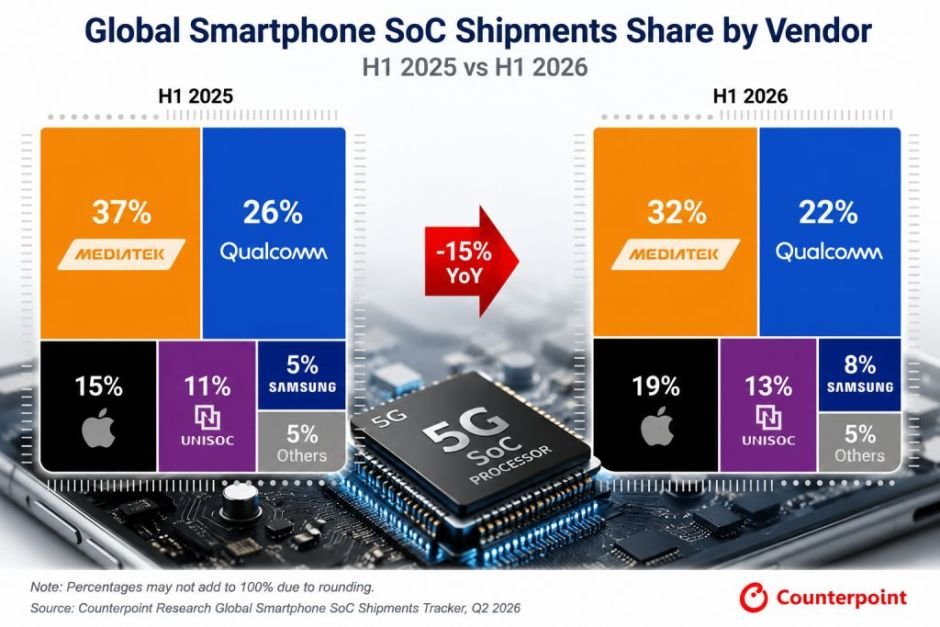
The downturn in smartphone chipset was particularly severe for two of the world’s largest smartphone chip suppliers, Counterpoint Research’s Global Smartphone SoC Shipments Preliminary View report indicated.
MediaTek and Qualcomm each recorded shipment declines of more than 25 percent year-on-year in H1 2026.
In contrast, Apple, Samsung, Google and UNISOC achieved shipment growth, reflecting shifts in smartphone demand, chipset sourcing strategies and the growing importance of artificial intelligence capabilities.
Apple was among the major beneficiaries of the changing competitive landscape. Apple’s smartphone SoC market share increased by 4 percent in H1 2026 compared with H1 2025, supported by strong demand for the iPhone 17 series.
Qualcomm faced pressure despite its strong position in premium smartphones. The Samsung Galaxy S26 series adopted a combination of Qualcomm’s Snapdragon 8 Elite Gen 5 and Samsung’s Exynos 2600, contrasting with the previous generation, which relied entirely on Qualcomm silicon. Softer Xiaomi 17 series sales also affected Qualcomm’s premium chipset shipments.
Qualcomm Smartphone Chipset
Qualcomm strengthened its Snapdragon smartphone portfolio in 2026 with new platforms spanning flagship, mid-range and affordable 5G smartphones. In February, Qualcomm introduced the Snapdragon 8 Elite Gen 5 for Galaxy, featuring its third-generation Oryon CPU, Adreno GPU and Hexagon NPU. The chipset powers the Samsung Galaxy S26 Ultra globally, while the Galaxy S26 and S26+ use it in selected markets, with Qualcomm positioning on-device agentic AI as a major capability.
Qualcomm extended the platform to Samsung’s latest foldables in July. The Snapdragon 8 Elite Gen 5 for Galaxy powers the Galaxy Z Fold8 Ultra, Galaxy Z Fold8 and Galaxy Z Flip8, reinforcing Qualcomm’s position in Samsung’s premium smartphone portfolio. In May, Qualcomm launched the Snapdragon 6 Gen 5 and Snapdragon 4 Gen 5 for broader smartphone segments. Snapdragon 6 Gen 5 delivers 20 percent faster app launches, 18 percent less screen stutter and up to 21 percent better GPU performance than its predecessor. Snapdragon 4 Gen 5 delivers 43 percent faster app launches, 25 percent less screen stutter and up to 77 percent higher GPU performance, while bringing 90 FPS gaming to the Snapdragon 4-series for the first time. Both platforms are scheduled to appear in commercial smartphones during the second half of 2026, with Honor, OPPO, realme and REDMI among the OEM partners.
MediaTek Smartphone Chipset
MediaTek experienced weakness primarily in low-end and entry-level 5G smartphone processors as the memory supply crisis increased device manufacturing costs. However, its premium 9500 series continued to perform strongly, supported by design wins with vivo, OPPO, Pocophone and Redmi.
MediaTek expanded its Dimensity smartphone chipset portfolio in 2026 across flagship, premium and mainstream devices, with AI, gaming, connectivity and power efficiency forming the core of its strategy. In January, the company introduced the Dimensity 9500s and Dimensity 8500, targeting flagship and premium smartphones respectively. The Dimensity 9500s uses an All Big Core CPU architecture led by an Arm Cortex-X925 processor and combines it with advanced AI, imaging, gaming and wireless capabilities.
MediaTek subsequently broadened its portfolio with chips including the Dimensity 6500 and Dimensity 6360 for more mainstream smartphones. The Dimensity 6500 offers up to 19 percent greater power efficiency across 20 common usage scenarios and delivers 18 percent faster CPU performance compared with alternative chips, according to MediaTek. The platforms also incorporate MediaTek UltraSave 3.0+ technology to improve 5G power efficiency. Another addition, the Dimensity 7500, brings Arm C1 processors and Armv9.3-A architecture to mainstream smartphones. Built using a 4 nm process, the chipset delivers 5-9 percent power-efficiency gains in popular applications, 4-7 percent gains in popular games, and up to 68 percent faster video transcoding, while supporting on-device generative AI through its NPU.
UNISOC benefited from manufacturers looking for ways to reduce smartphone bill-of-materials costs. A growing number of entry-level models migrated to UNISOC’s 4G platforms during H1 2026, helping the chipmaker expand shipments. UNISOC is also progressing in the 5G smartphone segment through partnerships with Pocophone and Redmi.
The biggest challenge facing the smartphone semiconductor industry is the dramatic increase in memory costs. Smartphone memory prices surged by more than 300 percent year-on-year in Q2 2026. The increase has pushed smartphone manufacturers to aggressively pursue long-term memory supply contracts, either to protect themselves against shortages or use secured supply as a competitive advantage.
The cost structure of smartphones has consequently changed significantly. Counterpoint said rising device costs are now being driven primarily by memory pricing rather than improvements in hardware specifications. In H1 2026, smartphone memory costs surpassed SoC costs across every smartphone price segment.
Despite the semiconductor downturn, generative AI is emerging as a major smartphone SoC growth engine. GenAI smartphone SoC shipments increased 24 percent in H1 2026, sharply outperforming the overall market’s 15 percent decline.
Growth in AI-capable processors is being supported by smartphone premiumization and increasing consumer demand for AI features. This is boosting semiconductor shipments across the mid-high, premium and flagship smartphone price categories even as the entry-level market struggles with escalating component costs.
The outlook for the remainder of 2026 remains challenging. Counterpoint expects global smartphone SoC shipments to decline 14 percent year-on-year for the full year.
Entry-level smartphones are expected to suffer the steepest contraction, with SoC shipments in the category forecast to fall by more than 30 percent in 2026. Higher memory costs have a disproportionate impact on affordable smartphones because manufacturers have significantly less room to absorb component price increases without raising retail prices.
The supply situation may extend well beyond 2026. Counterpoint does not expect smartphone memory supply conditions to normalize before the second half of 2027. With memory costs already exceeding SoC costs across all smartphone price segments in H1 2026, persistent supply constraints could make 2027 another difficult year for smartphone manufacturers and semiconductor suppliers.
The contrasting trends underline a significant restructuring of the smartphone SoC market. While overall shipments fell 15 percent and Qualcomm and MediaTek shipments declined by more than 25 percent in H1 2026, GenAI smartphone SoCs expanded 24 percent. Meanwhile, the more than 300 percent increase in smartphone memory prices during Q2 2026 is accelerating the divide between struggling entry-level devices and AI-driven premium smartphones.
BABURAJAN KIZHAKEDATH