Taiwan’s United Microelectronics Corporation (UMC) is stepping up semiconductor investment to capture rising demand from artificial intelligence, data centers, automotive electrification and emerging technologies, with approximately $5 billion in capital expenditure planned across 2026 and 2027.
UMC raised its 2026 capital expenditure budget to $2 billion, while its board approved about $5 billion of capex for the two-year 2026-2027 period. The investment will support manufacturing expansion in Singapore and Taiwan, positioning the chipmaker for expected semiconductor industry growth over the next five years.
In Singapore, UMC plans to add cleanroom capacity at its Phase 4 facility, including capacity supporting silicon photonics. In Taiwan, the company will construct a new fab building at its flagship Tainan campus, creating space for future Phase 7 and Phase 8 facilities.
AI is becoming an increasingly important growth engine for UMC. The company expects AI-related revenue of about $300 million in 2026, with the figure projected to exceed $1 billion within three years. That represents more than a threefold increase from the expected 2026 level.
UMC sees connectivity and power semiconductor products for AI data centers as important sources of future demand. Automotive electrification and emerging applications including robotics are also expected to support semiconductor consumption. The company is expanding its capabilities in advanced packaging, logic and memory stacking, and silicon photonics to address these opportunities.
UMC primarily concentrates on mature semiconductor manufacturing technologies, contrasting with Taiwan Semiconductor Manufacturing Company’s push into advanced 2-nanometre and 1-nanometre processes for high-performance and AI chips.
United Microelectronics (UMC) reported second-quarter 2026 revenue of NT$68.73 billion (US$2.18 billion), rising 12.6 percent sequentially from NT$61.04 billion in Q1 2026 and 17.0 percent year-on-year from NT$58.76 billion in Q2 2025.
Revenue growth was supported by stronger wafer shipments, improved utilization and demand from communication and consumer applications. Wafer shipments increased 10.6 percent quarter-on-quarter to 1.129 million 12-inch-equivalent wafers, from 1.021 million in Q1, while utilization improved to 85 percent from 79 percent.
UMC’s advanced specialty processes continued to become a larger revenue contributor. 40nm and below technologies generated 52 percent of wafer revenue, while 22/28nm accounted for 37 percent, up from 34 percent in Q1 2026, though below 40 percent in Q2 2025. Within this, 22nm alone reached a record 17.5 percent of second-quarter sales. The 40nm category contributed 15 percent, compared with 18 percent in Q1 and 15 percent a year earlier. Other technology contributions were 18 percent for 40nm-65nm, 7 percent for 65nm-90nm, 8 percent for 90nm-0.13um, 10 percent for 0.13um-0.18um, 4 percent for 0.18um-0.35um and 1 percent for 0.5um and above.
Geographically, Asia Pacific generated 66 percent of Q2 2026 wafer revenue, increasing from 65 percent in Q1, but down from 67 percent in Q2 2025. North America increased to 22 percent, versus 21 percent in Q1 and 20 percent a year earlier. Europe represented 8 percent, compared with 9 percent in Q1 and 8 percent a year ago, while Japan contributed 4 percent, down from 5 percent in both Q1 2026 and Q2 2025.
By customer type, fabless semiconductor companies generated 85 percent of wafer revenue, compared with 86 percent in Q1 2026 and 81 percent in Q2 2025. Integrated device manufacturers accounted for the remaining 15 percent, up from 14 percent sequentially but below 19 percent a year earlier.
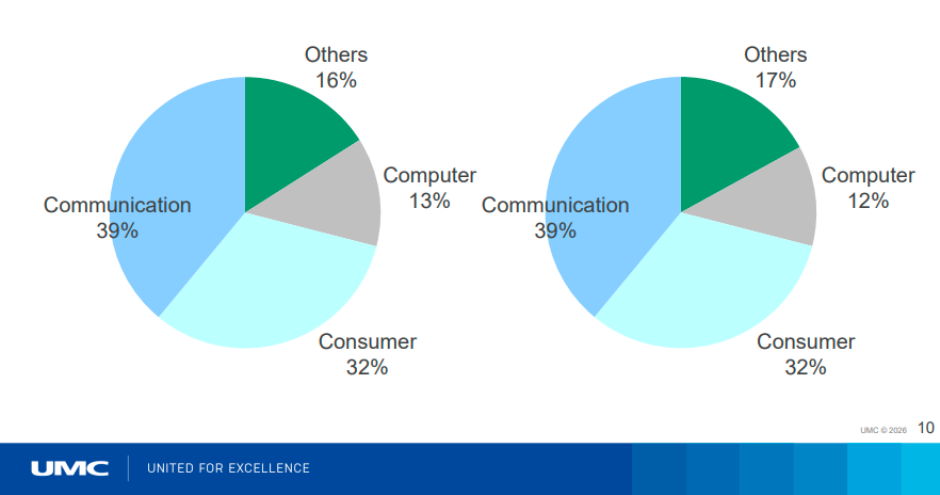
Communication remained UMC’s largest application market at 39 percent of wafer revenue, unchanged sequentially but down from 41 percent a year earlier. Consumer applications represented 32 percent, unchanged from Q1 and versus 33 percent in Q2 2025. Computer applications increased to 13 percent, from 12 percent in Q1 and 11 percent a year ago, while other applications represented 16 percent, compared with 17 percent sequentially and 15 percent year-on-year.
With $2 billion earmarked for 2026 capex, around $5 billion planned across 2026 and 2027, and AI-related revenue expected to rise from approximately $300 million in 2026 to more than $1 billion within three years, UMC is increasing investment to strengthen its position in the expanding AI infrastructure and semiconductor markets.
BABURAJAN KIZHAKEDATH