Global smartphone shipments fell 6 percent to 272 million in Q2 2026, compared with 288.9 million in Q2 2025, according to Omdia. Samsung remained the world’s largest smartphone vendor. Apple recorded the strongest growth among the top five brands.
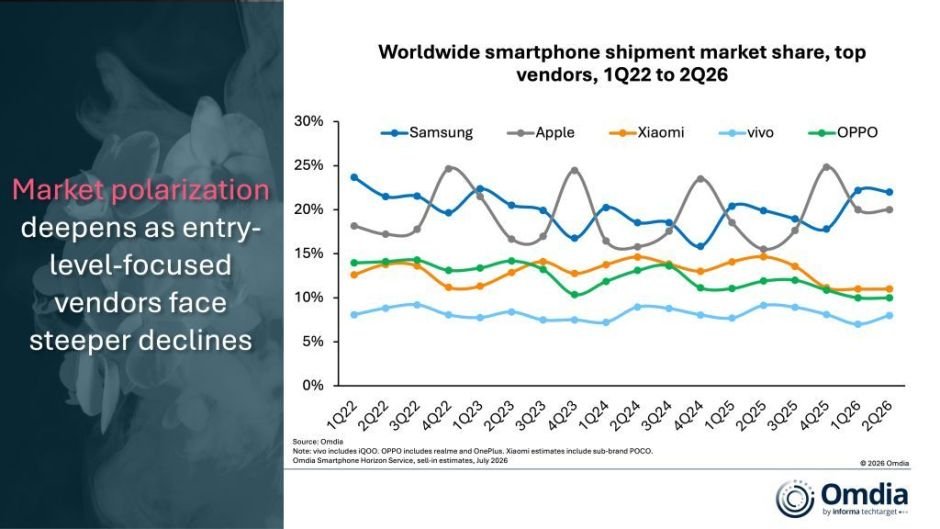
Samsung shipped 60.5 million smartphones in Q2 2026, up 5 percent from 57.5 million a year earlier. Its global market share increased to 22 percent from 20 percent, strengthening its leadership position in the global smartphone market, Omdia report said.
Samsung’s vertically integrated memory operations provided an advantage as the industry faced component shortages and rising costs. The delayed Galaxy S26 series launch also shifted premium smartphone demand into the second quarter.
Samsung additionally gained ground in entry-level smartphones as several Chinese competitors reduced their product ranges and increased prices.
Apple delivered the fastest growth, with iPhone shipments jumping 23 percent to 55.1 million units, compared with 44.8 million in Q2 2025. Apple’s market share climbed sharply to 20 percent from 16 percent, narrowing the shipment gap with Samsung to just 5.4 million units.
Channel partners accumulated significantly larger inventories of the base iPhone 17 amid expectations of price increases and anticipation that the iPhone 18 generation will enter the market at higher price points.
Apple has largely maintained stable iPhone pricing despite broader industry increases. However, price adjustments across other Apple product categories during late Q2 2026 have increased expectations that iPhone prices could rise later in 2026.
Samsung and Apple together shipped 115.6 million smartphones during the quarter and controlled 42 percent of the global market.
Xiaomi remained the third-largest smartphone vendor despite shipments dropping 26 percent to 31.2 million units from 42.4 million. Its global market share fell to 11 percent from 15 percent. Omdia’s Xiaomi figures include its Redmi and POCO sub-brands.
More than half of Xiaomi’s smartphone shipments are priced below US$200, making the company particularly exposed to memory cost inflation.
The impact has been especially pronounced across emerging markets in Asia Pacific and Latin America, where higher prices for entry-level smartphones have weakened consumer demand.
OPPO, including OnePlus and realme, shipped 28.4 million smartphones, down 17 percent from 34.4 million in Q2 2025. Its market share decreased to 10 percent from 12 percent. The company has been streamlining its three-brand portfolio and reducing entry-level SKUs as it focuses more heavily on profitability.
vivo recorded shipments of 21.5 million units, representing an 18 percent annual decline from 26.4 million. Its global smartphone market share slipped to 8 percent from 9 percent.
Other smartphone vendors collectively shipped 75.2 million units in Q2 2026, down 10 percent from 83.5 million a year earlier. Their combined market share edged down to 28 percent from 29 percent.
The performance of Xiaomi, OPPO and vivo highlights the disproportionate impact that rising component costs are having on vendors with significant exposure to price-sensitive smartphone segments.
Memory Costs Trigger Smartphone Market Reset
The first half of 2026 marked the beginning of what Omdia describes as a supply-driven reset for the global smartphone industry. Rising memory, storage and application processor costs are shifting vendor priorities away from maximizing shipment volumes and toward protecting margins and average selling prices.
Smartphone manufacturers are responding by passing some component increases to consumers, reducing the number of entry-level models and accelerating their transition toward mid-range and premium smartphones.
These strategies are helping global smartphone revenue remain comparatively resilient despite falling unit shipments.
The changes could have implications beyond the current memory cycle. Higher handset prices are resetting consumer expectations and potentially creating room for smartphone companies to establish permanently higher pricing structures and expand average selling prices over the longer term.
Middle East Smartphone Shipments Plunge 18 Percent
Regional disruptions added further pressure during Q2 2026. Smartphone shipments in the Middle East declined 18 percent year on year, as geopolitical tensions affected supply chains, retail activity and consumer demand.
Omdia expects this regional disruption to be temporary, with conditions gradually stabilizing during the second half of 2026.
Cost inflation, however, represents a more persistent challenge. Higher component prices are fundamentally changing how smartphone brands compete, with profitability and product positioning increasingly taking precedence over shipment growth.
Smartphone Shipments Expected to Keep Falling Over Next Two Quarters
Although channel inventories have largely normalized, elevated component costs are expected to keep the global smartphone market under pressure throughout the remainder of 2026.
Omdia expects the pace of shipment contraction to moderate following the sharp 6 percent decline in Q2, but a broad recovery in volumes is unlikely until component costs begin to ease.
More importantly, global smartphone shipments are expected to continue declining over the next two quarters, despite seasonal support from flagship smartphone launches, holiday promotions and major shopping festivals.
Smartphone manufacturers are consequently expected to maintain disciplined sell-in strategies, further rationalize product portfolios and focus on profitability rather than aggressively chasing market share.
Higher prices are also creating opportunities for vendors to expand device financing, trade-in programmes, bundled offers and services revenue. These strategies could improve device affordability while increasing customer lifetime value.
Industry revenue is expected to remain relatively resilient because higher average selling prices and a richer product mix should partially offset lower shipment volumes. However, the outlook could deteriorate if memory costs remain elevated for longer than expected or macroeconomic conditions weaken during the peak smartphone selling season.
The Q2 2026 results underline the growing divide between smartphone vendors. Samsung’s 60.5 million shipments and 5 percent growth and Apple’s 55.1 million shipments and 23 percent surge contrast sharply with Xiaomi’s 26 percent decline, OPPO’s 17 percent drop and vivo’s 18 percent contraction. Pricing power, supply-chain resilience and the ability to move consumers toward higher-value devices are increasingly becoming the defining competitive factors in the global smartphone market.
BABURAJAN KIZHAKEDATH