The global shift toward 5G Standalone (SA) and 5G-Advanced is gaining strong momentum, signaling the next phase of mobile network evolution.
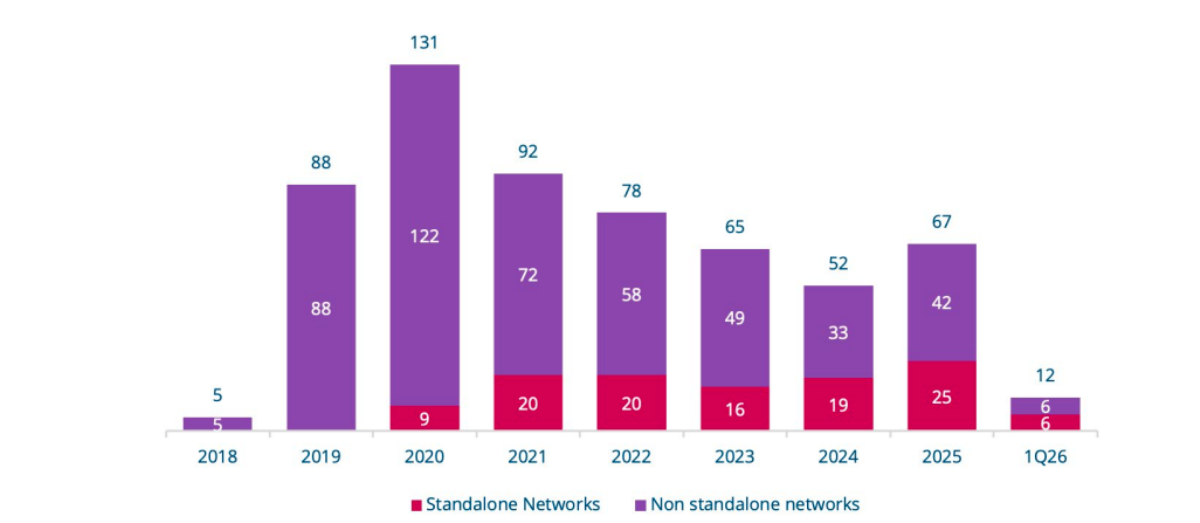
According to the Global mobile Suppliers Association, 5G Standalone has become the clearest marker of market maturity, now accounting for 29 percent of 5G services, up from 26 percent in March 2025, while 71 percent of deployments remain Non-Standalone.
A total of 95 operators have launched 5G Standalone services, representing a 42 percent increase since 1Q25. In 4Q25 alone, 11 operators were investing in 5G SA, with notable launches by Telia Lietuva and Swedish networks in December 2025. Additional deployments during the quarter came from Ucom, SFR, and YTL Communications. Since the beginning of 2026, Wind Tre has launched a 5G SA service, with further rollouts expected through the year, GSA report said.
The supporting ecosystem continues to expand, with 43 chipsets capable of enabling 5G Standalone from vendors such as MediaTek, Qualcomm, Samsung Electronics, and UNISOC. This is driving the adoption of 5G RedCap, with 14 operators having launched services and one more currently deploying. Asia Pacific and the Middle East initially led RedCap deployments, but momentum is now shifting toward Europe.
In Europe, Deutsche Telekom became the first to launch a 5G RedCap service in September 2025, aligned with the latest smartwatch release from Apple. In November 2025, VodafoneThree began trials, followed by a commercial launch by Telefónica Deutschland in January 2026 as part of its 5G Plus Pack. MasOrange also introduced a 5G RedCap service alongside its 5G-Advanced network announcement.
5G-Advanced, while still at an early stage, is emerging as a strong indicator of future network capabilities. A total of 35 operators are investing in 5G-Advanced technology, marking a 71 percent increase from last year, with 11 operators already launching services. During 2025, eight operators introduced 5G-Advanced services, including du, which launched its offering in December 2025.
As of March 2026, Bell Mobility has become the latest operator to launch a 5G-Advanced service. Meanwhile, SoftBank, Zain, and Viettel are actively trialing the technology, and SmarTone is planning a commercial rollout in the near future.
The device ecosystem for 5G-Advanced is also taking shape, with eight commercial chipsets currently available from Qualcomm and Sequans, supporting early deployments.
The rapid growth of 5G Standalone, combined with rising investments and early launches of 5G-Advanced, highlights a clear transition toward more advanced, efficient, and intelligent network architectures that will define the next stage of global 5G evolution.
BABURAJAN KIZHAKEDATH