
The United States is witnessing major progress in broadband performance, according to the Ookla’s Speedtest Intelligence report. During the first half of 2025, 33 states narrowed the digital divide between rural and urban users, marking a significant shift toward more equitable internet access.
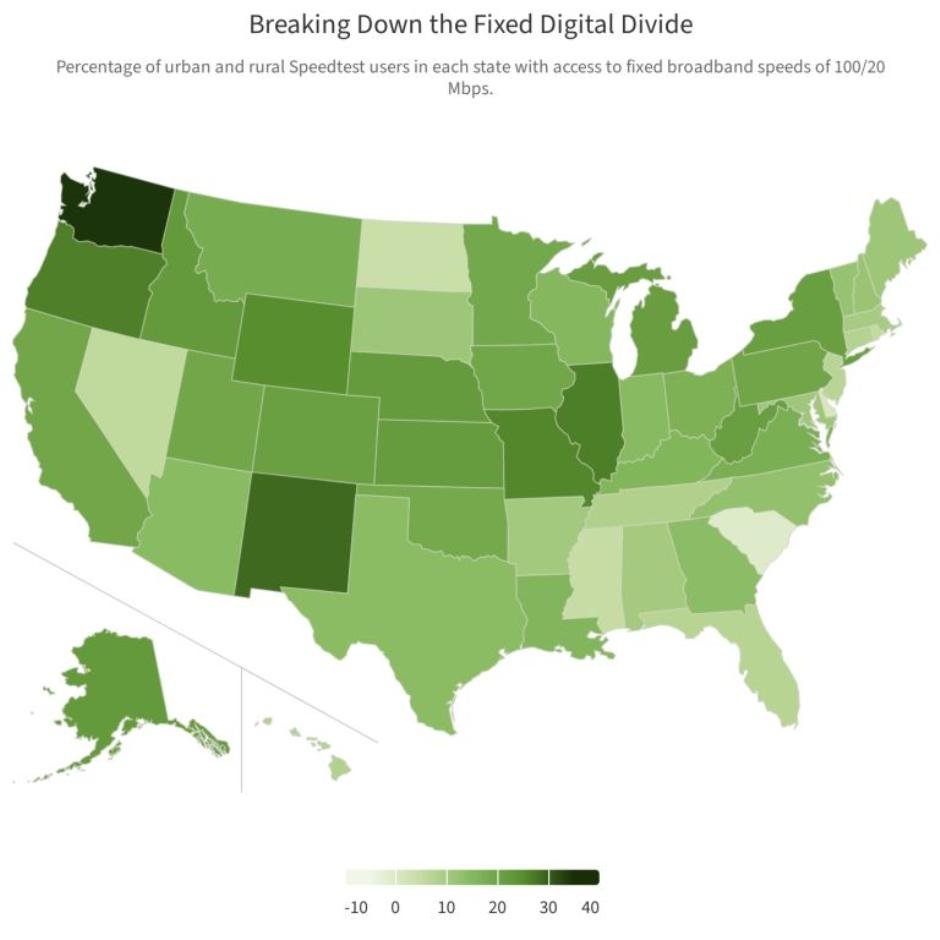
This improvement comes despite temporary delays in broadband deployments following the National Telecommunications and Information Administration (NTIA)’s restructuring of the $42.5 billion Broadband Equity, Access, and Deployment (BEAD) program in June 2025.
The revised BEAD framework requires states to re-submit broadband plans with a technology-neutral focus, prioritizing cost-effectiveness and allowing fiber, fixed wireless access (FWA), and low-Earth orbit (LEO) satellite solutions to compete for funding, Sue Marek, Ookla’s editorial director, said.
38 States Now Meet FCC Minimum Broadband Standards
Ookla’s findings reveal that 38 states and the District of Columbia now deliver broadband speeds of at least 100 Mbps download and 20 Mbps upload to 60 percent or more of users, up from just 22 states a year ago.
Five states — Connecticut, Delaware, New Jersey, North Dakota, and Rhode Island — now lead the nation, with over 70 percent of users achieving these benchmark speeds.
This marks one of the most significant year-over-year improvements in U.S. broadband infrastructure since the FCC began tracking high-speed access performance.
Key Highlights from Ookla’s Broadband Report 1H 2025
38 states + D.C. meet the FCC benchmark of 100/20 Mbps for 60 percent+ of users
5 states (CT, DE, NJ, ND, RI) deliver 100/20 Mbps for 70 percent+ of users
33 states reduced the urban–rural broadband performance gap
Starlink rural users outperform urban users in 26 states + D.C.
South Dakota ranks No. 1 for Starlink speeds, with 37.1 percent meeting FCC standards
32 states now include LEO satellite solutions in BEAD broadband plans
Starlink Drives Rural Broadband Growth
One of the most notable findings is the growing role of SpaceX’s Starlink in bridging the rural broadband gap.
In 26 states and the District of Columbia, rural Starlink users recorded faster broadband speeds than urban users — a rare reversal in internet access trends.
According to Ookla, South Dakota leads the nation for Starlink performance, with 37.1 percent of users achieving 100/20 Mbps speeds, followed by Maine (35.3 percent) and Wyoming (34.5 percent).
This demonstrates how LEO satellite broadband is effectively overcoming traditional infrastructure barriers and helping underserved areas gain access to reliable high-speed internet.
ISPs Ramp Up Fiber Expansion in 2025
Private sector investments also played a crucial role in accelerating broadband improvements:
AT&T added 2.3 million fiber locations in 1H 2025, reaching 30.3 million total.
Verizon’s Frontier Communications expanded to 655,000 new fiber locations.
Verizon is ahead of schedule to expand Fios coverage to 650,000 new homes this year.
Lumen Technologies, whose consumer division is being sold to AT&T, added 218,000 fiber locations.
These expansions reflect a broader trend of ISPs increasing fiber footprints to meet growing consumer demand for faster, more reliable connections.
States Showing the Fastest Broadband Growth
Colorado and Vermont posted the strongest year-over-year gains, each improving the share of users accessing 100/20 Mbps broadband by more than 13 percent.
Colorado’s success is driven by GFiber’s expansion and state-led efforts under the Advance Colorado Broadband program, which aims to connect 99 percent of households by 2027.
Vermont’s growth was fueled by USDA ReConnect funding for NEK Broadband, expanding fiber networks across multiple rural counties.
Conversely, Alaska continues to face challenges due to its vast geography and high deployment costs, averaging $17,366 per broadband location, compared to just $2,822 in more compact states like Delaware.
LEO Satellites Gain Policy Momentum
Following the NTIA’s policy shift in mid-2025, 32 states and territories have integrated LEO satellite broadband solutions — including Starlink and Amazon’s Project Kuiper — into their official BEAD proposals.
This marks a turning point toward a technology-agnostic strategy, enabling faster deployment and more competitive broadband options for rural and remote communities.
Consumers Upgrade to Faster Internet Plans
The shift in broadband infrastructure is mirrored by changing consumer behavior. According to OpenVault, the percentage of U.S. households subscribed to 500–900 Mbps broadband plans increased from 18 percent in 2024 to 24 percent in 2025.
This trend highlights growing demand for higher bandwidth, driven by streaming, remote work, gaming, and smart home technologies.
Conclusion: Broadband Momentum Builds Nationwide
Despite regulatory adjustments and infrastructure challenges, the U.S. broadband landscape is improving faster than ever. With a combination of fiber expansion, government incentives, and satellite innovation, more Americans are gaining access to reliable, high-speed internet.
As 38 states now meet or exceed FCC broadband benchmarks, and LEO satellite adoption expands, the U.S. is making measurable progress toward closing its digital divide and achieving nationwide broadband equity.
Baburajan Kizhakedath