
Indian government has approved the first batch of seven projects worth over Rs 5,532 crore ($625 million) under the Electronics Component Manufacturing Scheme (ECMS) to strengthen domestic production of critical electronic components and reduce reliance on imports.
The approved projects — spread across Tamil Nadu, Andhra Pradesh, and Madhya Pradesh — are expected to generate production worth Rs 44,406 crore and create more than 5,000 direct jobs, according to the Ministry of Electronics and Information Technology (MeitY).
Key Companies and Projects
Among the beneficiaries are Kaynes Circuits India, which will develop advanced multi-layer and high-density interconnect (HDI) printed circuit boards (PCBs), camera modules, and copper-clad laminates. Other approved firms include SRF, Syrma Strategic Electronics, and Ascent Circuits, marking a major step toward localizing high-value component manufacturing.
Strengthening India’s Electronics Value Chain
The initiative, announced by Union Minister Ashwini Vaishnaw, underscores the government’s strategy to deepen India’s electronics value chain. The ECMS, notified in April 2025 with an outlay of Rs 22,919 crore ($2.7 billion), aims to establish a self-sustaining ecosystem for electronics component manufacturing and integrate India into global supply chains.
The scheme is designed to attract domestic and foreign investment, promote higher value addition, and enhance India’s competitiveness in sectors such as telecom, defence, electric vehicles, renewable energy, and consumer electronics.
Investment and Output Targets
As of September 2025, total investment commitments under ECMS have reached Rs 1.15 lakh crore, nearly double the original target. Production output from approved projects is projected at Rs 10.34 lakh crore over six years — more than twice initial estimates. The scheme is also expected to create over 1.4 lakh direct jobs, surpassing early projections.
Components Covered Under the First Approvals
The first set of projects cover a diverse range of advanced electronic materials and components:
Camera Module Sub-Assemblies for smartphones, drones, and medical devices
Multi-Layer PCBs for automotive, telecom, and industrial applications
HDI PCBs for compact, high-performance electronic devices
Copper-Clad Laminates used in the manufacture of PCBs
Polypropylene Film, a key material for capacitors in consumer and industrial electronics
These components form the backbone of products used across industries including automotive, ICT, aerospace, defence, and industrial automation.
India’s Rapidly Expanding Electronics Industry
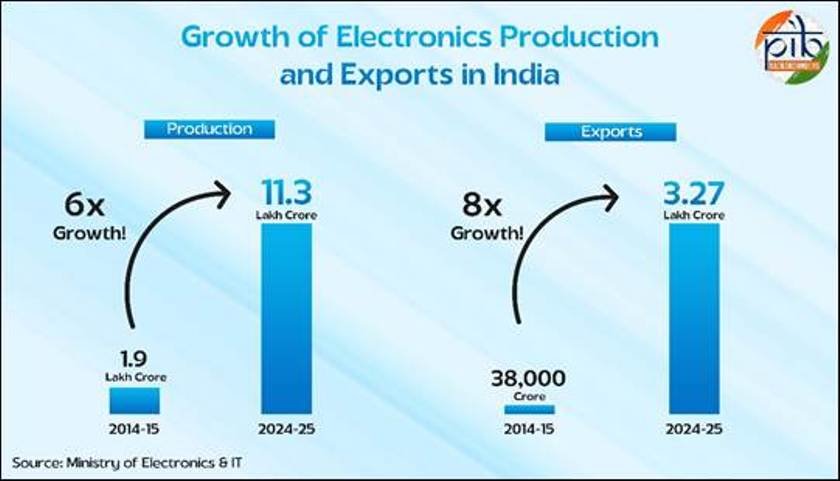
India’s electronics manufacturing has witnessed a six-fold rise over the past decade — from Rs 1.9 lakh crore in 2014–15 to Rs 11.3 lakh crore in 2024–25. Exports have grown eightfold to Rs 3.27 lakh crore during the same period, making electronics the third-largest and fastest-growing export category in 2024–25.
Mobile phone production, a key driver, surged from Rs 18,000 crore in 2014–15 to Rs 5.45 lakh crore in 2024–25, positioning India as the world’s second-largest mobile phone manufacturer. Exports of smartphones rose 127 times to Rs 2 lakh crore, with Apple alone contributing over Rs 1.1 lakh crore in FY2024–25.
A Strategic Push for Self-Reliance
The approval of the first batch of ECMS projects represents a pivotal step in India’s journey toward self-reliant electronics manufacturing. By focusing on high-value components, the government aims to ensure supply chain resilience, attract global OEMs, and elevate India’s position in the global electronics market.
With strong policy support, robust investment momentum, and participation from leading domestic manufacturers, India is on course to achieve its vision of becoming a global hub for advanced electronics manufacturing by 2030.
Baburajan Kizhakedath

