
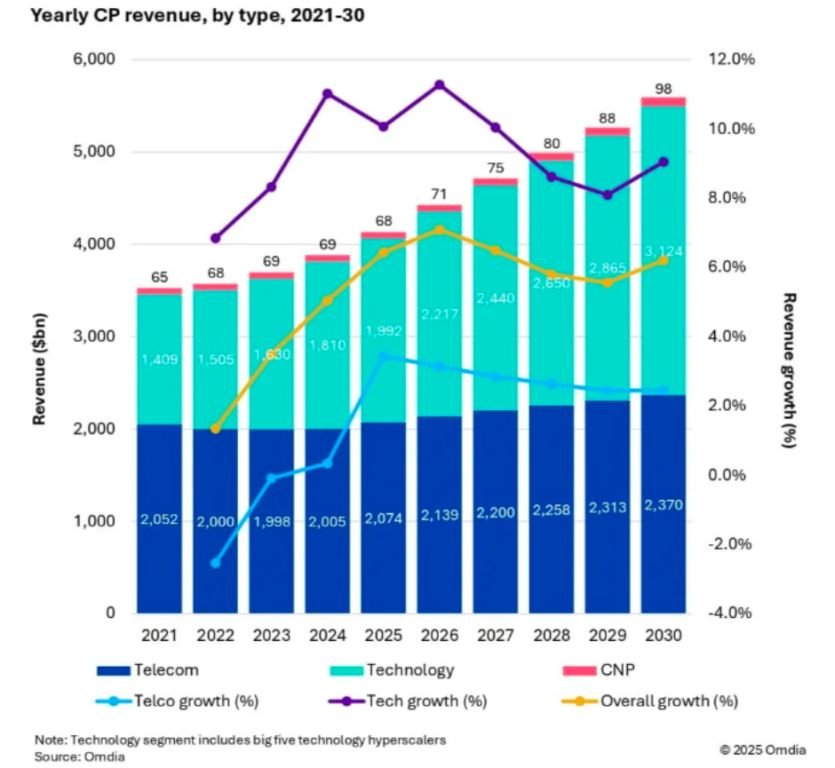
The global communications providers (CP) market is entering a phase of strong and sustained growth, with total revenue projected to reach $5.6 trillion by 2030, expanding at a 6.2 percent CAGR from 2025, according to Omdia report.
This growth is being propelled by advances in technology, large-scale infrastructure expansion, and rising investment in next-generation networks powered by 6G and artificial intelligence (AI).
Omdia’s research highlights a fundamental shift in the industry landscape. Traditional telecom revenue is expected to grow at a modest 2.7 percent CAGR, reflecting the maturity of core connectivity services.
In contrast, the technology segment — led by hyperscale players such as Amazon, Alphabet, Apple, Meta, and Microsoft — is forecast to expand at a much faster 9.4 percent CAGR, accounting for nearly 56 percent of total CP revenue by 2030. This acceleration underscores the growing convergence between telecommunications and cloud-based digital ecosystems, with hyperscalers increasingly influencing global connectivity economics.
“Telecom operators are entering a new phase of strategic investment,” said Dario Talmesio, Research Director at Omdia. “With 6G on the horizon and AI infrastructure demands accelerating, the connectivity business is shifting from volume-based pricing to value-driven connectivity.”
On the investment front, Omdia expects telecom capex to rise to $395 billion by 2030, marking a 3.6 percent CAGR, while technology capex is set to surge to $545 billion, growing at 9.3 percent CAGR. From 2028 onward, investment focus will gradually move from fixed to mobile networks as Tier 1 markets prepare for 6G rollout. Fixed telecom capex will begin to decline due to market saturation, but operators will increasingly allocate resources to AI infrastructure, data centers, and cloud capacity to support growing digital and enterprise demand.
AI and cloud-driven modernization are also being reinforced by national policies on digital sovereignty, prompting operators to invest in specialized hardware and regional data hubs. As a result, CP capex per person is projected to climb from $74 in 2024 to $116 in 2030, with overall capex reaching about 2.5 percent of global GDP investment. Capital intensity in telecom will likely decline until 2027 and then rise again as mobile networks are upgraded for 6G.
Regionally, North America, Oceania & Eastern Asia, and Western Europe are expected to remain the largest markets for revenue and capex, driven by mature digital ecosystems and ongoing network modernization. However, Central & Southern Asia will deliver the highest growth potential, backed by expanding broadband access, rapid urbanization, and public–private investment partnerships.
Overall, the communications industry is evolving into a new growth phase defined by the integration of AI, cloud computing, and 6G technologies. As telecom and technology players align their strategies, the focus will shift from traditional connectivity to value-driven, intelligent infrastructure.
By 2030, communications providers will play a pivotal role in enabling the digital economy — not just as network operators but as strategic enablers of data-driven innovation and economic transformation, Omdia’s latest global forecast for CP revenue and capital expenditure (capex) indicated.
Baburajan Kizhakedath

