The Philippines smartphone market in Q1 2026 remained one of Southeast Asia’s most price-sensitive and volume-driven mobile markets as smartphone vendors focused on affordable 5G devices, profitability, and aggressive retail expansion amid softer regional demand.
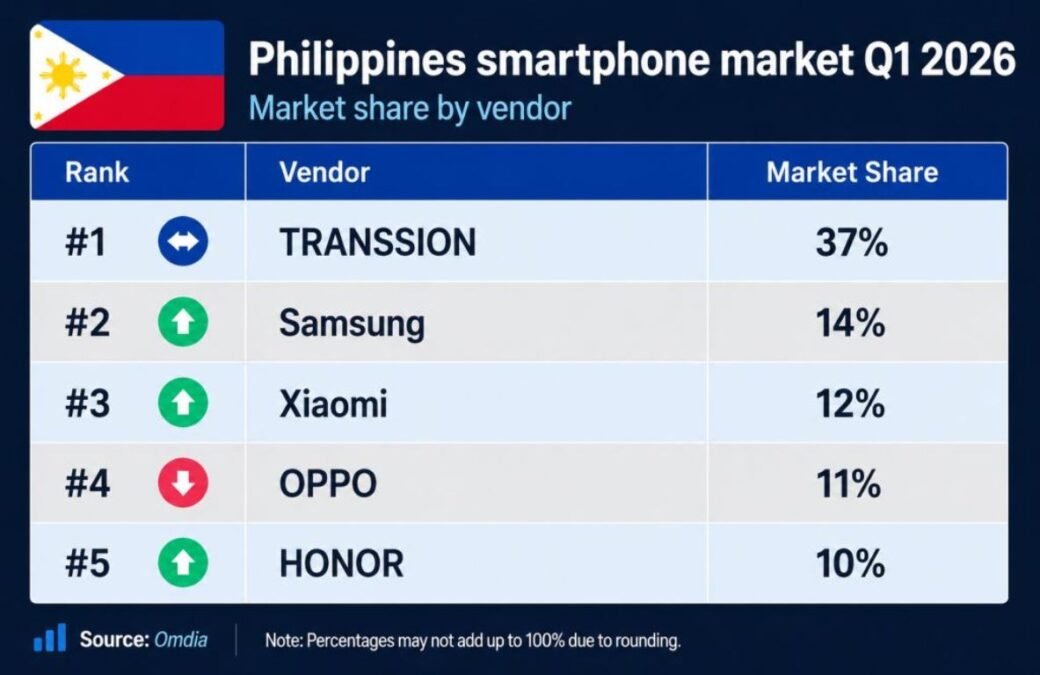
Chinese smartphone brands continued dominating the Philippine smartphone industry, capturing four of the top five market positions, while Samsung Electronics remained the leading non-Chinese smartphone vendor in the country.
According to Omdia, Southeast Asia smartphone shipments declined 9 percent year-on-year in Q1 2026 as smartphone vendors increasingly prioritized profitability, inventory optimization, and pricing discipline instead of shipment-led market share expansion. Rising memory and component costs also pushed average smartphone selling prices higher across the region during the quarter.
The Philippines continued benefiting from strong mobile internet usage, heavy social media engagement, gaming demand, and affordable prepaid data ecosystems that supported mass-market smartphone adoption.
TRANSSION captures 37 percent smartphone market share in the Philippines
TRANSSION secured the leading position in the Philippines smartphone market with a dominant 37 percent market share, driven by strong demand for its Infinix, Tecno, and itel smartphone brands.
The company continued benefiting from aggressive pricing, gaming-focused smartphones, stylish designs, large batteries, and strong appeal among younger consumers and first-time smartphone buyers.
Samsung Electronics captured second position with a 14 percent market share, supported by strong Galaxy brand recognition, broad retail presence, and steady demand for Galaxy A-series smartphones across affordable 5G and mid-range categories.
Xiaomi secured a 12 percent market share as its value-focused smartphone strategy continued attracting budget-conscious Filipino consumers seeking high specifications at affordable prices.
OPPO accounted for an 11 percent market share despite softer quarterly momentum. OPPO continued relying on offline retail expansion, installment-based financing programs, and youth-focused marketing campaigns to maintain visibility.
HONOR reached a 10 percent market share while continuing aggressive expansion in the Philippines through affordable 5G smartphones, online promotions, and growing retail partnerships.
TRANSSION’s dominance remained particularly significant as the company held a larger market share than the next three smartphone vendors combined. Outside the leading position, competition remained extremely tight, with only a four percentage point gap separating second place from fifth place.
Vendors focus on affordable 5G smartphones and gaming features
Smartphone vendors in the Philippines increasingly focused on affordable 5G smartphones, financing-led affordability, gaming optimization, and aggressive online promotions as economic pressure continued influencing consumer purchasing decisions.
TRANSSION strengthened its market position through ultra-affordable smartphones featuring gaming modes, AI-enhanced cameras, large batteries, and high-refresh-rate displays targeting younger mobile-first consumers.
Samsung Electronics focused on balancing profitability and market share through Galaxy A-series smartphones while leveraging premium Galaxy ecosystem positioning and stronger after-sales support infrastructure.
Xiaomi continued gaining momentum by offering feature-rich Redmi and Poco smartphones emphasizing battery life, gaming performance, fast charging technology, and competitive pricing.
OPPO maintained its retail-led strategy through offline store expansion, camera-centric smartphone positioning, and installment-based financing programs targeting younger users and mass-market consumers.
HONOR accelerated expansion through aggressive online campaigns, partnerships with e-commerce platforms, and competitively priced 5G smartphones aimed at value-focused consumers.
Budget and mid-range smartphones dominate consumer demand
The Philippines smartphone market in 2026 continued witnessing strongest demand for affordable smartphones priced between PHP 5,000 and PHP 20,000 as consumers prioritized value and financing affordability.
Samsung Galaxy A16 5G smartphones retailed between PHP 9,000 and PHP 12,000 depending on configuration and retail channels, while Galaxy A55 5G devices were available in the PHP 22,000 to PHP 28,000 category.
Xiaomi Redmi Note smartphones generally ranged between PHP 8,000 and PHP 15,000, while Poco gaming-focused smartphones increasingly targeted consumers in the PHP 10,000 to PHP 18,000 segment.
Infinix, Tecno, and itel smartphones aggressively competed in the PHP 4,000 to PHP 10,000 category, strengthening TRANSSION’s dominance in entry-level and affordable gaming smartphone segments.
Consumers increasingly preferred smartphones featuring 120Hz displays, gaming optimization, AI-powered photography, fast charging capabilities, and large battery capacity instead of premium flagship devices.
Mobile gaming, TikTok and prepaid data shape buying trends
Filipino consumers remained highly focused on affordability, prepaid flexibility, social media usage, and gaming performance during smartphone purchasing decisions in Q1 2026.
Mobile gaming, TikTok content creation, Facebook usage, YouTube streaming, and mobile-first digital lifestyles continued driving demand for affordable high-performance Android smartphones.
Installment financing, cashback promotions, prepaid operator bundles, and online flash-sale campaigns increasingly shaped consumer buying behavior across urban and provincial markets.
Consumers also favored smartphones optimized for long battery life and efficient mobile data usage because prepaid mobile internet plans remained dominant across the Philippine telecom market.
Offline retail stores remained important for smartphone purchases, though e-commerce platforms and online-exclusive launches continued gaining traction among younger consumers.
Telecom operators expand mobile internet and 5G services
The Philippines continued witnessing strong mobile internet usage growth as telecom operators expanded 4G and 5G infrastructure while increasing prepaid data offerings.
Major telecom operators including Globe Telecom and PLDT through its Smart Communications unit continued accelerating 5G expansion and digital services deployment across major cities and provincial regions.
Affordable prepaid data plans, gaming-focused internet packages, mobile wallet adoption, and video streaming demand continued supporting smartphone upgrades across lower-income consumer groups.
Operators increasingly competed through high-data prepaid plans, bundled streaming subscriptions, gaming-focused promos, and digital lifestyle ecosystems as mobile data consumption continued rising rapidly.
The Philippines remained one of Southeast Asia’s most socially connected and mobile-first markets, making smartphone affordability and internet accessibility critical drivers for the country’s digital economy.
Consumers report heating, battery drain and software optimization concerns
Consumer discussions across online reviews, smartphone forums, e-commerce platforms, and Reddit increasingly highlighted concerns related to overheating during gaming, software advertisements, battery optimization, and long-term device performance in affordable Android smartphones.
Several Infinix and Tecno users discussed occasional lag during extended gaming sessions and delayed Android software updates, although many consumers continued positively rating these smartphones for affordability and battery endurance.
Some Xiaomi users highlighted software advertisements and pre-installed applications affecting user experience, while Samsung Galaxy A-series users discussed battery drain concerns following software updates and occasional overheating during multitasking.
Consumers also increasingly raised concerns regarding rising prepaid mobile data costs, expiring data allocations, shorter validity periods, and inconsistent network performance during peak usage periods.
Longer smartphone replacement cycles increasingly pushed consumers to prioritize software stability, thermal performance, battery endurance, and after-sales support quality before purchasing new smartphones.
Outlook: Affordable AI-ready smartphones expected to intensify competition
The Philippines is expected to remain one of Southeast Asia’s most important smartphone growth markets because of its large mobile-first population, rising mobile internet penetration, and strong social media engagement.
Smartphone vendors are increasingly expected to compete through affordable AI-enabled features, gaming-focused optimization, financing-led affordability, ecosystem integration, and aggressive online retail campaigns instead of purely hardware-driven differentiation.
The market is also expected to witness stronger competition in affordable 5G smartphones as telecom operators continue expanding network coverage and consumers increasingly upgrade from older 4G devices during 2026.
FASNA SHABEER