India’s smartphone market witnessed a sharp slowdown in the second quarter of 2026, with shipments declining 13 percent year on year to 33.9 million units, according to Omdia.
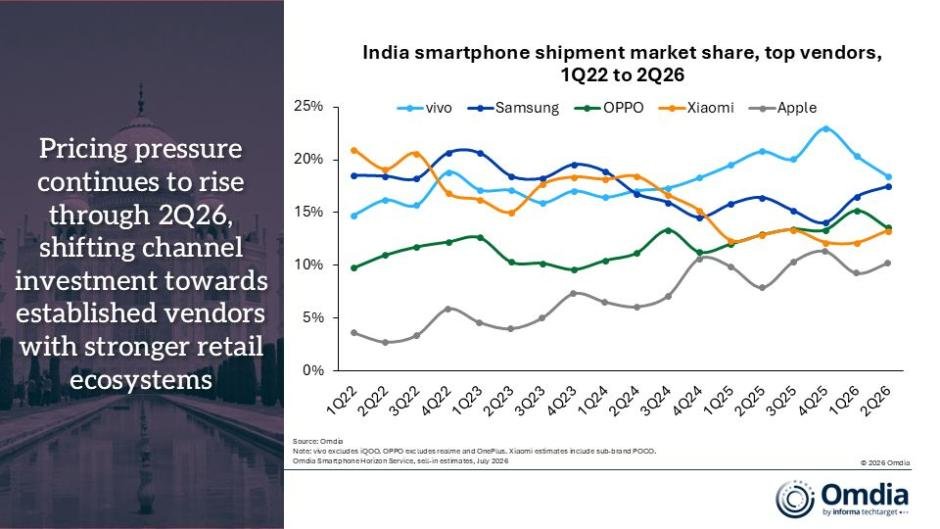
Rising memory costs pushed handset prices higher, reducing affordability in the mass-market segment of the Indian smartphone market. Delayed consumer upgrades ahead of festive offers, depreciation in rupee, inflation, and weak summer retail demand also contributed to the decline, while smartphone vendors remained cautious about channel inventory amid slower sell-out, Sanyam Chaurasia, Principal Analyst at Omdia, said.
Vivo (18 percent), Samsung (17 percent), Oppo (14 percent), Xiaomi (13 percent), Apple (10 percent) and Others (27 percent) are the leading smartphone brands in India in Q2-2026.
Vivo retained its position as the largest smartphone vendor in India, shipping 6.3 million smartphones despite recording a double-digit decline. The company defended its leadership by streamlining its entry-level portfolio around the Y11 5G and Y21 5G, while expanding its mid-range offerings with the V70 FE, Omdia report said.
Samsung ranked second with 5.9 million smartphone shipments, delivering the strongest performance among the leading brands during the quarter. Demand for the Galaxy A07 and Galaxy A17 supported volumes, while the Galaxy Forever programme, exchange offers, buyback schemes, and distributor financing strengthened sales of the flagship Galaxy S26 series and improved channel confidence.
OPPO secured the third position with 4.6 million units shipped. Although multiple price increases across its product portfolio affected volumes, the company continued to strengthen its position in the mid-range and premium segments through the F33 series, the expanded Reno 15 lineup, and the Find X9 family.
Xiaomi ranked fourth with 4.5 million smartphone shipments, supported by the Xiaomi 15A and Xiaomi 15C models. The company also continued serving entry-level buyers with the Redmi A7 4G and Redmi A7 Pro 4G, while reviving its Leica-backed T-series to strengthen its premium smartphone portfolio.
Apple completed the top five with 3.5 million iPhone shipments. The company benefited from higher channel inventory for the base iPhone 17 ahead of anticipated price increases and expectations that the base iPhone 18 would not launch this year. Financing schemes, exchange offers, and cashback programmes also supported premium smartphone sales.
Sanyam Chaurasia said smartphone brands increasingly simplified their product portfolios during the quarter to improve profitability, differentiate products, and enhance channel efficiency. Entry-level portfolios were streamlined around hero models, product lifecycles were extended, and premium portfolios were redesigned to offer clearer upgrade paths. Samsung and Apple were particularly well positioned as retailers increasingly favoured brands offering stronger premium demand, financing support, and lower inventory risk.
Omdia expects India’s smartphone market to record a double-digit decline in 2026, with demand continuing to face pressure from inflation, rupee depreciation, higher living costs, and elevated smartphone prices caused by persistent memory cost increases. The research firm believes meaningful smartphone price normalization is unlikely before the first half of 2027. It recommends that vendors maintain pricing discipline while supporting affordability through financing, exchange programmes, cashback offers, value-added service bundles, disciplined inventory planning, and stronger partnerships with both large-format retailers and the general trade channel.
BABURAJAN KIZHAKEDATH