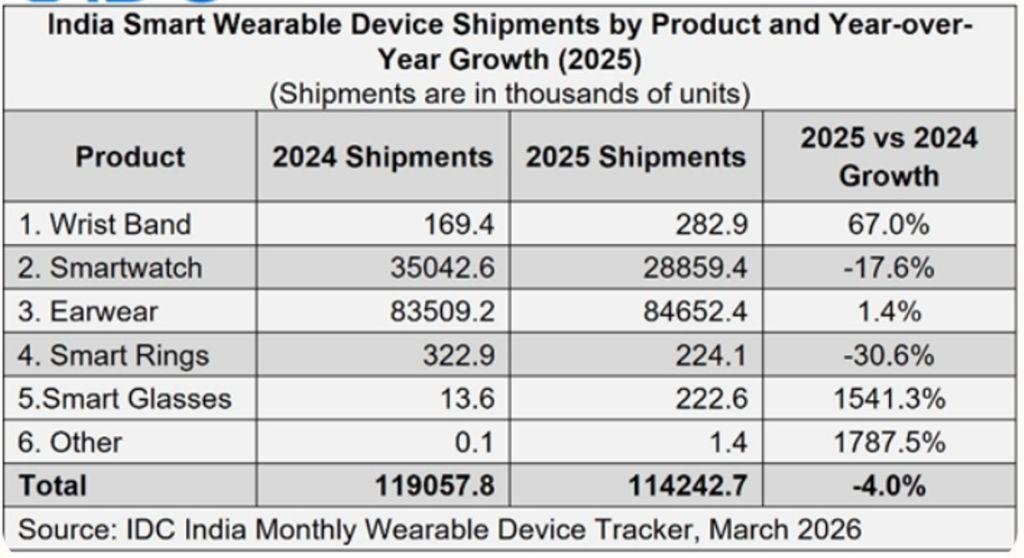
India’s wearable device market recorded its second consecutive annual decline in 2025, according to the latest India Monthly Wearable Device Tracker from International Data Corporation. Total shipments fell 4.0 percent year-over-year to 114.2 million units, impacted largely by a sharp contraction in smartwatch volumes.
Despite weaker shipments, the market showed early signs of premiumization. Selling prices increased 1.8 percent to $20.3 in 2025, reflecting a gradual consumer shift toward higher-quality, feature-rich devices and easing price erosion across categories, IDC report said.
Smartwatch Shipments Drop 17.6 Percent in 2025
Smartwatch shipments declined 17.6 percent to 28.9 million units in 2025. As a result, the category’s share of the overall wearables market dropped to 25.3 percent, compared to 29.4 percent in 2024.
However, selling prices in the smartwatch segment increased 11.7 percent, rising from $23.8 in 2024 to $26.5 in 2025. The increase in price of smartwatch suggests consumers are moving toward advanced and health-centric models, partially offsetting the fall in volumes.
Advanced smartwatch shipments declined 8.7 percent, though their market share edged up from 2.9 percent to 3.2 percent, signaling selective premium demand.
Earwear Segment Grows Marginally as TWS Faces Maturity
The earwear category grew 1.4 percent to 84.7 million units in 2025. However, selling prices dipped 1.1 percent to $17.5, reflecting intense competition in the mass-market Truly Wireless Stereo segment and aggressive online promotions.
TWS maintained dominance with a 70.2 percent market share, but volumes remained flat due to market maturity and longer replacement cycles.
Neckband shipments fell 10.2 percent, while over-the-ear headphones emerged as the fastest-growing segment, surging 65.4 percent to 7.4 million units. Growth was driven by hybrid work trends and rising demand for premium audio experiences.
Vendor Performance: boAt Extends Leadership
In the overall wearables market, boAt strengthened its leadership position, increasing its market share from 27.6 percent to 29.2 percent in 2025. The company dominated TWS, tethered and over-the-ear categories, accounting for nearly one-third of total shipments. Strong brand recall, a diverse portfolio and omnichannel execution supported its performance.
In the TWS segment, smartphone-led brands gained traction. Nothing including CMF recorded the highest growth at 91.5 percent year-over-year. OPPO including OnePlus grew 38.2 percent, supported by stronger ecosystem integration and improved channel presence.
The over-the-ear segment saw strong momentum led by Samsung through JBL and Zebronics alongside boAt. GoBoult and Noise posted exceptional growth of 698.3 percent and 276.5 percent respectively, reflecting growing demand for premium and lifestyle-oriented audio products.
In the smartwatch category, Noise led with a 26.6 percent market share, followed by boAt at 14.1 percent. Fire-Boltt ranked third with 9.7 percent share, while GoBoult maintained momentum with 29.8 percent growth.
Offline Channel Gains Strength in 2025
The offline channel expanded its share from 37.8 percent to 40.7 percent in 2025, growing 3.1 percent year-over-year. In contrast, the online channel declined 8.4 percent.
The online slowdown was primarily driven by a steep 22.7 percent drop in smartwatch shipments, while earwear recorded a milder 3.2 percent decline. Offline earwear shipments grew 9.4 percent, indicating stronger retail traction. However, offline smartwatch shipments declined 10.5 percent, suggesting a gradual recalibration of inventory and retail push strategies.
Emerging Categories: Smart Glasses Surge 1,541 Percent
Emerging wearable categories showed strong momentum in 2025. Smart glasses recorded the fastest growth, with shipments surging 1,541.3 percent year-over-year. Lenskart led the segment with 36.2 percent share, followed by Meta at 28.4 percent and Fire-Boltt at 17.1 percent. Average selling prices jumped 152.4 percent to $112.6, fueled by AI-driven features and imaging upgrades.
Smart wristbands staged a revival, growing 67.0 percent year-over-year to 0.3 million units. Samsung led with 59.0 percent share, while Pebble secured the second position. WHOOP and Amazfit contributed to growth with screenless health-focused designs.
Smart ring shipments declined 30.6 percent year-over-year. Ultrahuman led the category with 30.4 percent share, followed by Gabit at 18.3 percent. Average selling prices fell 8.7 percent to $159.7 as brands such as boAt, Aabo and Fittr intensified efforts to drive adoption.
2026 Outlook: Focus Shifts to AI and High-Value Platforms
The smartwatch market is expected to dip in mid-single digits in 2026 as vendors shift focus from aggressive volume expansion to high-value, health-centric platforms and ecosystem integration.
Anand Priya Singh, market analyst, Smart Wearable Devices at IDC India, said smartwatches are evolving beyond basic tracking. AI-led analytics, advanced sensors and seamless connectivity are enabling predictive health insights, positioning them as proactive digital wellness partners.
In earwear, growth is projected to remain in the low single digits in 2026 as the market matures. Vendors are expected to prioritize AI-powered real-time audio, personalized spatial sound and ergonomic open-ear designs to justify higher average selling prices.
Vikas Sharma, Senior Market Analyst, Smart Wearable Devices at IDC India, noted that in a competitive pricing environment, brands are focusing on differentiation, stronger offline reach and brand credibility, particularly amid the rise of sophisticated counterfeits in physical retail.
SHAFANA FAZAL