Apple reported a strong fiscal third quarter for 2026, with revenue reaching $109.4 billion for the three months ended June 27, 2026, up 16 percent year over year, as iPhone, Mac and Services sales expanded and every geographic market delivered growth.
Apple’s sales for the quarter totaled $109.417 billion, compared with $94.036 billion in the three months ended June 28, 2025, representing growth of about 16.4 percent. For the first nine months of fiscal 2026, net sales climbed 16.2 percent to $364.357 billion, from $313.695 billion in the comparable fiscal 2025 period.
Apple’s product performance was led by the iPhone, which remained the company’s largest revenue contributor. Quarterly iPhone sales surged 21.7 percent to $54.252 billion, compared with $44.582 billion in the three months ended June 28, 2025. For the nine-month period, iPhone sales rose 22.4 percent to $196.515 billion, from $160.561 billion a year earlier.
The Mac business delivered the fastest quarterly growth among Apple’s major product categories. Mac sales jumped 28.7 percent to $10.352 billion, compared with $8.046 billion in the prior-year quarter. Nine-month Mac sales increased 8.6 percent to $27.137 billion, from $24.982 billion.
Apple’s iPad business was the only major category to register a quarterly decline. iPad sales fell 5.9 percent to $6.191 billion, compared with $6.581 billion a year earlier. However, nine-month iPad revenue still increased 3 percent to $21.700 billion, from $21.071 billion.
Revenue from Wearables, Home and Accessories increased 6.5 percent to $7.883 billion during the quarter, compared with $7.404 billion in fiscal Q3 2025. Nine-month sales reached $27.277 billion, up 2.3 percent from $26.673 billion.
Apple’s Services business continued to expand rapidly, generating quarterly revenue of $30.739 billion, an increase of 12.1 percent from $27.423 billion. During the first nine months of fiscal 2026, Services revenue climbed 14.1 percent to $91.728 billion, compared with $80.408 billion a year earlier.
The Americas remained Apple’s largest geographic market, generating quarterly net sales of $45.781 billion, up 11.1 percent from $41.198 billion a year earlier. For the nine-month period, Americas sales increased 11.4 percent to $149.403 billion, compared with $134.161 billion in fiscal 2025.
Apple recorded particularly strong momentum in Europe, where quarterly sales surged 22.4 percent to $29.395 billion, from $24.014 billion in the prior-year quarter. Nine-month European sales rose 16.1 percent to $95.596 billion, compared with $82.329 billion.
China emerged as another major growth engine. Apple’s quarterly sales in the region jumped 22.4 percent to $18.816 billion, compared with $15.369 billion a year earlier. For the first nine months of fiscal 2026, Greater China revenue soared approximately 30 percent to $64.839 billion, from $49.884 billion, an increase of nearly $15 billion.
Apple’s sales in Japan increased 13.4 percent to $6.554 billion during the quarter, up from $5.782 billion. Nine-month Japan sales rose 10.4 percent to $24.368 billion, compared with $22.067 billion a year earlier.
In the Rest of Asia Pacific, quarterly sales increased 15.6 percent to $8.871 billion, from $7.673 billion in the year-ago period. Nine-month sales climbed 19.4 percent to $30.151 billion, compared with $25.254 billion.
Omdia views on Apple
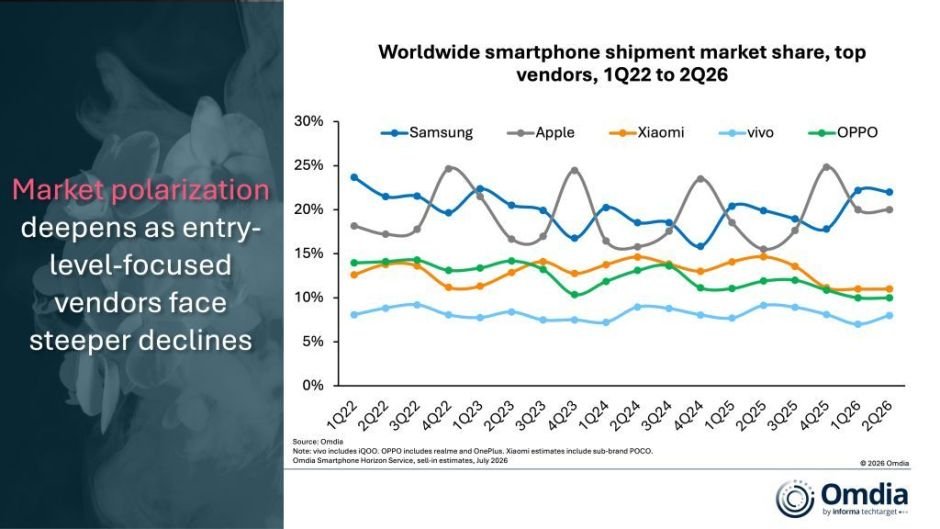
Apple outperformed the global smartphone market in the second quarter of 2026, delivering its strongest-ever second-quarter performance despite an overall industry downturn, according to Omdia report.
Apple shipped 55.1 million iPhones in Q2 2026, representing a 23 percent year-on-year increase, and captured a record 20 percent share of the global smartphone market. The performance was particularly significant because the second quarter is traditionally Apple’s weakest seasonal quarter.
Apple came close to market leader Samsung, which shipped 60.5 million smartphones, up 5 percent, for a 22 percent global market share. This left Apple only 5.4 million units behind Samsung in quarterly shipments and 2 percentage points behind in market share. Meanwhile, global smartphone shipments fell 6 percent year on year to 272 million units, highlighting the scale of Apple’s outperformance.
Apple’s growth was supported by substantially higher channel inventories of the base iPhone 17. Omdia said channel partners increased inventory ahead of anticipated price increases and expectations that the iPhone 18 series will launch at higher price points, helping boost sell-in of the existing iPhone generation.
Pricing has provided Apple with a competitive advantage. The company has largely maintained stable iPhone prices while the broader smartphone industry has faced increases caused by higher memory and other component costs. However, Apple made price adjustments across other product categories toward the end of Q2 2026, increasing the possibility of iPhone price increases later in 2026.
Apple’s performance contrasted with several Chinese rivals. Xiaomi shipped 31.2 million smartphones, down 26 percent, while OPPO, including realme and OnePlus, shipped 28.4 million units, down 17 percent. vivo shipments declined 18 percent to 21.5 million units.
Apple also performed strongly in key individual markets. In mainland China, Apple shipped 12.4 million iPhones in Q2 2026 and captured a record second-quarter market share of 19 percent, ranking second behind Huawei’s 23 percent share. In India, Apple shipped 3.5 million units during Q2 2026 and ranked among the country’s top five smartphone vendors.
The results suggest Apple is benefiting from its premium positioning as the smartphone industry shifts toward protecting margins and average selling prices rather than maximizing unit volumes. With global shipments down 6 percent but Apple shipments up 23 percent, the company gained significant ground during one of the industry’s most challenging quarters of 2026.
BABURAJAN KIZHAKEDATH