
IDC forecasts a significant surge in the automotive semiconductor market by 2027, driven by advancements in autonomous driving, advanced driver assistance systems (ADAS), and enhanced vehicle functionalities.
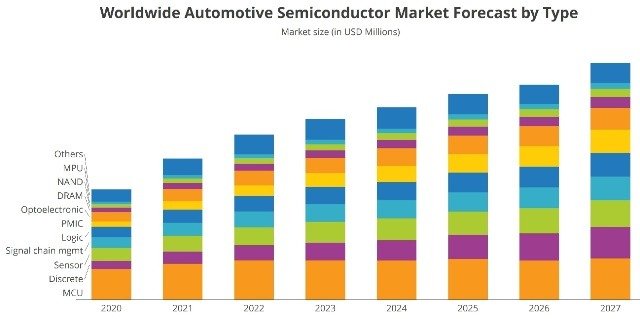
Key segments such as logic chips, memory chips, microprocessors, analog chips, optoelectronic devices, discrete devices, and sensors are expected to generate substantial revenue increases.
Logic Chips: Projected to generate over $8 billion in revenue, the demand for high-performance computing (HPC) chips will rise alongside the development of autonomous driving technologies and ADAS.
Memory Chips: Anticipated to exceed $7 billion in revenue, memory chips will see increased demand due to the rising need for storage capacity in vehicles. As vehicle functionalities expand, memory chips are enhancing their capacities to store larger volumes of source code, map data, media content, and log information. High-speed interface technologies like Peripheral Component Interconnect Express (PCIe) and Universal Flash Storage (UFS) are becoming prevalent to enable real-time data processing and instantaneous feedback.
Microprocessors: Expected to capture over $15 billion in revenue, the sophistication of vehicle functionalities necessitates more powerful microcontroller units (MCUs) and microprocessor units (MPUs) to process large amounts of data and execute complex algorithms. Automotive MCUs and MPUs are incorporating more functionalities, with increasing numbers tailored for specific applications such as battery management systems in electric vehicles or visual processing for autonomous driving.
Analog Chips: Analog chip revenue is set to surpass $17 billion, driven by the integration of additional functions aimed at reducing noise, enhancing accuracy, and improving response times.
Optoelectronic Devices: The market for optoelectronic devices is projected to exceed $8 billion, with developments focused on high performance, precision, integration, and cost-effectiveness.
Discrete Devices: Expected to generate over $11 billion in revenue, discrete devices are evolving to feature enhanced efficiency, higher power density, and miniaturization. The adoption of wide-bandgap semiconductor materials like silicon carbide (SiC) and gallium nitride (GaN) is gaining momentum due to their superior efficiency and high-temperature resistance.
Sensors: Sensor revenue is anticipated to exceed $9 billion, as automotive sensors advance towards greater integration and intelligence, enabling not only data collection but also preliminary data analysis and processing to improve response speed and accuracy.


