
Saudi Arabia’s fixed broadband market is entering a new era of ultra-fast connectivity, driven by Vision 2030 investments, nationwide fiber rollouts, and the rapid expansion of 5G-Advanced infrastructure. The Kingdom’s broadband ecosystem is now valued at approximately $28.74 billion, positioning Saudi Arabia among the most advanced digital infrastructure markets in the Middle East.
For internet customers searching for the best Internet Service Providers (ISPs) in Saudi Arabia, the market in 2026 offers a broad range of high-speed fiber, 5G Fixed Wireless Access (FWA), gaming-optimized broadband, and smart-home connectivity solutions. The competition between major operators is increasingly centered on gigabit performance, low latency, streaming quality, coverage reliability, and bundled digital services.
Best Internet Service Providers in Saudi Arabia
stc Leads the Fiber Broadband Market
stc remains the dominant broadband provider in Saudi Arabia with an estimated subscriber share exceeding 65 percent. Its Baity Fiber platform continues to serve as the benchmark for residential broadband performance across the Kingdom.
The company supports its broadband dominance through a national fiber backbone and more than 22,000 towers. stc’s broadband strategy now extends beyond internet access into digital banking, cloud services, cybersecurity, and smart digital ecosystems under its DARE 2.0 transformation strategy.
For customers seeking premium fiber broadband, stc offers entry-level 100 Mbps fiber plans starting at 287.50 SAR per month including 15 percent VAT. Its premium 1 Gbps package reaches 920 SAR monthly and includes stc tv and MySTC Rewards benefits.
stc is also deploying 5G Standalone (SA) architecture and network slicing capabilities to deliver guaranteed low-latency connectivity for gamers, home offices, and smart-home applications.
Mobily Expands High-Speed Fiber and International Connectivity
Mobily continues to strengthen its position as Saudi Arabia’s second-largest fixed broadband provider by leveraging its 66 percent ownership stake in the Saudi National Fiber Network.
The operator has aggressively expanded its fiber footprint while investing in international subsea cable systems and hyperscale-ready data center infrastructure. Mobily is increasingly positioning Saudi Arabia as a major digital transit corridor connecting Europe, Asia, and the Middle East.
For broadband consumers, Mobily offers 100 Mbps fiber packages starting at 287.50 SAR monthly, while its premium 1 Gbps broadband tier is priced at 920 SAR. The provider differentiates itself through gaming optimizations, premium entertainment bundles, and high-capacity streaming performance for 4K and cloud gaming users.
Zain KSA Focuses on 5G Home Broadband and Gaming
Zain KSA has emerged as the Kingdom’s specialist in 5G Fixed Wireless Access broadband. Instead of relying solely on physical fiber deployment, Zain utilizes 5.5G (5G-Advanced) technology to provide high-speed wireless home internet in regions where fiber installation is difficult.
Its strategy appeals strongly to younger digital consumers by bundling broadband services with premium entertainment and gaming platforms such as GeForce Now, OSN+, and Shahid VIP.
Zain’s entry-level broadband plan starts at 289 SAR monthly, while its premium broadband tier costs 804 SAR per month. The company is also conducting 5.5G trials aimed at delivering wireless broadband speeds of up to 10 Gbps.
For households outside major fiber zones, Zain’s 5G home broadband provides a plug-and-play alternative with average speeds reaching approximately 394.2 Mbps.
Salam Targets Premium Gigabit Broadband Users
Salam has positioned itself as the agile challenger in Saudi Arabia’s broadband market by focusing on high-performance urban connectivity.
The company became one of the first operators in the Kingdom to launch nationwide Fiber-to-the-Room (FTTR) services, enabling gigabit connectivity throughout large homes and villas using internal optical cabling infrastructure.
Salam’s pricing strategy aggressively targets premium broadband customers. While its standard entry-level plans begin around 290 SAR monthly, promotional pricing frequently reduces its 1 Gbps fiber plans to as low as 300 SAR per month to gain market share from larger incumbents.
The provider is particularly attractive for users demanding full-home gigabit Wi-Fi coverage, mesh networking support, and ultra-low latency for gaming and streaming.
GO Telecom Serves Budget Broadband Customers
GO Telecom continues to maintain relevance by targeting value-conscious residential users and small home-office customers.
The operator primarily uses 5G and fiber technologies to offer flexible prepaid broadband contracts that differ from the long-term postpaid commitments commonly required by larger ISPs.
GO Telecom’s strategy appeals to budget-focused consumers seeking affordable broadband alternatives without sacrificing modern internet speeds.
Fiber Broadband Dominates Saudi Arabia
Saudi Arabia’s broadband transformation is increasingly driven by Fiber-to-the-Home (FTTH) deployment.
Fiber broadband now represents approximately 69 percent of the total market, covering more than 3.58 million connected households. Legacy copper infrastructure is being retired rapidly as operators prioritize nationwide gigabit-capable fiber networks.
The market is also experiencing a strong migration toward premium broadband packages. Internet plans exceeding 1 Gbps now account for approximately 45 percent of total fiber broadband revenue, highlighting strong demand for ultra-fast internet services.
Saudi Arabia Internet Speed Rankings in 2026
Saudi Arabia currently ranks 45th globally in fixed broadband performance.
The national median fixed broadband download speed has reached 193.25 Mbps, while median upload speeds stand at 90.02 Mbps.
In major cities including Riyadh and Jeddah, gigabit internet availability is now nearly universal across modern residential developments.
For customers living outside fiber coverage areas, 5G Fixed Wireless Access services deliver average speeds around 394.2 Mbps, creating a practical alternative to traditional wired broadband.
Broadband Trends Shaping Consumer Demand
Saudi Arabia’s internet users are among the world’s most digitally intensive consumers, driving demand for advanced broadband capabilities.
Modern subscribers increasingly require:
Sub-15 millisecond latency for esports and online gaming
Gigabit-speed streaming for 4K and future 8K content
Bundled subscriptions including Netflix, Shahid VIP, and OSN+
Mesh Wi-Fi systems for multi-floor villas
Fiber-to-the-Room coverage for seamless smart-home connectivity
Reliable cloud gaming and remote work performance
This shift is transforming broadband from a basic utility into a full digital lifestyle platform.
Customer Complaints and ISP Challenges
Despite rapid infrastructure modernization, operational challenges continue to affect customer experience across several providers.
stc customers frequently report delays in fiber installation appointments, especially in older urban districts where technician wait times can exceed two weeks. Users also cite difficulties resolving complex home wiring issues through automated customer support systems.
Mobily customers often raise concerns regarding billing disputes after contract termination and limited transparency around promotional pricing expiration dates.
Zain KSA users continue to report occasional 5G signal fluctuations and speed degradation during peak evening usage periods in densely populated areas.
Salam customers praise network performance but note that technical support and hardware replacement services can be slower in regional cities compared with larger national operators.
Saudi Arabia Broadband Market Growth Outlook
Saudi Arabia’s broadband market is expected to expand from approximately $28.74 billion in 2026 to nearly $39.51 billion by 2031.
The Fiber-to-the-Home segment is projected to grow at a compound annual growth rate of 10.8 percent, while the 5G Fixed Wireless Access market is expanding at 16.2 percent annually to support rural and remote connectivity growth.
Overall broadband subscriber growth remains steady at approximately 2.4 percent annually.
Massive cloud infrastructure investments from Google, Microsoft, and AWS are also accelerating Saudi Arabia’s evolution into a regional digital and AI compute hub.
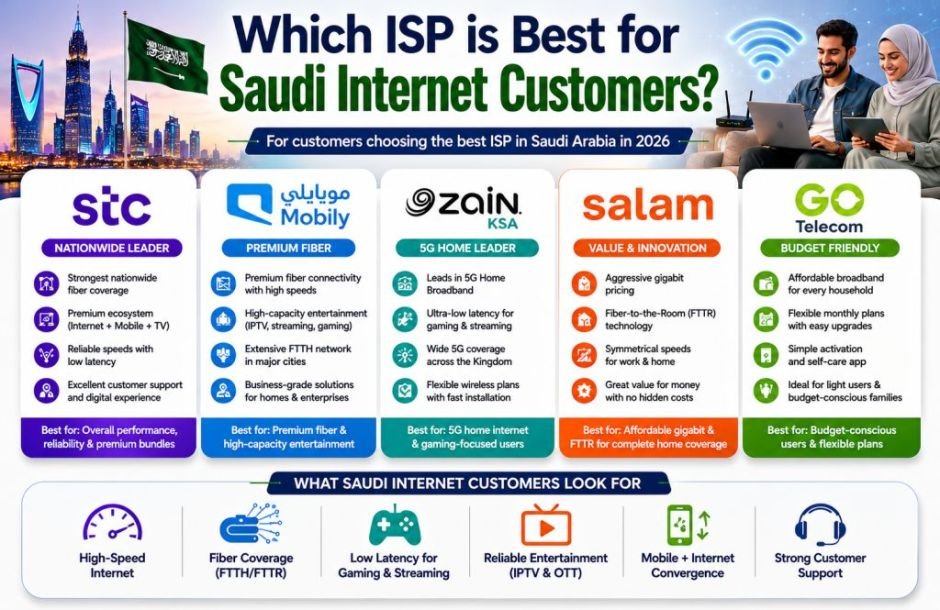
Which ISP is Best for Saudi Internet Customers?
For customers choosing the best ISP in Saudi Arabia in 2026:
stc remains the strongest option for nationwide fiber coverage and premium ecosystem integration.
Mobily is attractive for premium fiber connectivity and high-capacity entertainment services.
Zain KSA leads in 5G home broadband and gaming-focused services.
Salam stands out for aggressive gigabit pricing and Fiber-to-the-Room technology.
GO Telecom appeals to budget-conscious households seeking flexible broadband plans.
Saudi Arabia’s broadband market in 2026 is no longer simply about internet access. The Kingdom is building one of the world’s most advanced gigabit digital societies, where fiber broadband, 5G-Advanced wireless networks, AI-ready infrastructure, and smart-home connectivity are becoming standard expectations for residential internet customers.
FASNA SHABEER