The Philippines fixed communications market is entering a new growth phase, fueled by investments in fiber broadband infrastructure, expanding subscriber bases, improving average revenue per user (ARPU), and increasing demand for high-speed internet services.
According to GlobalData, total fixed communications services revenue in the Philippines is projected to increase from $3.8 billion in 2025 to $4.3 billion in 2030, representing a 2.7 percent CAGR during the forecast period.
The growth in fixed communications services revenue in the Philippines is being led by fixed broadband services, while traditional fixed voice continues to decline as consumers increasingly shift toward mobile and over-the-top (OTT) communication platforms.
PLDT, Globe and Converge Drive Fiber Investments
Telecom operators are significantly increasing investments in fiber-to-the-home (FTTH) networks, capacity expansion, and infrastructure modernization.
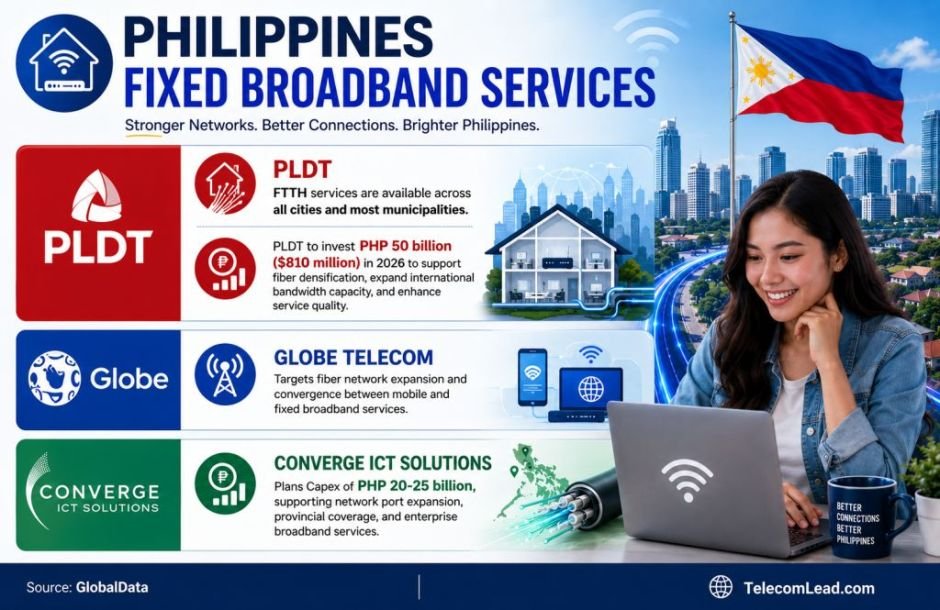
PLDT remains the market leader, with FTTH services available across all cities and most municipalities in 2025. The company plans to invest approximately PHP 50 billion ($810 million) in 2026 to support fiber densification, expand international bandwidth capacity, and enhance service quality.
Globe Telecom is pursuing a more focused investment strategy, emphasizing targeted fiber network expansion and convergence between mobile and fixed broadband services.
Meanwhile, Converge ICT Solutions continues its aggressive fiber-led growth strategy with estimated annual capital expenditure of PHP 20 billion to PHP 25 billion, supporting network port expansion, provincial coverage, and enterprise broadband services.
These investments are expected to push fiber penetration from 85 percent in 2025 to 91 percent by 2030, strengthening broadband availability nationwide.
Broadband Subscriber Base Continues to Expand
Subscriber growth remains a key contributor to market expansion.
PLDT leads with approximately 3.5 million fixed broadband subscribers, supported by continued migration from legacy DSL networks to FTTH services.
Converge ICT Solutions follows with around 2.8 million subscribers, benefiting from strong demand for fiber broadband in residential and provincial markets.
Globe Telecom has approximately 1.8 million fixed broadband subscribers, driven by the rollout of GFiber services and bundled mobile-broadband offerings.
Demand for broadband connectivity continues to rise due to increasing streaming consumption, remote work adoption, online education, cloud-based services, and digital transformation initiatives across enterprises.
ARPU Growth Supports Revenue Expansion
Operators are increasingly focusing on value-based growth strategies to improve profitability.
PLDT generates the highest fixed broadband ARPU in the market at approximately ₱1,485 per month, supported by premium fiber plans, enterprise connectivity services, managed Wi-Fi offerings, and digital service bundles.
Globe Telecom is enhancing ARPU through converged service packages that combine mobile and broadband subscriptions, alongside greater adoption of higher-speed fiber plans.
Converge ICT Solutions maintains a competitive pricing strategy but continues to improve ARPU through premium broadband tiers and upselling of faster connectivity packages.
Industry-wide ARPU growth is increasingly driven by fiber migration, service bundling, premiumization, and digital ecosystem offerings rather than basic internet access alone.
Service Quality Remains a Competitive Priority
Customer experience continues to play a critical role in subscriber retention and revenue stability.
Common customer complaints include installation delays, service interruptions, speed inconsistencies, billing disputes, and customer support responsiveness.
To address these challenges, operators are investing in network automation, predictive maintenance technologies, digital support platforms, and FTTH upgrades.
PLDT is reducing service issues through nationwide fiber deployment and capacity enhancements. Globe is improving customer experience through network modernization and digital service tools, while Converge benefits from its pure-fiber network architecture, which reduces disruptions associated with legacy infrastructure.
Fixed Broadband Becomes the Main Revenue Engine
GlobalData forecasts that fixed broadband revenue will expand at a 4.2 percent CAGR through 2030, outpacing overall market growth and becoming the dominant contributor to fixed communications revenue.
In contrast, fixed voice revenue is expected to decline at a 7.4 percent CAGR as consumers increasingly adopt mobile and OTT communication services.
Revenue growth will be supported by expanding broadband subscriptions, rising ARPU, growing enterprise connectivity requirements, bundled digital services, and increasing fiber penetration.
With the market expected to reach $4.3 billion by 2030, the Philippines is steadily evolving into a fiber-first broadband ecosystem. Investments by PLDT, Globe Telecom, and Converge ICT Solutions are intensifying competition across network infrastructure, subscriber acquisition, service quality, and pricing, positioning fixed broadband as the primary growth engine of the country’s telecom sector over the next five years.
SHAFANA FAZAL