Germany’s fixed broadband market is entering a transformative phase in 2026 as fiber broadband replaces legacy copper networks, creating new opportunities for internet users seeking faster, more reliable connectivity. The country’s fixed broadband sector, valued at approximately $27.75 billion annually, has stabilized at 36.8 million subscriptions, with Fiber-to-the-Home (FTTH) emerging as the main driver of growth and customer migration.
Deutsche Telekom Maintains Broadband Leadership
Deutsche Telekom remains Germany’s largest broadband provider with a 41 percent market share and 15.1 million broadband subscribers. The operator has expanded its fiber footprint to more than 13.37 million optical fiber lines and is accelerating customer migration from DSL to FTTH. Deutsche Telekom expects adjusted EBITDA AL of €47.4 billion in 2026 and is using targeted pricing strategies to encourage fiber adoption, including a €2 monthly increase on legacy DSL plans.
For internet users, Telekom offers the broadest coverage and extensive fiber rollout, though some customers continue to experience delays in final in-home fiber activation due to technician shortages.
Vodafone Focuses on Cable and Fiber Competition
Vodafone Germany holds a 22 percent share of Germany’s broadband market and remains the leading cable internet provider. The company has faced challenges since the 2024 repeal of the Nebenkostenprivileg regulation, which ended bulk cable TV billing in apartment complexes.
Despite these challenges, Vodafone reported a 0.7 percent increase in service revenue in early 2026 as its retail broadband business stabilized. The operator launched a nationwide Upload Booster in January 2026, increasing cable upload speeds to 75 Mbps to better compete with fiber services.
While Vodafone’s GigaCable offerings provide attractive high-speed options, users in densely populated urban areas still report peak-time congestion where actual speeds can fall below 30 percent of advertised gigabit performance.
1&1 Expands Fiber Presence with Value Pricing
1&1 AG commands roughly 11 percent of Germany’s broadband market and continues its transition toward becoming a fully integrated network operator. The company leverages its own fiber backbone through 1&1 Versatel while maintaining aggressive pricing strategies.
A key differentiator is its “Permanent Price” model. The provider offers introductory broadband plans from €9.99 per month for the first 10 months, while its standard 100 Mbps fiber package is priced at €34.99. The company remains attractive for cost-conscious consumers seeking predictable pricing and bundled hardware offers.
However, some customers report dissatisfaction with significant price increases after promotional periods and limited English-language technical support.
O2 Strengthens Broadband Growth Through Converged Services
Telefonica Deutschland controls approximately 7 percent of the broadband market through a wholesale-driven strategy. By utilizing infrastructure from Deutsche Telekom and regional fiber providers, O2 delivers nationwide fiber and VDSL services without extensive network ownership.
The company’s strongest growth driver is Fixed-Mobile Convergence (FMC), offering discounts to customers who combine mobile and home broadband services. Flexible no-contract broadband plans have also proven popular among remote workers and mobile professionals.
Customer concerns primarily center on installation delays and repair coordination issues involving third-party infrastructure providers.
Regional Fiber Providers Gain Market Share
Regional alternative network providers collectively account for 19 percent of Germany’s broadband market and are becoming increasingly important to national fiber expansion efforts. Companies such as Deutsche Glasfaser, M-net, EWE and NetCologne continue to expand fiber coverage across underserved regions.
Deutsche Glasfaser achieved a leading Speed Score of 218.53, highlighting the performance advantage many regional fiber specialists offer compared with national providers. Supported by billions of euros in federal and state funding under Germany’s Gigabit Strategy, these operators are playing a critical role in connecting rural communities.
Fiber Becomes Germany’s New Broadband Standard
Germany’s broadband performance improved significantly in 2026. Average national download speeds reached 118 Mbps, while fiber connections delivered median download speeds of 234 Mbps. Gigabit broadband packages are increasingly becoming the standard residential offering.
Legacy copper infrastructure remains constrained, with median speeds of only 61 Mbps. The Bundesnetzagentur has established that copper networks can be retired once fiber coverage reaches 80 percent in a given area, accelerating the nationwide transition toward full-fiber connectivity.
ISPs have responded by adopting a 24-month migration strategy, ending DSL marketing activities two years before planned copper switch-offs.
Investment Reaches Record Levels
Broadband investment activity has reached an execution peak in 2026. Deutsche Telekom continues expanding fiber coverage with a target of passing 2.5 million additional homes annually.
Industry-backed initiatives such as OXG and GlasfaserPlus are investing billions of euros to accelerate fiber deployment beyond commercially attractive urban areas. Government support remains substantial, with the Gigabitförderung 2.0 program receiving more than €3.6 billion in funding to reduce the rural digital divide.
What Internet Customers Want in 2026
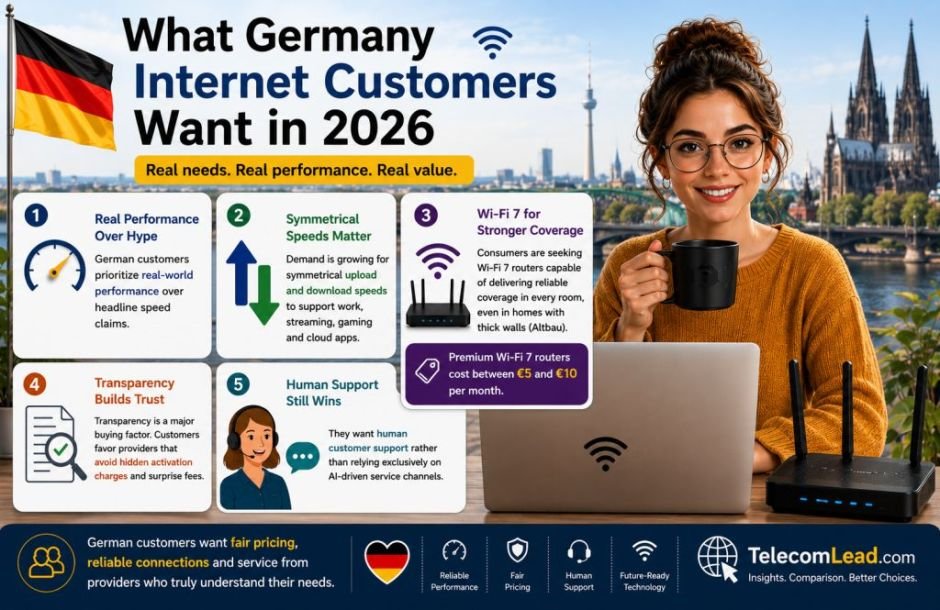
German broadband users increasingly prioritize real-world performance over headline speed claims. Demand is growing for symmetrical upload and download speeds to support hybrid work, cloud computing, online gaming and content creation.
Consumers are also seeking Wi-Fi 7 routers capable of delivering reliable coverage in traditional German buildings with thick masonry walls. Hardware monetization has become common, with premium Wi-Fi 7 routers typically costing between €5 and €10 per month.
Transparency has become another major buying factor, with customers favoring providers that avoid hidden activation charges and offer accessible human customer support rather than relying exclusively on AI-driven service channels.
Germany Broadband Market Outlook
Germany’s broadband market is approaching 94 percent household penetration, meaning future growth will be driven primarily by technology upgrades rather than new subscriber additions. The fiber segment is expanding at a compound annual growth rate of 13.5 percent and has become the largest revenue-generating broadband category.
As DSL subscriptions decline by 1.4 percent annually and fiber deployments accelerate, Germany is moving toward a high-capacity, fiber-centric broadband ecosystem capable of supporting increasingly data-intensive consumer and business applications. For internet users searching for the best ISP, fiber availability, upload performance, reliability and customer service quality are becoming more important than simple download speed comparisons.
FASNA SHABEER