The smartphone replacement cycle is approaching four years in 2026, creating a new challenge for telecom operators that have traditionally used handset upgrades to strengthen customer relationships, drive 5G adoption and support premium mobile plans.
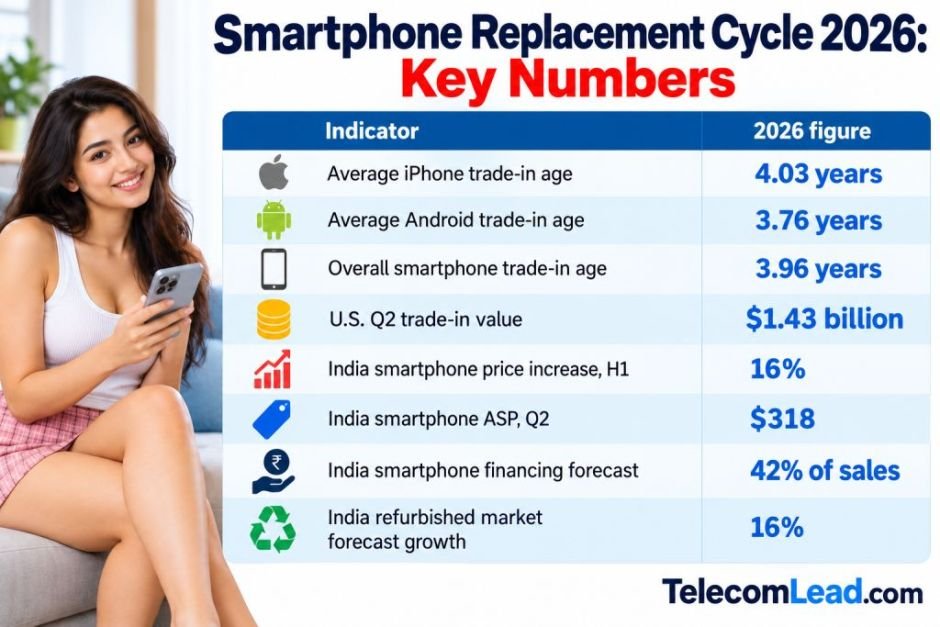
The average age of iPhones traded in reached 4.03 years in Q2 2026, crossing four years for the first time, according to Assurant. Android smartphones averaged 3.76 years, while the overall smartphone average reached 3.96 years.
Consumers are not abandoning upgrades altogether. Trade-in programs returned $1.43 billion to U.S. consumers during Q2 2026, up 7 percent year over year. Instead, customers are keeping devices longer before using their residual value to reduce the cost of a replacement.
For telecom operators, the shift is changing device economics. AT&T and Verizon are using large trade-in incentives, Deutsche Telekom is lowering monthly handset payments, while Airtel and Jio are connecting newer smartphones with 5G capabilities, financing and customer acquisition.
Higher Smartphone Prices Are Extending the Upgrade Cycle
Affordability is becoming one of the biggest factors behind longer smartphone ownership.
Smartphone prices in India increased an average 16 percent in H1 2026, while average selling price reached a record $318 in Q2 2026, according to Counterpoint Research’s analysis of smartphone price increases.
Higher DRAM and NAND costs contributed to the increase as AI data centers absorbed growing memory supply. India’s smartphone shipments consequently declined 10 percent year over year during Q2 2026, with affordability pressures delaying replacement purchases.
The economic calculation for consumers is straightforward. If an existing smartphone remains functional for another year, an incremental camera, processor or display improvement may not justify paying substantially more for a new device.
This creates a difficult equation for telecom operators. They need customers using newer devices to take advantage of advanced 5G capabilities, but higher smartphone prices give consumers an incentive to keep older devices.
AT&T and Verizon Use Trade-Ins to Trigger Upgrades
Large U.S. operators are addressing the problem by reducing the effective price customers pay for premium smartphones.
AT&T’s September 2026 iPhone 18 promotion offered new and existing customers up to $1,200 off an iPhone 18 Pro with an eligible iPhone trade-in, including devices in any condition.
Customers switching to AT&T could also receive up to $800 toward paying off their existing device.
The strategy turns an older smartphone into an asset that helps finance the next purchase. At the same time, long-term bill credits can strengthen the customer’s relationship with the operator.
Verizon is following a similar model. Its September Motorola promotion offered customers on selected myPlan options up to $1,100 off selected Motorola smartphones with eligible trade-ins, with discounts delivered through 36 months of bill credits.
Verizon also offered the Motorola razr fold for $25 per month through a 48-month device payment plan.
The important shift is from handset price to monthly affordability. A $1,000-plus smartphone becomes easier to sell when its cost is distributed across three or four years.
That model also mirrors the smartphone’s actual useful life.
Financing Is Replacing the Traditional Upgrade Cycle
The same transition is becoming visible in India.
Average smartphone financing tenure in India’s mainline channel reached 10 months in Q2 2026. Financing penetration in Tier 2 markets reached 57.5 percent, while Tier 3 and smaller markets remained above 50 percent.
Apple customers had the longest average financing tenure at 17.2 months.
Counterpoint expects financing to account for 42 percent of smartphone sales in India during 2026, with some financing programs extending as long as 30 months.
This changes how consumers evaluate expensive smartphones.
Rather than asking whether they can afford the complete handset price, customers compare the monthly installment with their available disposable income.
For operators and smartphone manufacturers, financing therefore becomes another mechanism for shortening a replacement cycle that would otherwise continue to expand.
Deutsche Telekom Cuts Monthly Smartphone Payments
Deutsche Telekom is using residual-value financing to attack the affordability problem from another direction.
Its September 2026 Telekom Rückgabedeal assigns a future residual value to the smartphone and deducts that amount from the installments paid during the financing period.
For example, a €1,179 smartphone with a €99 down payment would normally cost €45 per month over 24 months.
Under the Rückgabedeal, €312 is treated as the final payment, reducing monthly installments to €32 — a saving of €13 per month.
Customers can subsequently keep the smartphone by paying the final amount or return the device in eligible condition.
Returned devices can then be refurbished and brought back into circulation.
The model connects three important parts of the smartphone business: financing, trade-ins and refurbishment.
Airtel Uses 5G as a Smartphone Upgrade Trigger
Price incentives are not the only way operators can encourage smartphone replacement.
Network technology itself can create an upgrade trigger.
Bharti Airtel’s Priority Postpaid service uses 5G network slicing to provide enhanced service quality. Plans range from ₹449 plus GST for an individual customer to ₹1,749 plus GST for a family of five.
The important device consideration is compatibility.
Airtel says Priority Postpaid using 5G network slicing requires a 5G SA-enabled smartphone with appropriate software.
As operators introduce differentiated 5G services, customers using older smartphones may therefore have another reason to upgrade.
This could become important as operators move beyond marketing 5G primarily around faster download speeds and begin introducing services requiring specific device and network capabilities.
Jio Connects Smartphone Affordability with Customer Acquisition
Reliance Jio is approaching the device affordability challenge through handset support and financing.
The JioExclusive program provides instant price support on selected smartphones, financing eligibility through partners and additional offers.
Importantly, the program is not restricted to existing Jio customers. Non-Jio users can obtain the benefits by activating a Jio SIM or porting their existing number to Jio.
That turns device affordability into a customer-acquisition tool.
The strategies of Airtel and Jio illustrate the particular challenge facing Indian operators: encourage migration toward newer 5G smartphones without creating an affordability barrier in a predominantly prepaid market.
Refurbished Smartphones Become a Second Growth Market
Longer smartphone lifecycles are also creating opportunities beyond new-device sales.
India’s refurbished smartphone volumes increased 13 percent year over year in H1 2026, even as new smartphone volumes declined around 11 percent.
Samsung led the refurbished market with 30 percent share, followed by Apple at 23 percent.
Counterpoint expects India’s refurbished smartphone market to grow 16 percent during 2026.
The figures reveal an important consequence of longer smartphone lifecycles: a four-year-old premium smartphone does not necessarily disappear when its original owner upgrades.
Trade-in programs can move these devices into refurbishment channels, where they become lower-cost smartphones for another customer.
Vodafone is also developing this circular model through trade-ins, repairs, refurbishment and second-life devices. The operator said it reached its target of collecting 1 million used mobile phones for reuse, recycling or donation through its WWF partnership.
What Longer Replacement Cycles Mean for Telecom Operators
The four-year smartphone creates several strategic challenges for mobile operators.
Fewer upgrade opportunities: If customers replace smartphones less frequently, operators have fewer opportunities to renew device financing relationships and engage subscribers around handset upgrades.
Slower migration to advanced 5G devices: Older smartphones can restrict access to newer capabilities, including services dependent on 5G Standalone networks or specific handset features.
Greater importance of financing: Longer installment periods can reduce monthly handset costs and make premium devices more accessible.
Trade-ins become retention tools: The residual value of an older smartphone can subsidize a new handset while keeping the customer within the operator relationship.
Refurbishment creates a second device lifecycle: Returned premium smartphones can be resold to more price-sensitive customers instead of leaving the mobile ecosystem.
The device business is consequently becoming closely connected with customer acquisition, retention and lifetime value.
The Four-Year Smartphone Is Changing Telecom Economics
Consumers holding smartphones for around four years does not mean the upgrade market is disappearing. It means the economics of upgrading are changing.
Higher device prices encourage consumers to retain smartphones longer. Operators are responding by making the eventual replacement easier through trade-ins, longer financing periods, residual-value models and device promotions.
At the same time, 5G provides operators with another potential upgrade trigger. As advanced services require newer device capabilities, network features can give customers a practical reason to replace otherwise functional smartphones.
The refurbished market completes the cycle by giving traded-in devices a second economic life.
For AT&T, Verizon, Deutsche Telekom, Airtel, Jio and other operators, the challenge is therefore shifting from selling smartphones more frequently to extracting greater customer value across a longer device lifecycle.
The emerging telecom device model can be summarized as:
Higher smartphone prices → Longer ownership → Trade-in → Financing → 5G upgrade → Customer retention → Refurbishment.
The operators that successfully connect these stages can continue to generate customer value even as the traditional two- or three-year smartphone replacement cycle gives way to an era of the four-year smartphone.
FASNA SHABEER