The economics of mobile subscribers are changing as telecom markets mature. Telecom operators are measuring success by revenue per customer, churn, data consumption, acquisition costs and customer lifetime value.
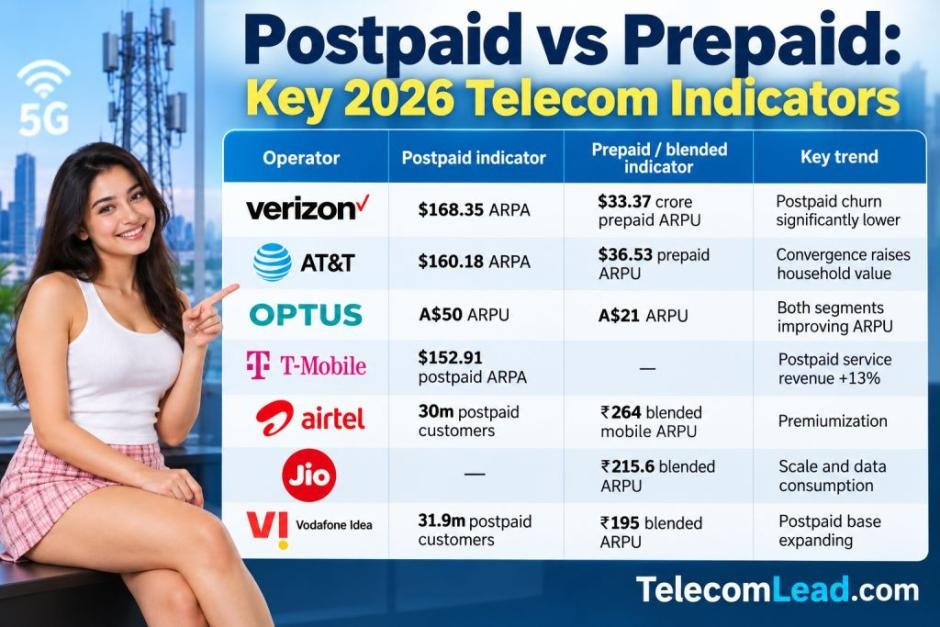
Results from Verizon, AT&T and Optus show a substantial monetization advantage for postpaid customers. Verizon reported postpaid ARPA of $168.35 against prepaid ARPU of $33.37, while AT&T reported postpaid ARPA of $160.18 compared with prepaid ARPU of $36.53.
However, ARPA and ARPU are not directly comparable: ARPA measures revenue per account, which can include multiple connections, while ARPU measures revenue per user. The figures nevertheless illustrate the much larger revenue relationships operators can build around postpaid accounts.
India presents a different model. Reliance Jio, Bharti Airtel and Vodafone Idea operate in a market dominated by prepaid connections, making higher tariffs, 4G/5G migration and rising data consumption critical to improving customer economics.
Verizon Shows the Revenue and Churn Advantage of Postpaid
Verizon’s Q2 2026 results provide one of the clearest examples of the different economics associated with postpaid and prepaid customers.
Wireless retail postpaid ARPA reached $168.35, compared with $33.37 for core prepaid ARPU.
More importantly, Verizon’s postpaid phone churn was only 0.92 percent, compared with 3.59 percent for core prepaid.
Verizon had 126.62 million retail postpaid connections and 19.35 million core prepaid connections at June 30, 2026. The operator added 184,000 postpaid phone connections and 73,000 core prepaid connections during the quarter.
The churn difference is particularly important. Higher revenue combined with longer customer retention can substantially increase the lifetime economics of a postpaid relationship.
Verizon has also been reducing customer acquisition and retention costs, making the combination of revenue, churn and cost important to profitability.
AT&T Uses Mobile and Broadband Convergence to Increase Customer Value
AT&T reported a similar revenue pattern.
Consumer postpaid wireless ARPA reached $160.18 in Q2 2026, compared with $36.53 for prepaid wireless ARPU.
The company had 75.23 million consumer postpaid wireless subscribers and 16.52 million prepaid subscribers. AT&T added 432,000 postpaid phone customers during the quarter while maintaining postpaid phone churn at just 0.86 percent.
But AT&T’s strategy illustrates why operators are looking beyond mobile ARPU.
About 42.5 percent of Advanced Home Internet customers also had an AT&T postpaid wireless account during Q2.
The AT&T Q2 2026 earnings highlight an important telecom strategy: combining mobile and broadband services to increase the value and durability of the household relationship.
A customer buying mobile, broadband and potentially additional services can be economically more valuable than measuring each connection independently suggests.
Why Churn Matters Almost as Much as ARPU
ARPU attracts considerable attention in telecom earnings, but churn can have an equally important impact on customer economics.
Verizon’s 0.92 percent postpaid phone churn versus 3.59 percent core prepaid churn provides the clearest example.
AT&T reported postpaid phone churn of 0.86 percent, while T-Mobile’s postpaid account churn improved to 0.99 percent from 1.04 percent in the previous quarter.
T-Mobile’s postpaid ARPA reached $152.91, up 2 percent year over year. The operator added 277,000 postpaid accounts, while postpaid service revenue increased 13 percent to $15.9 billion.
Lower churn extends customer relationships and allows operators to generate revenue from premium plans, additional connections, devices and other services over a longer period.
This explains why the economics of a subscriber need to be assessed through customer lifetime value rather than ARPU alone.
Optus Shows Prepaid ARPU Can Also Grow
The postpaid advantage does not mean prepaid monetization is stagnant.
Optus reported branded postpaid ARPU of A$50, up 3.4 percent, while prepaid ARPU increased a stronger 7.7 percent to A$21.
The operator had 5.769 million postpaid customers and 3.853 million prepaid customers. Blended mobile ARPU increased 3.4 percent to A$34 as data usage rose 16.5 percent.
Postpaid therefore continued to generate considerably higher revenue per user, but the prepaid business demonstrated that operators can increase customer value without necessarily migrating every subscriber to a contract.
Deutsche Telekom Shows Why Subscriber Numbers Can Mislead
Deutsche Telekom’s German operation demonstrates another reason subscriber totals should not be viewed in isolation.
Germany had 76.73 million mobile customers, including 28.15 million contract customers and 48.59 million prepaid customers, including M2M connections.
Prepaid customers increased 10.2 percent year over year compared with 4.1 percent growth in contract customers. However, much of the prepaid increase came from M2M SIM cards used by the automotive industry.
At the same time, Deutsche Telekom added approximately 419,000 high-value mobile contract customers compared with year-end 2025, supported by demand for plans offering larger data allowances.
The numbers illustrate why subscriber growth needs to be examined alongside customer type, ARPU and usage.
India Changes the Postpaid vs Prepaid Equation
India provides perhaps the strongest counterargument to the idea that postpaid is always the superior telecom business model.
Airtel, Jio and Vodafone Idea operate with enormous prepaid customer bases. Their challenge is therefore not simply converting prepaid subscribers to postpaid but increasing the economic value of prepaid users.
Bharti Airtel’s mobile ARPU reached ₹264 in Q1 FY27, compared with ₹250 a year earlier. Its mobile customer base reached approximately 376.5 million, including 30 million postpaid customers.
Monthly data consumption reached 34.4 GB per customer.
Airtel’s strategy combines expansion of its postpaid base with monetization of hundreds of millions of prepaid customers through tariff increases, premium plans and higher 4G/5G consumption.
Vodafone Idea is following a similar direction. Customer ARPU increased 10.2 percent to ₹195, while its postpaid subscriber base expanded from 26.6 million to 31.9 million.
Its 4G/5G customer base reached 130.1 million, while blended churn improved from 4.4 percent to 3.8 percent.
Jio Shows How Prepaid Scale Can Produce Strong Economics
Reliance Jio demonstrates why prepaid cannot automatically be equated with weak customer economics.
Jio reached 533.3 million connectivity customers at the end of June 2026. ARPU increased to ₹215.6, while monthly data consumption reached an extraordinary 43.7 GB per customer.
Quarterly data traffic reached 69.4 exabytes, and Jio had approximately 285 million 5G users.
The connectivity business generated ₹34,212 crore in operating revenue and ₹19,590 crore in EBITDA, producing an EBITDA margin of 57.3 percent.
These figures change the postpaid-versus-prepaid discussion.
Jio demonstrates that a prepaid-heavy operator can create attractive economics through enormous scale, high network utilization, rising tariffs, increasing data consumption and migration toward 5G.
The objective does not necessarily have to be converting hundreds of millions of prepaid customers into postpaid subscribers. Increasing revenue and reducing the cost of serving each customer can also improve economics significantly.
How Telecom Operators Are Increasing Customer Lifetime Value
The 2026 results reveal several common strategies.
Premiumization: Operators are encouraging customers to move toward higher-value plans with larger data allowances and additional services.
Lower churn: Verizon, AT&T and T-Mobile demonstrate the financial importance of retaining high-value postpaid customers.
5G migration: Airtel, Jio and Vodafone Idea are using growing 4G/5G adoption and data consumption to improve monetization in prepaid-heavy markets.
Fixed-mobile convergence: AT&T illustrates how combining broadband and wireless services can deepen the household relationship and improve retention.
Devices and digital services: Postpaid accounts provide operators with opportunities to attach smartphones, financing, family plans and additional digital products to the customer relationship.
These strategies mean that telecom operators are gradually moving from SIM economics toward household and customer-lifetime economics.
Postpaid vs Prepaid: Where Do Telecom Operators Make More Money?
The 2026 numbers point to a nuanced answer.
Postpaid customers generally provide higher revenue and lower churn, particularly in mature telecom markets. Verizon, AT&T and Optus demonstrate the monetization advantage clearly.
But prepaid remains enormously valuable because of its scale, accessibility and flexibility.
India demonstrates the alternative model. Jio’s 533.3 million connectivity customers, ₹215.6 ARPU and 43.7 GB monthly data consumption show that a prepaid-heavy operator can generate substantial revenue and network utilization without relying primarily on postpaid conversion.
The most important telecom performance indicators are therefore no longer simply subscriber additions or even ARPU.
Operators need to optimize ARPU/ARPA, churn, acquisition and retention costs, data consumption, convergence and customer lifetime value.
The winning model is not necessarily postpaid or prepaid. It is the model that generates the highest lifetime value from each customer relationship while keeping acquisition, retention and network costs under control.
FASNA SHABEER