The global wrist-worn wearables market is entering a new phase as slowing shipments push Huawei, Xiaomi, Apple, Garmin and other vendors to look beyond conventional smartwatch upgrades.
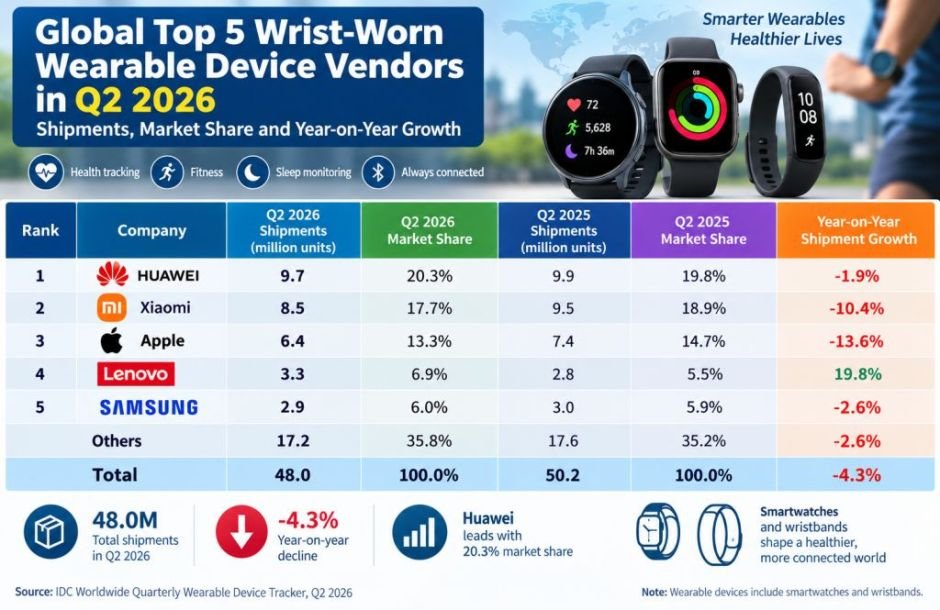
Worldwide wrist-worn device shipments reached 48.01 million units in Q2 2026, down 4.3 percent year over year, according to IDC. Smartwatch shipments fell 4.2 percent to 37.08 million units, while wristband shipments declined 4.7 percent to 10.92 million units.
IDC report on wearables market indicates that future growth will increasingly depend on on-device AI, health intelligence, specialised sports capabilities and screenless wearables, rather than simply expanding hardware volumes.
Two strategies are emerging. Smartwatch makers are attempting to increase product value through AI and health features, while companies such as WHOOP are targeting new users with screenless devices and subscription-based health services.
On-Device AI Could Drive Smartwatch Upgrades
Smartwatch intelligence has traditionally depended heavily on smartphones or cloud processing. That is beginning to change as wearable chips gain dedicated AI capabilities.
Qualcomm introduced its Snapdragon Wear Elite platform in March 2026, its first wearable platform with an integrated NPU.
Snapdragon Wear Elite delivers up to 12 TOPS of AI performance, supports models containing up to 2 billion parameters and uses a 3nm architecture. Qualcomm says single-core CPU performance can improve by up to 5x, GPU performance by up to 7x, while battery life can rise by up to 30 percent compared with the previous generation.
The platform supports more than 50 sensors along with 5G RedCap, Bluetooth 6.0, UWB, Wi-Fi, GNSS and NB-NTN connectivity.
More powerful local processing could enable smartwatches to analyse heart rate, sleep, activity and other sensor information without constantly relying on smartphones or cloud infrastructure.
Potential applications include personalised fitness coaching, contextual health recommendations, activity recognition and voice-driven AI assistance.
The bigger question is whether those capabilities are valuable enough to persuade existing smartwatch owners to upgrade. Features that merely reproduce smartphone AI are unlikely to create a major replacement cycle. Continuous health interpretation and personalised assistance could provide a stronger reason to buy.
Huawei Leads With Broad Wearables Portfolio
Huawei remained the world’s leading wrist-worn wearable vendor by shipments in Q2 2026, according to IDC.
The company is expanding across multiple segments rather than relying on one flagship watch.
The HUAWEI WATCH FIT 5 series targets consumers looking for lightweight fitness and health functions, while the WATCH Ultimate portfolio addresses premium buyers. Children’s products such as the X1 and X1 Pro broaden Huawei’s reach into family-oriented wearables.
This gives Huawei exposure to mainstream fitness users, premium customers, sports enthusiasts and children’s smartwatch buyers — an important advantage as overall market growth weakens.
Huawei’s strategy also reflects the increasing importance of health tracking and ecosystem integration in differentiating smartwatches from inexpensive fitness bands.
Apple Uses Health, AI and Promotions to Sustain Demand
Apple is pushing Apple Watch further toward health intelligence while also relying on promotions to support mature markets.
Apple expanded sleep apnoea notifications for Apple Watch users in India in May 2026, adding another clinically oriented capability to its wearable platform.
The upcoming watchOS 27 also expands AI-assisted functions, including personalised Workout Buddy insights based on metrics such as pace, distance and workout duration.
IDC said Apple Watch benefited from wider promotions in Q2 2026. China’s 618 shopping festival supported demand, while retail and channel promotions contributed to growth in Japan and Latin America.
The reliance on promotions highlights a broader challenge for premium smartwatch vendors: mature users increasingly need either lower prices or significantly better functionality before replacing existing devices.
Xiaomi Moves Up From Low-Cost Fitness Bands
Xiaomi is attempting to turn its large base of affordable wearable customers into buyers of higher-value smartwatches.
IDC highlighted the Xiaomi Band 10 Pro, while Redmi Watch products continued addressing the mass market. The Xiaomi Watch S5 series expanded Xiaomi’s presence at higher price points, with more advanced smartwatches strengthening its premium portfolio.
This strategy is important because increasing average selling prices can support revenue even when overall unit shipments remain under pressure.
Xiaomi’s smartphone and IoT ecosystem also creates opportunities to connect wearables with phones, earbuds, smart-home devices and future AI services.
Garmin Targets Sports and Premium Fitness Users
Garmin continues to focus on running, outdoor activities and specialised fitness rather than competing mainly on general-purpose smartwatch functions.
The company launched the Forerunner 70 and Forerunner 170 in May 2026. Both feature 1.2-inch AMOLED displays and health and training capabilities.
The Forerunner 170 offers up to 10 days of smartwatch battery life, while the Forerunner 170 Music supports downloadable music.
US pricing is $249.99 for Forerunner 70, $299.99 for Forerunner 170 and $349.99 for Forerunner 170 Music.
Garmin’s positioning shows that specialised users may represent a more resilient market than general smartwatch buyers because runners and athletes can place greater value on training analytics, recovery data and long battery life.
BBK Expands Children’s Smartwatches
BBK remains strong in children’s smartwatches, particularly in China.
Products including the Z12 and Z9A strengthened its mid-range and premium children’s portfolio during Q2 2026.
BBK is also expanding internationally through the imoo brand, particularly in Southeast Asia and Europe.
Children’s smartwatches operate differently from conventional wearables because parents are frequently the buyer. Location tracking, communications, safety and parental controls may therefore matter more than fitness applications.
This gives BBK access to a relatively distinct growth segment even as the mainstream smartwatch replacement cycle slows.
WHOOP Shows Potential of Screenless Wearables
The second major change in wearables is the growth of devices without conventional displays.
Screenless wearables appeal to users who want continuous health and fitness monitoring without notifications or another screen demanding attention.
WHOOP has become one of the most prominent examples.
Its portfolio includes WHOOP 5.0 and WHOOP MG, with battery life of up to 14 days and a design 7 percent smaller than the previous generation. WHOOP MG adds ECG capabilities, while its software focuses on sleep, strain, recovery and long-term health analytics.
WHOOP also uses a fundamentally different business model from most smartwatch vendors.
Its US subscriptions currently include WHOOP One at $199 a year, WHOOP Peak at $239 and WHOOP Life at $359.
Rather than depending primarily on replacing hardware every few years, WHOOP attempts to generate recurring revenue through analytics, coaching and health services.
Can Screenless Bands Become Mainstream?
Screenless bands and smart rings offer several advantages: lower distraction, lighter designs, continuous monitoring and potentially longer battery life.
But they are unlikely to replace inexpensive fitness bands quickly.
Without a screen, most of the value comes from software, algorithms and health insights. Vendors must turn heart rate, sleep, movement and recovery data into recommendations useful enough to justify the hardware price or recurring subscription.
That requires continued investment in AI, cloud infrastructure, health research and data analytics.
Subscription models may therefore work best for companies with strong software and health-service capabilities, rather than traditional hardware vendors focused mainly on device volumes.
AI and Screenless Devices Define Two Growth Paths
The wearables industry is effectively pursuing two growth strategies.
On-device AI is a value-expansion strategy. Vendors hope smarter health analysis and personalised assistance will convince consumers to pay more or replace watches sooner.
Screenless wearables are a user-expansion strategy. They target consumers who want continuous health monitoring but dislike smartwatch screens, notifications or frequent charging.
These categories may also coexist. Consumers could use a smartwatch for communication and interaction while relying on a screenless band or smart ring for continuous health monitoring.
What the 4.3% Decline Means for Vendors
The 48.01 million wrist-worn devices shipped in Q2 2026 show that wearables remain a large technology market, but the 4.3 percent decline indicates that traditional growth drivers — first-time buyers, replacement cycles and falling prices — are weakening.
The next competitive battle will increasingly centre on AI, health data, specialised applications and recurring services.
Huawei is relying on portfolio breadth and health capabilities. Xiaomi is moving upmarket. Apple is combining health and AI while using promotions to stimulate replacement demand. Garmin is targeting specialist sports users. BBK is expanding children’s watches, while WHOOP demonstrates the potential of screenless subscription wearables.
Qualcomm’s new AI-focused wearable silicon could accelerate these changes.
The key question is no longer how many sensors vendors can add to a watch. It is whether they can convert those sensors, processors and continuous streams of health data into insights valuable enough for consumers to pay for — and potentially upgrade sooner.
BABURAJAN KIZHAKEDATH