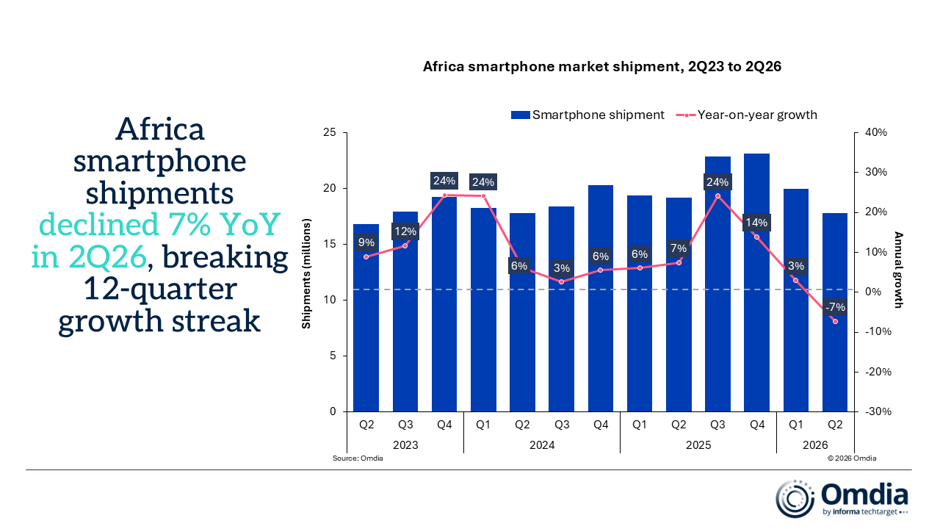
Africa’s smartphone market is heading for its first annual contraction in three years as higher device prices, rising component costs and affordability challenges reshape demand. Omdia expects African smartphone shipments to decline 26 percent in 2026, following a 7 percent year-over-year drop in 2Q26.
The drop in Africa’s smartphone business marks a significant change for a market that had recorded sustained growth, driven largely by affordable smartphones. Rising memory costs are now making ultra-low-cost devices harder to manufacture profitably, while consumers are increasingly stretching their budgets toward higher-priced smartphones with better specifications and longer replacement cycles, Omdia report said.
Africa Smartphone Shipments Fall to 17.8 Million
African smartphone shipments declined 7 percent to 17.8 million units in 2Q26, compared with 19.2 million units in 2Q25, ending a 12-quarter growth streak.
The market had reached a peak of more than 23 million units in 4Q25. Year-over-year shipment growth had hit 24 percent in 4Q23, 1Q24 and 3Q25, before slowing sharply to 3 percent in 1Q26 and turning negative in 2Q26.
The slowdown in Africa’s smartphone market indicates that the combination of higher production costs and weaker consumer purchasing power is having an impact on smartphone replacement and upgrade demand, Manish Pravinkumar, Principal Analyst at Omdia, said.
Sub-$100 Smartphone Shipments Plunge 34%
The biggest pressure is concentrated at the bottom of the market. Shipments of smartphones priced below $100 dropped 34 percent in 2Q26, representing a decline of nearly 3 million units.
The sub-$100 segment’s share of African smartphone shipments fell from 45 percent in 3Q25 to 30 percent in 2Q26. In contrast, devices priced between $100 and $199 accounted for 41 percent of shipments, while the $200-$299 segment represented 15 percent.
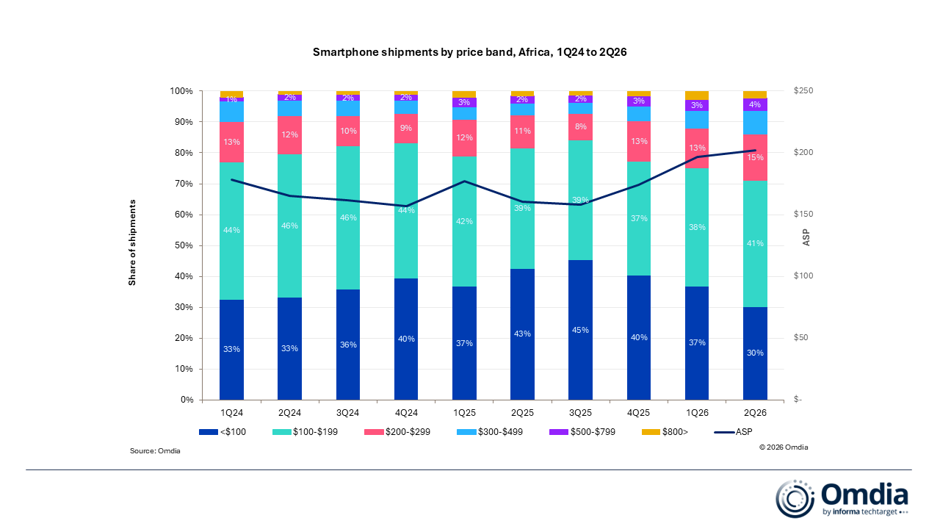
Africa’s smartphone average selling price increased by $41 year over year to $202 in 2Q26, reversing the price reductions recorded in 2Q25.
Omdia says smartphone manufacturers can no longer profitably produce $75 smartphones, forcing vendors and consumers into higher price tiers.
One of the biggest challenges is memory. Memory components account for nearly 60 percent of the bill of materials for smartphones priced below $400 and more than 64 percent for devices below $99. That cost structure significantly limits vendors’ ability to offset weaker demand through aggressive price reductions.
South Africa Grows 17% as Nigeria, Egypt and Kenya Contract
Performance varied substantially across Africa’s major smartphone markets.
South Africa grew 17 percent year over year, supported by stronger consumer purchasing power and the transition toward 5G smartphones.
Nigeria’s smartphone market declined 11 percent, as higher prices encouraged consumers to postpone purchases.
Egypt recorded a much steeper 26 percent contraction after smartphone manufacturers introduced mid-quarter price increases. Local production input costs in Egypt have risen 50 percent since January, putting additional pressure on device pricing.
Kenya’s smartphone shipments fell 15 percent, with weakness particularly evident in the highly price-sensitive sub-$150 segment.
TRANSSION Leads With 47% Share Despite 14% Shipment Drop
TRANSSION, which owns TECNO, Infinix and iTel, remained Africa’s largest smartphone vendor in 2Q26. The company shipped 8.3 million smartphones, giving it a 47 percent market share, despite shipments declining 14 percent year over year.
Samsung strengthened its position as the second-largest vendor. Samsung smartphone shipments increased 15 percent to 3.9 million units, expanding its market share to 22 percent. Its performance was supported by inventory buffers for the Galaxy A07 and Galaxy A17.
Xiaomi shipments dropped 30 percent to 1.9 million units, while OPPO shipments declined 25 percent to 0.9 million units as both companies placed greater emphasis on profitability and disciplined participation in entry-level segments.
HONOR was one of the stronger performers, growing 13 percent to 0.9 million units and capturing a 5 percent market share.
Other smartphone brands collectively increased shipments 34 percent to 1.8 million units.
Samsung Uses Promotions to Protect Smartphone Demand
Samsung is using aggressive promotions in South Africa to improve affordability while maintaining its presence across multiple price segments.
During its Blue Tag Sale, Samsung reduced the Galaxy A26 price to R4,499 from R4,999, while the Galaxy A17 dropped to R3,499 from R3,999. The Galaxy A07 was reduced to R2,199 from R2,499, and the Galaxy A06 fell to R1,599 from R1,999.
The Galaxy S25 FE received a much larger reduction, falling to R9,999 from R13,999, with promotional savings reaching up to 40 percent.
At the premium end, Samsung launched the Galaxy S26 series at R20,999 for the Galaxy S26, R25,999 for the Galaxy S26+ and R30,999 for the Galaxy S26 Ultra. Pre-order promotions included doubled storage capacity and savings of up to R5,000.
HONOR Targets $300-Plus Smartphone Segment
HONOR’s strategy illustrates the shift toward higher-value devices. The company grew 13 percent to 0.9 million units, securing 5 percent of the African smartphone market.
Omdia says HONOR’s focus on smartphones priced above $300 reduces its exposure to the severe pressure affecting entry-level devices. South Africa accounts for roughly 60 percent of HONOR’s African smartphone volumes.
The HONOR 600 features a 200MP camera, 7,000mAh battery, 80W charging, AI Image to Video 2.0, an 8,000-nit display and IP68, IP69 and IP69K protection.
The HONOR 600 Pro adds the Snapdragon 8 Elite, a 50MP periscope telephoto camera with 3.5x optical zoom and 50W wireless charging.
In South Africa, the HONOR 600 is priced at R14,999, or R549 per month for 36 months, while the HONOR 600 Pro costs R19,999, or R799 per month.
Promotions have included 365-day accidental-damage protection worth R3,999 and three months of Google AI Pro with 5TB of storage.
Financing Becomes Critical to Africa Smartphone Growth
With outright device affordability deteriorating, financing is becoming an increasingly important competitive tool. TRANSSION is expanding its financing activities, while Xiaomi is exploring financing partnerships.
The shift suggests African smartphone competition will increasingly focus on monthly affordability, financing, promotions, specifications and perceived value, rather than simply cutting upfront handset prices.
This transition could benefit vendors with established financing channels and stronger portfolios in the $100-plus categories, while putting additional pressure on manufacturers heavily dependent on ultra-low-cost smartphones.
Africa Smartphone Market Faces Structural Reset in 2026
Omdia’s forecast for a 26 percent decline in African smartphone shipments in 2026 points to a significant market reset rather than a temporary quarterly slowdown.
The combination of a 34 percent contraction in sub-$100 smartphones, a $202 average selling price, 17.8 million shipments in 2Q26, rising memory costs and shrinking entry-level affordability is changing the structure of the African smartphone industry.
The market is increasingly splitting into two segments: consumers able to move toward $200-plus and higher-value smartphones, and price-sensitive buyers who are delaying purchases as the availability of genuinely low-cost smartphones declines.
For smartphone vendors, future growth in Africa will increasingly depend on balancing higher component costs with financing, promotions, stronger specifications and affordable monthly payment plans.
FASNA SHABEER