Asia Pacific’s telecom industry is entering a major investment and technology transition as operators shift billions of dollars toward 5G, fibre, mobile broadband, cloud, edge infrastructure and AI-ready networks.
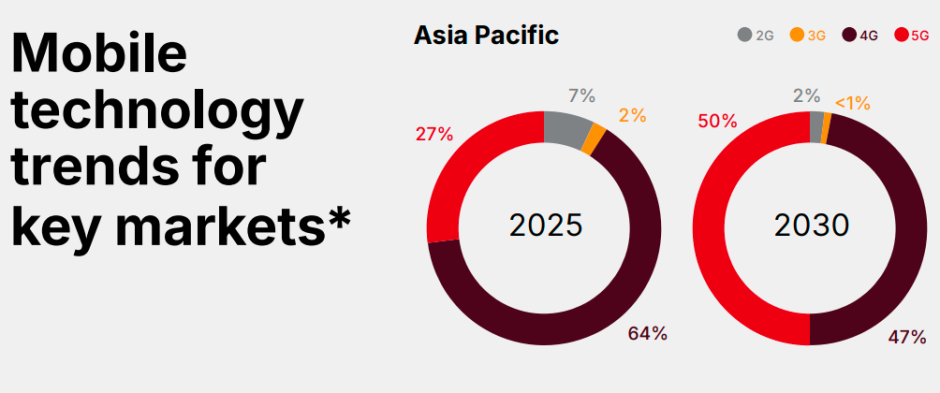
The GSMA’s The Mobile Economy Asia Pacific 2026 forecasts rising operator revenue, nearly 1.5 billion 5G connections by 2030 and more than $200 billion in network capital expenditure between 2025 and 2030.
The scale of the market is already substantial. Asia Pacific operators support nearly 2.7 billion mobile connections, including close to 1.8 billion unique mobile internet users, equivalent to more than 60 percent of the population. Mobile technologies and services generated around $1 trillion in economic value in 2025.
Mobile Operator Revenue to Rise From $201 Billion to $224 Billion
Mobile operator revenue in Asia Pacific is forecast to increase from $201 billion in 2025 to $224 billion in 2030, demonstrating continued revenue growth despite the maturity of mobile services in several developed markets.
Operators are expected to invest $213.7 billion in capex between 2025 and 2030 as they expand network capacity and prepare infrastructure for higher mobile data consumption, 5G, AI and enterprise digital services.
The investment requirement extends beyond radio networks. GSMA expects operators to continue spending on spectrum, sites, fibre, cloud, edge infrastructure, 5G Standalone and 5G-Advanced as AI and enterprise workloads demand higher capacity, lower latency and more reliable connectivity.
Asia Pacific 5G Connections to Approach 1.5 Billion
The biggest network transition will be the continued migration from 4G to 5G.
Asia Pacific is forecast to have almost 1.5 billion 5G connections by 2030, representing more than a quarter of global 5G connections. 5G will account for 50 percent of total mobile connections in Asia Pacific by 2030, nearly doubling its regional adoption level.
The regional average, however, hides substantial differences between markets. Developed Asia Pacific is expected to reach 91 percent 5G adoption by 2030, while India is projected to reach 62 percent and Southeast Asia 43 percent.
This divergence means operators in markets such as Australia, Japan, Singapore and South Korea will increasingly focus on 5G monetisation and advanced network capabilities, while operators in developing markets will continue balancing 4G expansion with 5G deployment.
4G Remains Critical as Networks Transition to 5G
Despite rapid 5G growth, 4G will remain an essential connectivity platform across several large Asia Pacific markets through the end of the decade.
The GSMA’s market data shows how dramatically network mixes vary. Bangladesh had around 92 percent of connections on 4G and 4 percent on 5G in 2025. By 2030, its mix is projected to shift to 71 percent 4G and 28 percent 5G.
India is moving faster. Its connections were approximately 58 percent 4G and 37 percent 5G in 2025, while 5G is expected to increase to 62 percent by 2030, with 4G declining to around 37 percent.
Indonesia is another important growth market. The report shows 65 percent 4G and 32 percent 2G in 2025, with 5G still at only around 1 percent. By 2030, 5G is projected to reach 20 percent, while 4G increases to 74 percent.
Pakistan had around 80 percent 4G and 19 percent 2G connections in 2025. By 2030, 5G is projected to account for 8 percent, while 4G increases to 86 percent.
Developed Markets Race Toward More Than 90 Percent 5G
Developed Asia Pacific markets are moving much faster toward predominantly 5G networks.
Australia is forecast to increase from around 54 percent 5G in 2025 to 92 percent in 2030, while its 4G share drops from 45 percent to 8 percent.
Japan is expected to move from 71 percent 5G to 94 percent, with 4G falling from 29 percent to 6 percent.
Singapore is projected to increase from 34 percent 5G in 2025 to 96 percent in 2030, while 4G declines from 65 percent to just 3 percent.
These shifts create opportunities for operators to move beyond basic connectivity and generate additional revenue from 5G Standalone, network APIs, enterprise services, edge computing, AI infrastructure and private 5G.
Mobile Internet Coverage Gap Falls to Just 2 Percent
Asia Pacific has made substantial progress in expanding mobile broadband coverage.
The regional mobile internet coverage gap has fallen to just 2 percent, while 63 percent of the population was connected to mobile internet in 2024. However, the usage gap remained 35 percent, demonstrating that network availability does not automatically translate into internet adoption.
More than 1 billion people, including nearly 700 million adults, live within mobile broadband coverage but remain offline.
GSMA identifies smartphone affordability, limited digital skills, lack of perceived relevance, digital trust and online-safety concerns among the barriers preventing people from using mobile internet. India’s PMGDISHA digital inclusion programme, for example, has trained more than 64 million rural citizens.
The figures suggest that the next stage of broadband expansion will increasingly depend on converting existing network coverage into active internet usage rather than simply adding coverage.
Spectrum Investment Could Lift Rural 4G and 5G Coverage
Spectrum availability will be another major factor determining broadband quality, speeds and rural connectivity.
GSMA says low-frequency bands such as 600 MHz and 700 MHz are particularly important for extending coverage. Rural users spend around twice as much time connected to low-band spectrum as urban users.
An additional 50 MHz of sub-1 GHz spectrum is associated with a 7 percentage-point increase in 4G coverage and an 11 percentage-point increase in 5G coverage, strengthening the economic case for rural network expansion.
Mid-band spectrum will meanwhile be essential for delivering higher broadband capacity. Regional spectrum roadmaps are focusing on bands including 2.6 GHz, 3.5 GHz and upper 6 GHz, while future requirements could extend toward 7 GHz.
Philippines Mobile Data Traffic Reaches 7.7 GB Per Month
Increasing internet consumption is putting additional pressure on mobile broadband networks.
In the Philippines, average mobile data traffic reached 7.7 GB per connection per month in the fourth quarter of 2025. The country launched commercial 5G in June 2019, becoming the first ASEAN market to do so.
However, approximately 845 MHz is currently assigned for mobile services, while GSMA estimates markets could require around 2–2.5 GHz of mid-band spectrum during 2035–2040 to support future traffic growth, 5G and 5G-Advanced.
The figures illustrate why additional spectrum, fibre backhaul and network investment will be necessary to sustain higher internet speeds as mobile data consumption rises.
India BSNL Deploys More Than 97,000 4G Sites
India is also demonstrating the continued importance of 4G investment even as the market rapidly adopts 5G.
Under the Atmanirbhar Bharat initiative, BSNL is deploying an indigenous 4G network that can be upgraded to 5G. By January 2026, more than 97,000 sites had been installed, with over 95,000 already live.
The deployment combines broadband coverage expansion with India’s strategy to increase domestic telecom technology capabilities.
Japan is pursuing another approach to network diversification. In April 2026, Japan’s METI selected Rakuten Symphony for virtualised Open RAN trials across seven countries, including India, Indonesia, Malaysia and Vietnam. Around 100 virtualised base stations per market are targeted, supported by funding of up to JPY8 billion, or $50 million.
Fibre Becomes Critical to 5G, Cloud and AI Infrastructure
Fibre investment will increasingly underpin both mobile broadband and AI infrastructure.
The expansion of 5G, cloud computing, edge infrastructure and data centres requires high-capacity fibre connectivity. GSMA specifically identifies investment in spectrum, sites, fibre, cloud and edge infrastructure as necessary for operators seeking to extract greater value from 5G.
AI is increasing this requirement further. Asia Pacific is expected to add 4.8 GW of data-centre supply by 2027, with 78 percent already pre-leased. These facilities require supporting infrastructure including power, cooling, water, fibre and grid connections. AI training and inference could increase regional data-centre electricity demand by 165 percent by 2030.
Telecom operators therefore have an opportunity to expand beyond mobile access into fibre connectivity, data centres, cloud, edge computing and AI infrastructure.
Airtel Nxtra Secures $1 Billion for Data-Centre Expansion
Operator infrastructure investments are already reflecting this strategic shift.
Airtel’s data-centre subsidiary Nxtra secured $1 billion in March 2026 to expand its infrastructure, building on an October 2025 partnership with Google to develop a gigawatt-scale AI hub in Visakhapatnam.
Singtel, meanwhile, agreed with KKR to acquire full control of STT Global Data Centres, giving Singtel exposure to a platform with approximately 2.3 GW of design capacity across 12 major markets. Singtel’s Nxera also opened a 58 MW Tuas data centre in 2026, increasing its Singapore data-centre capacity to 120 MW.
These investments show how telecom infrastructure spending is expanding beyond traditional 4G and 5G networks into the cloud, fibre and computing assets needed for AI workloads.
Asia Pacific Telecom Growth Shifts From Coverage to Monetisation
The GSMA figures point to a significant change in Asia Pacific’s telecom investment cycle. Operators are no longer investing only to connect additional subscribers. They increasingly need to improve broadband capacity, accelerate 5G adoption and build the fibre, cloud, edge and data-centre infrastructure required by enterprises and AI applications.
With operator revenue rising from $201 billion in 2025 to $224 billion in 2030, $213.7 billion of capex planned during 2025–2030, and 5G connections approaching 1.5 billion, the region represents one of the world’s biggest telecom infrastructure opportunities.
However, the industry’s biggest challenge may be monetisation. A 2 percent coverage gap means networks already reach most of the population, while a 35 percent usage gap shows that more than 1 billion people within mobile broadband coverage remain offline. Closing that gap while generating higher returns from 5G, fibre, broadband, enterprise connectivity and AI infrastructure will be central to Asia Pacific operators’ growth strategies through 2030.
BABURAJAN KIZHAKEDATH