Africa’s fiber broadband market is entering a faster growth phase as operators make investment to expand FTTP networks, regulators promote infrastructure sharing and consumers demand higher internet speeds. However, expensive broadband deployments, low average revenue per user, repeated cable damage and competition from SpaceX’s Starlink continue to challenge fiber operators.
Fiber investment has accelerated in the past four years, although coverage and broadband performance vary significantly across the continent. North Africa remains the most developed sub-region, with Algeria and Morocco leading in FTTP coverage and Egypt delivering the strongest fixed broadband performance, Ookla said.
Central and East Africa remain less advanced, with Kenya emerging as a notable exception following deployments by multiple operators. Southern Africa is one of the continent’s largest FTTP markets, with nearly 6.5 million homes passed and 2.6 million connected. Mauritius has achieved almost nationwide fiber coverage, while deployments in several other markets remain concentrated in affluent urban areas.
Senegal targets nearly 2 million fiber ports by 2028
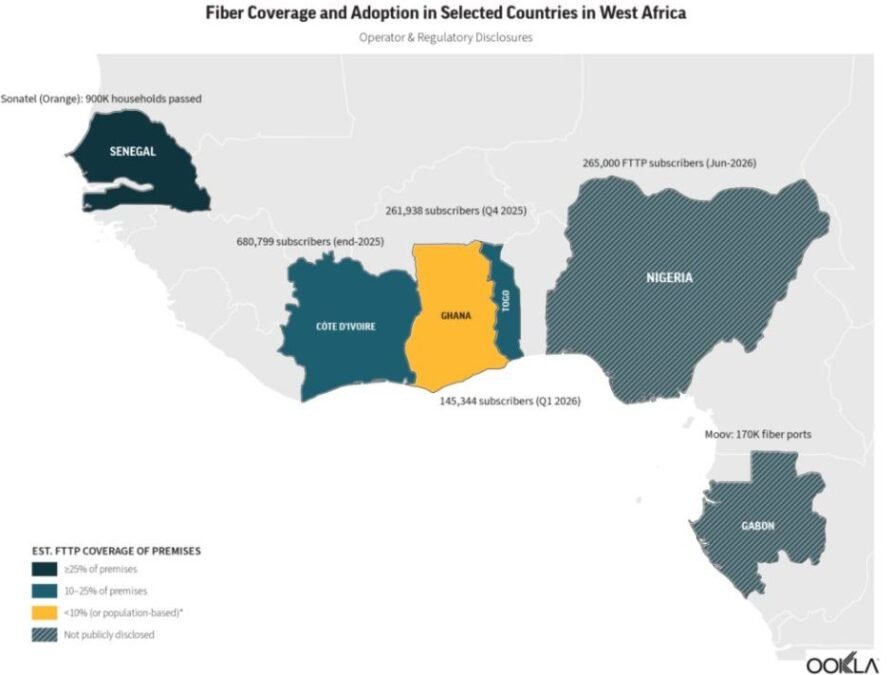
Senegal is the most mature fixed-fiber market in Francophone West Africa, with FTTP covering an estimated 35–40 percent of premises.
Orange brand operator Sonatel had passed 900,000 households by April 2026. It plans to add another 1 million fiber ports between 2026 and 2028, taking the total to nearly 2 million by end-2028.
Sonatel’s fiber subscriber base increased 26.5 percent year on year in Q1 2026. Its residential packages offer speeds ranging from 30 Mbps to 1 Gbps.
Senegal introduced infrastructure-sharing and fiber-unbundling measures during 2023–2024 to reduce duplication and deployment costs. The framework can eventually allow subscribers to change internet service providers without requiring another physical connection.
Ookla data shows that Senegal’s fixed broadband download speed increased 78 percent between 2023 and H1 2026 to 38.55 Mbps. Most of the improvement occurred during the latest year, with median speed more than doubling between end-2025 and June 2026.
P90 download speed more than doubled over three-and-a-half years, while P10 followed a similar pattern. Latency decreased 16.3 percent to nearly 80 milliseconds in H1 2026.
The performance improvement followed Sonatel’s residential fiber overhaul in February 2026, which simplified its broadband portfolio, increased speeds and reduced monthly prices for higher-end plans.
Côte d’Ivoire leads West Africa in median broadband speed
Côte d’Ivoire has estimated FTTP coverage of 15 percent. Orange reported 680,799 broadband subscribers at end-2025, representing growth of 39.4 percent.
Orange offers residential speeds from 50 Mbps to 1 Gbps, while Canalbox provides 50 Mbps and 200 Mbps packages. The country’s multi-technology broadband strategy combines urban fiber, licensed non-terrestrial networks for rural communities and commercial 5G, which started in July 2026.
Côte d’Ivoire recorded the fastest median download speed among the six West African countries analysed. Median speed rose 28.3 percent, from 47.52 Mbps in 2023 to 60.99 Mbps in H1 2026.
P10 speed increased 95.4 percent, from 5.83 Mbps to 11.39 Mbps, while P90 grew 16.9 percent. Median multi-server latency improved from 92.3 milliseconds to 79.4 milliseconds.
Recent performance growth has slowed, indicating a need for additional capacity, upgraded customer-premises equipment and greater adoption of devices supporting modern Wi-Fi standards.
Nigeria FTTP subscribers more than triple to 265,000
Nigeria’s fixed broadband market has traditionally relied on fixed wireless access, but fiber has now moved ahead. FTTP subscriptions increased from 84,141 in Q4 2025 to 265,000 by June 2026, more than tripling and surpassing the 217,083 FWA connections recorded in Q1 2026.
The Nigerian Communications Commission is promoting wholesale infrastructure sharing and open-access networks. It is also encouraging state governments to reduce or eliminate right-of-way charges that increase fiber deployment costs.
Nigeria recorded the strongest and most consistent broadband performance improvement among the leading West African markets. Median download speed increased 2.55 times, from 13.50 Mbps in 2023 to 34.47 Mbps in H1 2026.
P10 download speed rose from 2.24 Mbps to 6.04 Mbps, while P90 increased from 74.37 Mbps to 90.04 Mbps. Median download performance improved in every quarter during the past two years.
Median upload speed increased nearly 2.5 times, from around 11 Mbps in 2023 to 25.17 Mbps in H1 2026. Median latency fell from 47.9 milliseconds to 35.8 milliseconds and remained within 36–39 milliseconds during the full years of 2024 and 2025.
Nigeria’s operators nevertheless face serious infrastructure risks. The country recorded more than 50,000 fiber cuts in 2024, including around 30,000 caused by road construction. Operators are responding through aerial fiber installations on utility poles and anti-theft coatings for underground conduits, while Nigeria and Gambia have introduced policies to protect telecom infrastructure.
Ghana fiber speeds surge as latency falls
Ghana recorded 261,938 fiber subscribers in Q4 2025, up 18.4 percent from 221,153 a year earlier. FWA accounted for fewer than 1,500 connections.
Despite fiber’s dominance in fixed broadband, fiber subscriptions represented less than 0.8 percent of Ghana’s population. This contrasts with 42.87 million mobile subscriptions and mobile penetration of 127 percent. MTN and Telecel dominate the market, while fiber availability remains concentrated in urban and suburban locations.
Ghana delivered the broadest improvement across broadband performance measurements. Median download speed increased 69.3 percent, from 31.17 Mbps in 2023 to 52.78 Mbps in H1 2026.
P10 speed surged 135.6 percent, from 3.03 Mbps to 7.13 Mbps, while P90 increased by more than 70 percent.
A significant performance shift occurred in Q3 2025. Multi-server latency dropped from 34.6 milliseconds to 12.6 milliseconds, while median upload speed jumped from 22.60 Mbps to 49.16 Mbps during the same quarter. The Meta-backed 2Africa subsea cable landing in Accra should provide additional international capacity.
Togo cuts wholesale fiber prices by 60 percent
Togo reached estimated FTTP coverage of 12 percent at end-2024. Its fiber subscriber base increased 13.8 percent to 145,344 in Q1 2026, representing household penetration of 7.6 percent.
Canalbox controlled 55.8 percent of the market, while Togocom’s YAS held 44.2 percent. Canalbox offers 50 Mbps and 200 Mbps packages, while YAS provides plans including 100 Mbps weekly and monthly tariffs.
A 2022 study found that Togo offered some of West Africa’s cheapest packages below 25 Mbps, but its packages exceeding 100 Mbps were among the region’s most expensive. Regulatory revisions subsequently allowed customers to move from 10 Mbps to 50 Mbps without paying a higher price.
In January 2025, Togo reduced wholesale dark-fiber pricing by 60 percent to encourage competition and support lower retail tariffs.
Median download speed increased 19.8 percent to 34.49 Mbps in Q1 2025 before stabilising within a 34–38 Mbps range. Latency initially remained between 97 milliseconds and 103 milliseconds before falling to 41.8 milliseconds in Q2 2025. It stayed within 39–58 milliseconds through Q2 2026.
Togo’s P10 speed increased by nearly 56 percent to 7.61 Mbps. P90 rose by only nearly 10 percent to 95.98 Mbps, reflecting the tendency of premium customers to select 100 Mbps packages.
Gabon plans 1,800-kilometre fiber backbone expansion
Gabon’s fiber broadband market is dominated by two operators. Moov Africa Gabon Telecom operates in 19 cities and offers speeds of up to 500 Mbps. Canalbox provides unlimited 50 Mbps and 200 Mbps packages.
A 50 Mbps entry-level package costs more than US$40 per month in Gabon, compared with approximately US$20–25 elsewhere in West Africa.
A public-private venture announced in late 2025 aims to extend Gabon’s national fiber backbone by 1,800 kilometres and introduce a transparent open-access framework.
Gabon recorded relatively modest performance gains. Median download speed increased 15.9 percent between 2023 and Q2 2026 to 42.25 Mbps. P10 increased 23.5 percent and P90 grew 20.1 percent, with most of the improvement occurring in 2024.
Latency remained the highest among the six markets despite declining 18.5 percent to 179.8 milliseconds in Q2 2026. The backbone expansion could help reduce this latency and improve broadband quality.
Starlink intensifies competition across Africa
Low-Earth-orbit satellite broadband is creating a significant competitive challenge for African fiber operators. Starlink has secured licences in more than 28 African countries and accumulated an estimated 500,000 subscribers.
Nigeria, one of Starlink’s largest African markets, had 66,523 subscribers in Q2 2025. The satellite service is also available in Benin, Cape Verde, Ghana, Guinea-Bissau, Niger, Liberia and Sierra Leone, while its Côte d’Ivoire launch was scheduled for July 2026.
Terrestrial operators are responding with hybrid connectivity services. Orange Côte d’Ivoire launched Orange Sat using Eutelsat’s KONNECT geostationary satellite platform. Its prepaid “Wi-Fi village” model targets rural communities. Sonatel Orange introduced a similar service in Senegal, offering unlimited satellite broadband to residential and enterprise customers.
Affordability will determine Africa’s fiber broadband growth
African ISPs face higher costs per premise passed than operators in other developing markets. Right-of-way fees, administrative hurdles, low purchasing power and limited ARPU make it difficult to generate returns from fiber investments.
Flexible prepaid services and weekly tariffs, such as those offered by YAS Togo, could improve affordability and increase network utilisation. Infrastructure sharing, open-access regulation and reductions in wholesale fiber costs could also make deployments more commercially sustainable.
Senegal, Côte d’Ivoire, Nigeria and Ghana have progressed beyond fiber deployments concentrated in one or two cities and are now building wider coverage, larger subscriber bases and stronger broadband performance. Togo and Gabon remain at an earlier stage, where expansion depends more heavily on regulatory action and targeted infrastructure investment.
Long-term profitability will require operators to balance high-density urban fiber deployments with affordable tariff models. In rural areas, partnerships combining fiber with geostationary, medium-Earth-orbit and low-Earth-orbit satellite capacity could connect underserved communities, narrow Africa’s digital divide and help telecom operators defend their broadband market share.
BABURAJAN KIZHAKEDATH