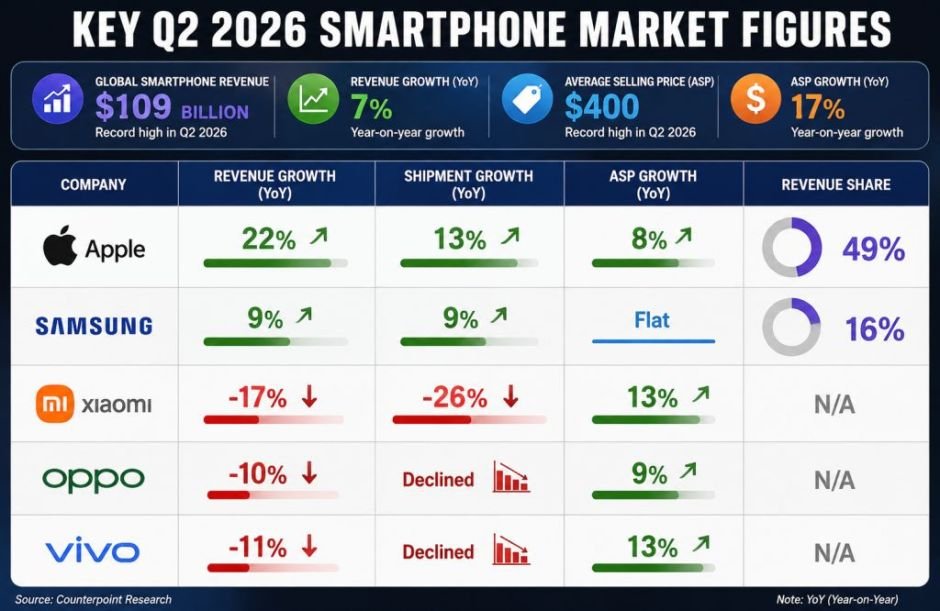
Global smartphone revenue reached a record $109 billion in the second quarter of 2026, increasing 7 percent year-on-year despite a decline in worldwide smartphone shipments, according to Counterpoint Research. The industry achieved its highest-ever second-quarter revenue as consumers continued shifting toward premium smartphones, driving the average selling price (ASP) up 17 percent year-on-year to a record $400.
The latest smartphone market data indicates that vendors are prioritizing profitability over shipment growth. Rising memory prices, higher component costs and continued demand for flagship smartphones encouraged manufacturers to focus on premium devices rather than increasing shipment volumes.
Apple Captures Record 49 Percent Smartphone Revenue Share
Apple further strengthened its dominance in the premium smartphone market by securing a record 49 percent share of global smartphone revenue during Q2 2026. The iPhone maker increased revenue by 22 percent year-on-year, supported by a 13 percent rise in shipments and an 8 percent increase in ASP.
Strong demand for the iPhone 17 lineup, particularly the base iPhone 17 and iPhone 17 Pro Max, enabled Apple to expand both revenue and shipment volumes while maintaining relatively stable pricing despite rising bill-of-materials costs.
Samsung Maintains Second Position with 16 Percent Revenue Share
Samsung ranked second with a 16 percent share of global smartphone revenue. The company recorded 9 percent year-on-year growth in both smartphone revenue and shipments while maintaining a relatively flat ASP.
Demand for the Galaxy A-series and continued momentum for the Galaxy S26 series supported Samsung’s premium strategy. The company also benefited from strong shipment growth across the Middle East and Africa, along with double-digit percentage growth in North America.
Xiaomi Records Steepest Revenue Decline
Xiaomi experienced the sharpest decline among the top five smartphone brands. Smartphone shipments fell 26 percent year-on-year, resulting in a 17 percent decline in revenue despite a 13 percent increase in ASP.
Higher memory costs and Xiaomi’s larger exposure to entry-level and mid-range smartphones weakened demand. In response, the company streamlined its product portfolio, increased prices and accelerated its strategy toward premium smartphones and improved profitability.
OPPO and vivo Shift Toward Premium Smartphones
OPPO reported a 10 percent decline in smartphone revenue even though its ASP increased 9 percent year-on-year. The company continued moving its portfolio toward higher-value smartphones as softer demand in entry-level segments weighed on shipments.
vivo posted an 11 percent decline in revenue despite recording the strongest ASP growth among the top five smartphone brands. Its ASP increased 13 percent year-on-year as the company improved its product mix through higher pricing and disciplined portfolio management. However, weaker shipments in price-sensitive markets offset these gains.
Premium Smartphones Drive Industry Growth
The Q2 2026 results highlight a significant shift in the global smartphone market. Instead of pursuing shipment growth, smartphone manufacturers are increasingly focusing on premium devices with higher margins. Higher memory prices, rising component costs and longer replacement cycles are accelerating this transition toward value-driven growth.
Counterpoint Research expects smartphone manufacturers to continue raising prices during the second half of 2026 as memory shortages and higher component costs persist. Supply constraints are expected to remain a bigger challenge than demand, leading to continued pressure on smartphone shipments while supporting further growth in ASPs and premium smartphone revenue.
BABURAJAN KIZHAKEDATH