Portugal has become one of Europe’s most advanced broadband markets, making it easier than ever for consumers to access high-speed internet. Extensive fiber-to-the-home (FTTH) deployment, competitive pricing and strong investment from leading internet service providers (ISPs) have transformed the country’s digital landscape.
In 2026, choosing the best ISP in Portugal is no longer just about finding the cheapest broadband plan. Customers need to compare fiber availability, download and upload speeds, Wi-Fi performance, customer service, bundled offers and future-ready technologies such as AI-powered networking and Wi-Fi 7.
Leading providers including MEO, NOS, Vodafone Portugal and DIGI Portugal are competing aggressively with gigabit broadband, bundled mobile and television services, smart home features and improved customer support, giving consumers more choices than ever before.
Portugal’s Fiber Network Gives Customers More Choice
Portugal’s broadband market is built on one of Europe’s strongest fiber infrastructures. By 2026, FTTH networks covered approximately 6.2 million homes and premises, representing around 95.4 percent of Portuguese households and establishments. Overall high-speed broadband infrastructure reached approximately 95.9 percent of dwellings, placing Portugal among Europe’s leading fiber broadband markets.
The transition from copper to fiber continues to accelerate. By the end of 2025, 72.2 percent of all fixed broadband accesses used FTTH/B technology, while fiber subscriptions increased 7.1 percent year over year. Regional deployment also continued to expand, with Alentejo and the North region recording approximately 2.7 percent annual growth in high-speed broadband coverage.
For customers, this widespread fiber availability means faster internet, lower latency, better reliability and greater choice among competing ISPs.
How to Select the Best ISP in Portugal
Before signing up for a broadband service, customers should evaluate several important factors beyond monthly pricing.
Fiber availability should be the first consideration. Although fiber coverage exceeds 95 percent, available providers can differ depending on the address.
Internet speed should match household requirements. Families using video streaming, remote work, cloud applications and gaming should consider 1 Gbps or faster plans, while lighter users may find 300 Mbps to 500 Mbps sufficient.
Wi-Fi performance has become equally important. Many households now connect smart TVs, gaming consoles, security cameras, IoT devices and multiple smartphones simultaneously. Providers offering Wi-Fi 6, Wi-Fi 7 and mesh networking equipment can deliver a better in-home experience.
Customers should also compare:
Monthly subscription costs
Contract duration
Installation charges
Mobile and television bundles
Customer service reputation
Router quality
Upgrade options
AI-powered network management
Selecting the right ISP depends on both budget and the number of connected devices within the home.
Broadband Offers: MEO, NOS, Vodafone Portugal and DIGI
Portugal’s leading broadband providers are competing through fiber-first services rather than traditional DSL or cable networks.
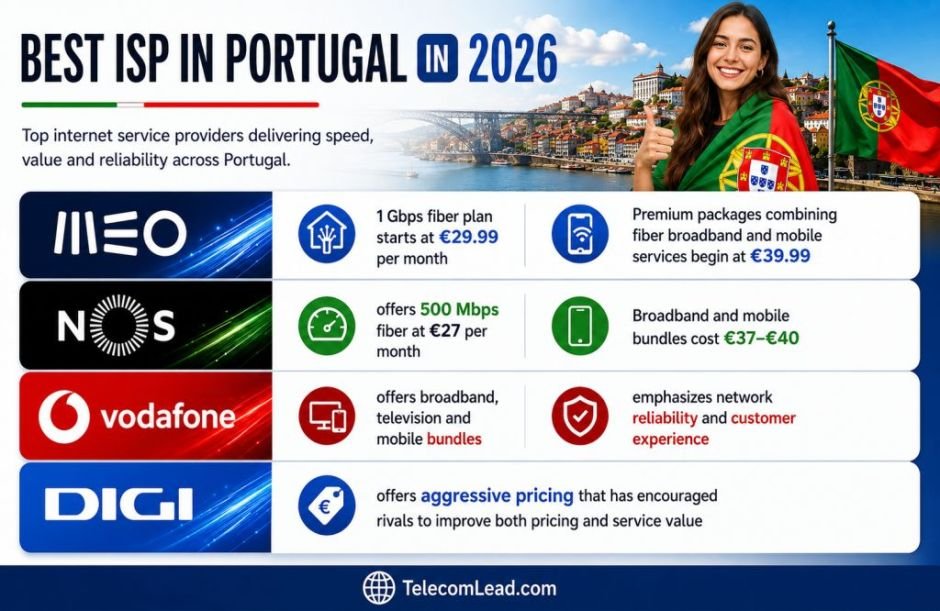
MEO, operated by Altice Portugal, remains one of the country’s largest broadband providers. Its 1 Gbps fiber plan starts at approximately €29.99 per month, while 2 Gbps services are available from around €34.99 per month. Premium packages combining fiber broadband and mobile services begin at approximately €39.99 per month, with multi-gigabit options available in selected locations.
NOS targets customers looking for high-performance broadband at competitive prices. Its 500 Mbps fiber plans start from approximately €27 per month, while 1 Gbps services begin around €30 per month. Broadband and mobile bundles generally cost €37-€40 per month.
Vodafone Portugal continues expanding its fiber footprint through broadband, television and mobile bundles while emphasizing network reliability and customer experience.
DIGI Portugal has significantly increased competition following its acquisition of NOWO, which served approximately 130,000 fixed telecommunications customers. DIGI’s aggressive pricing strategy has encouraged established operators to improve both pricing and service value.
Standalone fiber broadband plans across Portugal generally start between €25 and €30 per month, while premium gigabit services typically range from €30 to €45 per month. Bundled packages including broadband, television and mobile services generally begin around €35-€45 per month, while premium multi-service packages can exceed €60 per month.
Portugal’s Broadband Market Continues Growing
Portugal recorded approximately 4.8 million fixed broadband connections by the end of 2025, representing annual growth of approximately 100,000 new connections, or 2.1 percent.
Broadband penetration reached approximately 90.6 connections per 100 households, reflecting the maturity of Portugal’s broadband market.
High-speed broadband adoption also remains strong, with approximately 3.9 million residential customers using high-speed fixed broadband services. Household penetration reached 86.6 percent, while approximately 80 percent of high-speed broadband customers used FTTH connections.
Bundled services continue driving market growth. Approximately 87.1 percent of Portuguese households subscribe to communication bundles, with fixed broadband included in 91.7 percent of bundled households. Mobile services are included in 79.4 percent of bundles.
Television remains an important part of broadband packages. Portugal recorded approximately 4.7 million TV subscribers during Q1 2025, with fiber supporting approximately 67.4 percent of television subscriptions, or roughly 3.1 million customers.
Gigabit Broadband Is Becoming the New Standard
Portugal’s broadband market is rapidly shifting toward gigabit connectivity.
By the third quarter of 2025, approximately 93.4 percent of fixed broadband connections supported speeds of at least 100 Mbps, while 33.2 percent already offered 1 Gbps or faster.
Fiber broadband supports increasingly demanding applications, including:
4K and 8K streaming
Cloud gaming
Artificial intelligence applications
Enterprise cloud services
Video conferencing
Smart home platforms
Remote working
MEO, NOS and Vodafone Portugal continue expanding multi-gigabit broadband availability, while DIGI is increasing pricing pressure across the market.
AI-Powered Wi-Fi Improves Home Connectivity
Fast broadband alone no longer guarantees a good user experience. Modern households rely heavily on wireless connectivity across multiple devices.
With approximately 4.8 million fixed broadband connections, Portuguese homes increasingly use smart TVs, security systems, gaming consoles, IoT devices and cloud applications simultaneously.
To improve performance, ISPs are introducing AI-powered home networking that automatically:
Optimizes Wi-Fi channels
Detects interference
Prioritizes devices
Improves wireless coverage
Performs predictive diagnostics
MEO, NOS and Vodafone Portugal increasingly include intelligent routers, mesh Wi-Fi systems, Wi-Fi 6 and emerging Wi-Fi 7 technologies within premium broadband packages.
5G Fixed Wireless Access Provides Additional Flexibility
Although FTTH remains Portugal’s preferred broadband technology, Fixed Wireless Access (FWA) provides additional connectivity options.
With high-speed broadband infrastructure already covering 95.9 percent of Portuguese dwellings, FWA primarily serves rural communities, tourism businesses, temporary installations and locations where fiber deployment remains challenging.
Using 4G and 5G networks, MEO, NOS and Vodafone Portugal can deliver broadband speeds ranging from approximately 100 Mbps to more than 1 Gbps, depending on network conditions.
Satellite Broadband Supports Remote Areas
Satellite broadband remains a niche solution because Portugal already enjoys excellent fiber coverage.
Starlink leads the consumer satellite broadband market with download speeds typically ranging from 100 Mbps to more than 200 Mbps, while latency generally ranges between 25 milliseconds and 60 milliseconds. The service operates using a global constellation of more than 7,000 low Earth orbit satellites.
Amazon Project Kuiper plans a network of more than 3,200 satellites, while OneWeb operates more than 600 satellites serving enterprise and government customers.
Satellite services are particularly useful for Madeira, the Azores and isolated rural communities where terrestrial broadband deployment is more difficult.
Customer Service Is Becoming a Major Competitive Advantage
As network quality improves, customer experience is becoming one of the main differentiators among Portuguese ISPs.
Portugal recorded approximately 103,000 electronic communications complaints in 2024, representing a 14 percent decline compared with 2023. Common issues include billing disputes, contract conditions, service interruptions and technical support.
Fiber adoption has contributed to higher reliability, with FTTH/B accounting for 72.2 percent of fixed broadband accesses. Operators are increasingly using AI-powered diagnostics, proactive network monitoring and digital customer service platforms to improve customer satisfaction.
Which ISP Is Best for You?
Each broadband provider offers different strengths.
MEO is well suited for customers seeking premium fiber, multi-gigabit speeds and comprehensive bundled services.
NOS offers competitive pricing and strong value for households wanting high-speed fiber and mobile bundles.
Vodafone Portugal focuses on reliable fiber connectivity, customer experience and entertainment packages.
DIGI Portugal appeals to budget-conscious consumers through aggressive pricing and increased competition following the NOWO acquisition.
The best ISP ultimately depends on fiber availability, pricing, bundled services, Wi-Fi performance and individual household requirements.
Conclusion
Portugal has established one of Europe’s strongest broadband ecosystems, supported by 6.2 million homes passed, 95.4 percent FTTH coverage, 95.9 percent high-speed broadband availability, 4.8 million fixed broadband connections, 3.9 million high-speed residential customers and widespread gigabit adoption. With 33.2 percent of broadband connections already supporting 1 Gbps or higher, competition is increasingly centered on customer experience rather than infrastructure alone.
For consumers choosing an ISP in Portugal in 2026, the most important factors are fiber availability, broadband speed, Wi-Fi quality, pricing, bundled services, customer support and future-ready technologies such as AI-powered networking and Wi-Fi 7. MEO, NOS, Vodafone Portugal and DIGI each offer compelling advantages, giving households the flexibility to select a broadband provider that best matches their connectivity needs and budget.
FASNA SHABEER