SoftBank has completed a major outdoor verification trial showing that centimeter-wave spectrum in the 7GHz band can deliver both wide-area coverage and high-quality communication performance in dense urban areas. Conducted in partnership with Nokia, the project marks an important step toward preparing Japan’s mobile networks for future 6G services, which will need to support massive data usage driven by AI applications.
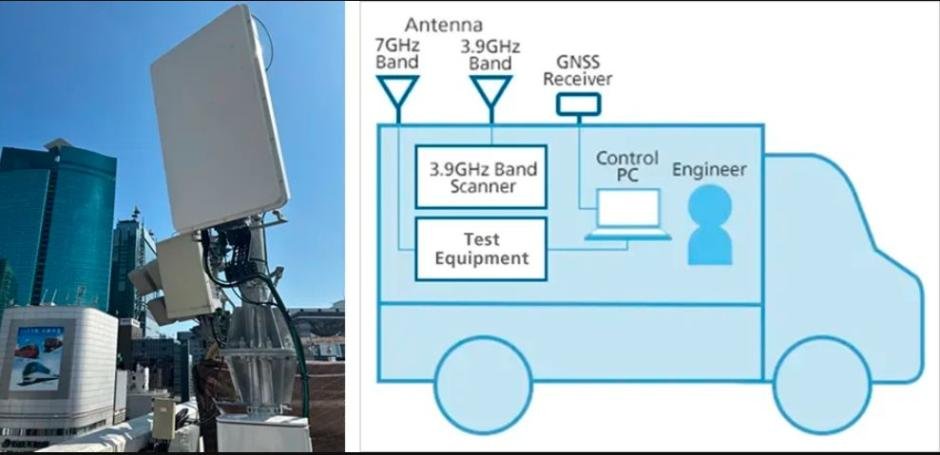
The trial began in June 2025 after SoftBank obtained an experimental license for the 7GHz band. Engineers deployed three experimental Massive MIMO base stations across Tokyo’s Ginza district and evaluated how the band performs in real-world conditions compared with commercial 3.9GHz 5G networks.
Wide-area Coverage Confirmed Even in Dense Urban Streets
Using a measurement vehicle, SoftBank collected signal data from Ginza 4-chome to 8-chome. The results showed strong received signal power along major line-of-sight routes, while narrow alleys and other non-line-of-sight areas also maintained viable connections. The widespread coverage demonstrates that 7GHz can support macro-layer deployments in city centers.
Communication quality was equally encouraging. Statistical analysis showed SINR values of zero dB or higher throughout the area, and the median SINR reached 5.9 dB. This indicates consistent and stable connectivity with minimal interference between neighboring base stations. The propagation behavior of the 7GHz band helped maintain performance, despite limited diffraction into obscured areas.
Propagation Characteristics Comparable to 3.9GHz in Line-of-sight Zones
A detailed analysis of radiowave propagation loss showed that 7GHz performs similarly to the 3.9GHz band in line-of-sight environments. The median difference was less than one dB, much smaller than the six dB difference predicted by theoretical models. According to SoftBank, reflections from buildings in urban spaces likely improved the performance of the higher frequency band.
In non-line-of-sight areas, the 7GHz band showed greater signal attenuation than 3.9GHz, with a typical difference of around ten dB. This aligns with expected behavior due to reduced diffraction and different reflection characteristics at higher frequencies. Even so, the signals remained strong enough to support urban macro coverage.
7GHz Validated as a Candidate Band for 6G Deployment
The successful verification strengthens the case for adopting the 7GHz band as a key FR3 frequency for 6G. As AI-driven services expand, mobile networks will need both high capacity and broad coverage. The trial shows that 7GHz spectrum can deliver on both fronts when deployed with high-power Massive MIMO equipment.
Dr. Akihiro Nakao, Professor at the University of Tokyo’s Graduate School of Engineering and Co-Chairman of the XG Mobile Promotion Forum, said the results provide important evidence for global 7GHz ecosystem development. He noted that continued collaboration among industry, government, academia, and international partners will be essential for realizing next-generation mobile networks.
SoftBank plans to continue studying the technology as part of its broader 6G research initiatives, supporting the industry’s transition toward high-capacity, AI-native communications infrastructure.
Shafana Fazal