
Hong Kong has reached one of the world’s most advanced 5G deployment milestones, achieving more than 99 percent population coverage by March 2025.
However, a new Ookla Speedtest Intelligence analysis reveals that outdoor coverage alone does not reflect the actual mobile experience because residents spend more than 85 percent of their daily lives indoors, making in-building connectivity the true benchmark for network performance.
In its report, Hong Kong’s Indoor Divide: 5G Performance in the World’s Densest Vertical City, Ookla highlights that Hong Kong’s unique urban landscape presents one of the world’s most challenging environments for indoor wireless connectivity. The city is home to approximately 7.5 million residents, with most living within a built-up area covering only about one-quarter of the territory’s land mass.
Hong Kong also has the world’s largest concentration of skyscrapers, with 669 completed buildings above 150 meters as of January 2025, according to the CTBUH Skyscraper Center. This exceeds Shenzhen (626), New York (318), Dubai (267) and Shanghai (196), making indoor network infrastructure increasingly important for delivering reliable 5G services.
Ookla analyzed indoor 5G performance across more than 760 buildings throughout 2025, covering residential estates, office buildings, shopping malls, hotels and transport hubs. Across Hong Kong’s four mobile operators, the study recorded a median indoor 5G download speed of 167.37 Mbps and a median upload speed of 27.98 Mbps, sufficient for applications such as 4K streaming and HD video conferencing.
Despite the strong overall performance, the research found dramatic differences between buildings. The fastest 10 percent of buildings achieved median download speeds of 479.97 Mbps, while the slowest 10 percent recorded only 43.02 Mbps, representing an 11-fold performance gap.
The disparity was even greater for uploads. The lowest-performing 10 percent of buildings recorded just 5.35 Mbps, while the fastest 10 percent reached 79.04 Mbps, creating nearly a 15-fold difference. According to Ookla, building design, distributed antenna systems, indoor network investment and operator infrastructure have a much greater impact on indoor performance than geographic location.
Regional analysis also showed that Hong Kong’s newest districts generally outperform traditional business centers. Sha Tin and Ma On Shan delivered the highest median indoor 5G download speed at 189.72 Mbps, narrowly ahead of Tseung Kwan O at 189.66 Mbps. Hong Kong Island ranked third with 179.01 Mbps, followed by other New Territories areas at 174.75 Mbps.
The overall Hong Kong median remained 167.37 Mbps, while Tuen Mun recorded 165.76 Mbps, Tsuen Wan and Kwai Tsing achieved 163.42 Mbps, and Kowloon delivered 157.07 Mbps despite recording the largest sample with 245 measured buildings. Yuen Long and Tin Shui Wai reached 147.56 Mbps, while Airport and North Lantau recorded the lowest regional median at 128.59 Mbps.
Signal quality measurements using 5G SS-RSRP showed an average indoor signal strength of -89.5 dBm, placing Hong Kong between good and fair coverage levels. Only 4.2 percent of measured buildings achieved signal strength stronger than -80 dBm. Good signal quality was available in 50.5 percent of buildings, while 44.8 percent fell within the fair range of -90 dBm to -100 dBm. Less than 1 percent of buildings experienced poor signal levels below -100 dBm.
Ookla found that shared indoor infrastructure significantly improves consistency across operators. At venues such as Hong Kong International Airport Terminal 1 and the Hong Kong Convention and Exhibition Centre, all four operators delivered strong and closely matched 5G performance.
At the Hong Kong Convention and Exhibition Centre New Wing, 5G signal strength ranged between -72 dBm and -75 dBm, while download speeds varied from 235.69 Mbps to 333.76 Mbps across operators. At Hong Kong International Airport Terminal 1, even the lowest-performing operator achieved a median download speed of 196.49 Mbps.
In contrast, privately managed buildings without shared infrastructure displayed substantial performance gaps. At Park Central, SmarTone delivered 906.55 Mbps, while China Mobile Hong Kong recorded only 11.27 Mbps, creating an approximately 80-fold difference within the same building. At APM Millennium City V, SmarTone achieved 586.82 Mbps compared with csl’s 35.87 Mbps, while Metro City Plaza II saw csl lead with 834.86 Mbps.
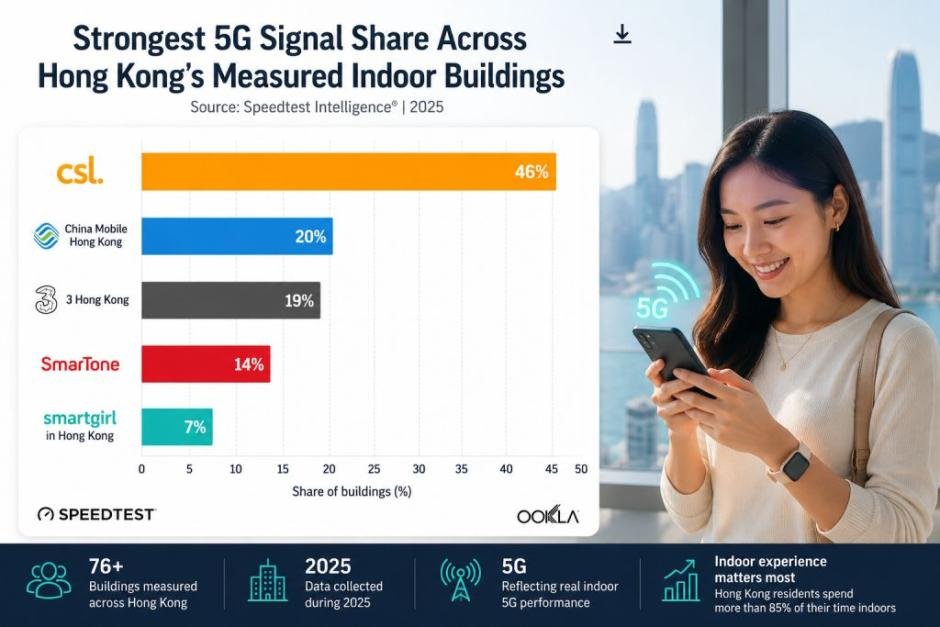
The study also identified distinct strengths among Hong Kong’s mobile operators. csl delivered the strongest 5G signal in 46 percent of measured buildings and achieved 834.86 Mbps at Metro City Plaza II. China Mobile Hong Kong led in 20 percent of buildings and recorded 512.65 Mbps at Hong Kong International Airport Terminal 1 and 337.28 Mbps at AsiaWorld-Expo. 3 Hong Kong achieved 333.76 Mbps at the Hong Kong Convention and Exhibition Centre New Wing and 685.45 Mbps at East Point City. SmarTone produced the strongest venue-level results, recording the highest median download speeds in 10 of the 16 selected venues, including 906.55 Mbps at Park Central.
To address future indoor connectivity challenges, Hong Kong introduced the Telecommunications (Amendment) Ordinance 2024, which came into effect in April 2025. The regulation enables operators to access designated mobile infrastructure spaces in newly approved buildings without additional charges, supporting wider deployment of distributed antenna systems, indoor small cells and neutral-host infrastructure.
Ookla concludes that Hong Kong’s achievement of more than 99 percent 5G population coverage marks only the first phase of network evolution. As users spend the vast majority of their time indoors, the next stage of competition will focus on delivering consistent, high-performance indoor connectivity through shared infrastructure, AI-driven network optimization and advanced enterprise mobile solutions across one of the world’s most densely built urban environments.
FASNA SHABEER

