Telecom operators are broadening network competition beyond download speeds as customers judge connectivity by whether video calls, gaming, uploads and cloud applications work reliably. High throughput remains valuable, but it provides an incomplete picture of everyday mobile performance.
Opensignal’s 2026 Global Mobile Network Experience Awards assessed 266 operators across 82 markets using eight measures, including speed, reliability, consistent quality and application experience. The awards used measurements collected between July 1 and December 29, 2025, making them a 2026 assessment of an earlier measurement period.
For operators, this wider scorecard changes how network leadership is demonstrated. Strong customer experience requires sufficient capacity, dependable connections and predictable application performance across locations and busy periods.
Download Speed Remains Important but Does Not Explain Everything
T-Mobile USA led Download Speed Experience among large land-area markets at 180.2 Mbps in the Opensignal Global Mobile Network Experience Awards 2026. SK Telecom led the small land-area group at 192.2 Mbps, according to the supplied results.
These are measured user-experience averages, not advertised maximum speeds. The awards also separate operators by market land area, so the category winners should not be presented as directly equivalent rankings.
Download performance helps users transfer files and access data-intensive services. However, a fast download does not establish that a network delivers stable gaming latency, dependable uploads or uninterrupted voice applications.
Operators therefore need to explain both how quickly their networks transfer data and how consistently they support customer activities.
Reliability Measures Whether Connections Deliver Useful Results
Reliability Experience assesses users’ ability to connect and successfully complete basic tasks. It considers connectivity, task completion and whether the network provides sufficient performance.
In the supplied global results, Japan’s au scored 954.5 points in the large land-area group, while SK Telecom reached 971.4 points in the small land-area group.
These scores are reliability measures, not percentages or download-speed results.
The distinction matters commercially. Customers experience a failed payment, interrupted call or unsuccessful upload as a service problem regardless of the network’s best speed-test result.
Improving reliability requires attention to coverage, congestion, mobility between cells and supporting infrastructure. It cannot be achieved through higher headline throughput alone.
Consistent Quality Reveals Everyday Performance
Consistent Quality evaluates whether measured network performance is sufficient to support common demanding applications without noticeable disruption.
The supplied 2026 results show 87.2 percent for Norway’s ice, 86.1 percent for au, 84.6 percent for SoftBank and 82.7 percent for Telekom Germany in the large land-area group. SK Telecom reached 90.8 percent in the small land-area group.
These percentages should not be interpreted as geographic coverage or network uptime. They describe performance against the metric’s quality requirements.
Consistency is particularly useful when assessing busy-hour conditions. A network may perform strongly during quiet periods while struggling where many users gather. Operators need localized measurements to identify those differences and prioritize improvements.
Upload Performance Expands the Competitive Scorecard
Mobile usage includes video creation, cloud backups, document sharing and live collaboration. These activities depend on the uplink as well as the downlink.
According to the supplied global results, Finland’s DNA led Upload Speed Experience among large land-area markets at 19.4 Mbps, while SK Telecom led the small land-area group at 27.2 Mbps.
Upload capacity also influences how efficiently users can transmit large files and contribute video during calls. However, application performance depends on latency, stability and packet delivery alongside throughput.
For operators serving enterprise customers, uplink quality can become a practical differentiator in field operations, mobile reporting and remote collaboration.
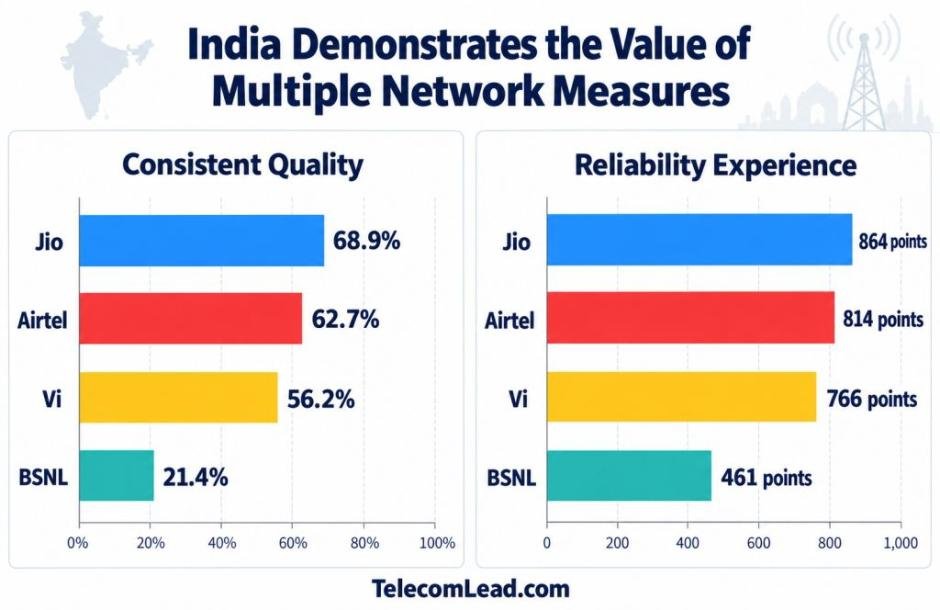
India Demonstrates the Value of Multiple Network Measures
The India Mobile Network Experience Report for February 2026 used measurements collected from October 1 to December 29, 2025. Opensignal named Jio India’s Best Network, with eight outright awards and one shared award.
The figures illustrate how reliability and consistency complement speed comparisons.
Each metric answers a different question. Consistent Quality assesses whether performance meets application requirements, while Reliability Experience examines successful connectivity and task completion.
A national ranking also does not guarantee the same experience in every district, building or travel corridor. Local performance remains important when customers choose a provider.
Kerala Shows Why Regional Results Matter
In Kerala, Jio recorded 132.1 Mbps Download Speed Experience, compared with 46.6 Mbps for Airtel. Upload results were 7.5 Mbps for Jio and 5.9 Mbps for Airtel.
Jio’s Time on Network reached 99.6 percent, compared with 99.0 percent for Airtel, 97.2 percent for Vi and 86.0 percent for BSNL.
Time on Network measures the proportion of time users have a mobile-network connection. It should not be described as the percentage of Kerala’s territory covered or a guaranteed indoor service level.
Regional results help operators identify where national averages conceal different customer experiences.
Local Quality Maps Connect Metrics With Customer Decisions
The Opensignal UK Mobile Network Quality Checker illustrates a more localized approach. Its dataset covers August 1, 2025 to July 31, 2026 and compares how often networks provide performance sufficient for everyday tasks.
The checker uses thresholds including 5 Mbps download throughput, 1.5 Mbps upload throughput and maximum latency of 50 milliseconds. Its quality maps are not coverage maps, and individual experience can vary within an area.
This approach makes network assessment more relevant to where customers actually live and work.
Network Experience Changes Investment Priorities
Broader local network experience analysis encourages operators to connect investment decisions with specific service problems. Congestion may require additional capacity, weak indoor performance may require coverage improvements, and unstable applications may expose latency or transport issues.
Experience-led planning can guide spectrum optimization, backhaul upgrades, small cells and automation. Commercial benefits such as retention or premium positioning must still be demonstrated through customer and financial results.
The strongest competitive proposition combines speed with dependable task completion. Operators need to show that their networks deliver useful performance across applications, locations and times of day — and sustain that experience as demand grows.
FASNA SHABEER