BT Group reported a 5 percent decline in capital expenditure (Capex) to £2.282 billion during the first half of fiscal 2027, ended September 30, 2026, as the UK telecom operator reduced fiber network construction spending while accelerating full-fiber broadband connections and expanding EE’s 5G+ coverage.
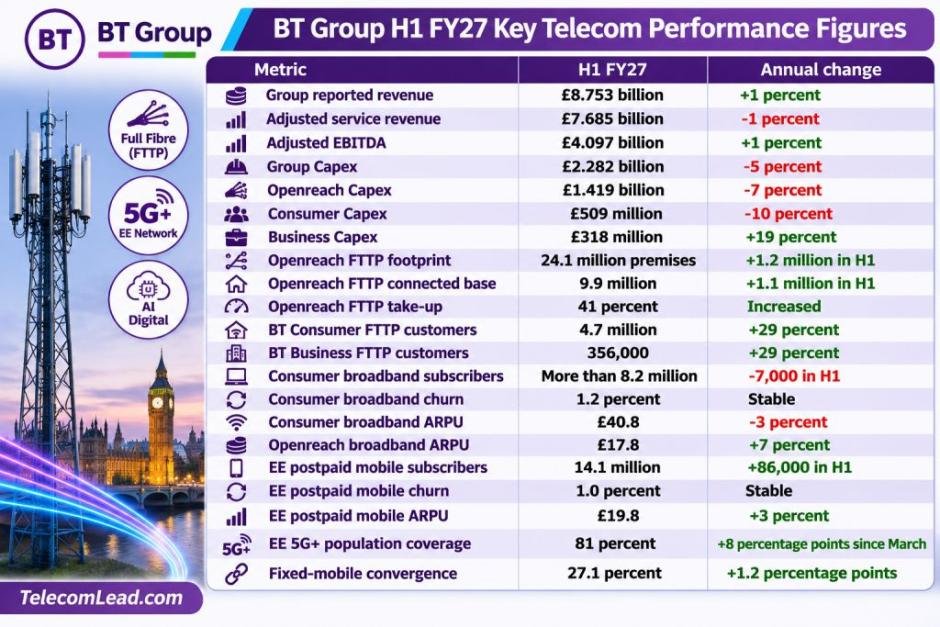
Openreach increased its fiber-to-the-premises (FTTP) network footprint to 24.1 million premises, adding 1.2 million during the six-month period. Its full-fiber connected customer base reached 9.9 million, with more than 10 million connections achieved in October 2026.
EE expanded 5G+ population coverage to 81 percent from 73 percent in March 2026. BT’s Consumer division reported 14.1 million postpaid mobile subscribers and more than 8.2 million broadband customers.
According to BT Group’s financial results and investor disclosures, the company generated revenue of £8.753 billion, representing 1 percent annual growth, while adjusted EBITDA increased 1 percent to £4.097 billion.
BT also reaffirmed its FY27 Capex guidance of £4.2 billion–£4.3 billion, excluding spectrum investment, and outlined plans to reduce annual capital expenditure by more than £1 billion from FY26 levels by the end of the decade.
BT Group Capex Declines 5 Percent to £2.282 Billion
BT Group reduced capital expenditure to £2.282 billion during H1 FY27 from £2.390 billion in the corresponding period of FY26.
The decline reflected lower fiber construction activity as Openreach moved closer to its medium-term FTTP deployment target.
Cash capital expenditure declined 1 percent to £2.518 billion from approximately £2.533 billion.
Openreach reported Capex of £1.419 billion, down 7 percent from £1.529 billion, reflecting reduced FTTP construction and Ethernet provisioning volumes, partly offset by increased fiber connection activity.
BT’s Consumer division reduced Capex by 10 percent to £509 million from £567 million, primarily reflecting lower spending on core systems and IT operations.
The Business division increased Capex by 19 percent to £318 million from £268 million, driven by higher customer-related investment and digital transformation expenditure.
BT expects Openreach Capex in the second half of FY27 to decline by approximately 30 percent year over year because of lower fiber construction volumes.
For the full financial year, BT expects capital expenditure excluding spectrum of £4.2 billion–£4.3 billion.
The company also expects annual Capex to decline by more than £1 billion from FY26 levels by the end of the decade.
Openreach Fiber Network Expands to 24.1 Million Premises
Openreach increased its FTTP footprint to 24.1 million premises at the end of September 2026, following the addition of 1.2 million premises during the first half.
The company expects to achieve its target of passing 25 million premises by March 2027.
Openreach recorded more than 1.1 million net FTTP connections during the six-month period, taking its connected base to 9.9 million.
The operator crossed 10 million FTTP connections in October 2026, marking a significant milestone in the UK’s transition from copper to fiber broadband.
The FTTP take-up rate increased to 41 percent, reflecting stronger demand across the expanded network.
Full-fiber connections now account for more than 50 percent of Openreach’s broadband lines.
The Openreach full-fiber broadband network continues to support retail service providers as they migrate customers from legacy copper networks to higher-speed fiber connectivity.
Openreach reported adjusted revenue of £3.160 billion during H1 FY27, representing 1 percent growth from £3.131 billion.
Adjusted EBITDA increased 4 percent to £2.238 billion from £2.148 billion.
Openreach’s broadband ARPU increased 7 percent to £17.8, supported by inflation-linked price increases, higher FTTP adoption and customers selecting faster broadband packages.
BT Broadband Subscribers Exceed 8.2 Million
BT’s Consumer division reported more than 8.2 million broadband subscribers at the end of September 2026.
The broadband customer base declined by 7,000 during the first half, partly reflecting the introduction of an activation fee.
Consumer broadband churn remained stable at 1.2 percent.
Broadband ARPU declined 3 percent to £40.8, reflecting lower voice revenue and competitive pricing in the UK broadband market.
Despite the overall decline in broadband subscribers, BT achieved record growth in retail FTTP adoption.
The Consumer FTTP subscriber base increased by 574,000 during the six-month period to 4.7 million, representing 29 percent annual growth.
Full-fiber customers accounted for 58 percent of BT Consumer’s broadband subscriber base.
The Business division also expanded its FTTP customer base by 29 percent year over year to 356,000.
BT reported that its Consumer and Business FTTP customer bases together reached approximately 5.1 million.
The combined FTTP share of BT’s retail broadband customer base increased to 54 percent.
Openreach Broadband Line Losses Reach 366,000
Openreach recorded broadband line losses of 366,000 during the first half of FY27.
The company lost 175,000 broadband lines during the second quarter alone.
BT expects Openreach broadband line losses to reach approximately 800,000 during the full financial year.
The decline reflects intense competition from alternative fiber network operators and changing broadband market dynamics.
Openreach is attempting to offset these losses through higher FTTP adoption, faster broadband packages and improved ARPU.
Its full-fiber take-up rate of 41 percent and 7 percent ARPU growth indicate that increasing fiber penetration is helping support revenue despite the decline in total broadband lines.
EE 5G+ Population Coverage Reaches 81 Percent
EE, BT Group’s mobile network operator, expanded its 5G+ population coverage to 81 percent at the end of September 2026.
Coverage increased from 73 percent in March 2026, representing an improvement of 8 percentage points over six months.
The expansion supports BT’s strategy of strengthening mobile network capacity, improving customer experience and introducing advanced 5G services.
EE also launched the UK’s first commercial 5G+ network slicing service for consumers and businesses.
The service, marketed as Fast Lane, provides differentiated mobile connectivity for applications requiring more consistent network performance.
The technology supports business activities including mobile payments, video communications and other digital services.
EE was recognised as the UK’s best mobile network for the 13th consecutive year by RootMetrics.
Customers can review the operator’s EE mobile network and 5G coverage to understand the availability of mobile connectivity services.
BT’s H1 FY27 report does not disclose a separate 5G subscriber count, number of 5G base stations or dedicated 5G Capex.
EE Postpaid Mobile Subscribers Reach 14.1 Million
BT Consumer reported 14.1 million postpaid mobile subscribers at the end of September 2026.
The company added 86,000 net postpaid mobile subscribers during the first half of FY27.
Postpaid mobile churn remained low at 1.0 percent.
Postpaid mobile ARPU increased 3 percent year over year to £19.8.
The improvement in ARPU reflects stronger mobile monetization despite competitive conditions in the UK telecom market.
BT also increased the proportion of customers subscribing to both fixed broadband and mobile services.
Fixed-mobile convergence reached 27.1 percent, compared with 25.9 percent a year earlier.
The increase of 1.2 percentage points was supported by the launch of EE One Up, BT Mobile and other bundled connectivity offerings.
BT’s Consumer division also recorded 26,000 net TV customer additions during the first half.
BT Group Revenue Increases 1 Percent to £8.753 Billion
BT Group reported revenue of £8.753 billion during H1 FY27, compared with £8.700 billion in the corresponding period of FY26.
The 1 percent increase was supported by higher handset revenue in the Consumer business.
Adjusted revenue increased 1 percent to £8.750 billion from £8.696 billion.
Adjusted service revenue declined 1 percent to £7.685 billion from £7.726 billion, reflecting continued pressure from legacy voice services.
Adjusted EBITDA increased 1 percent to £4.097 billion from £4.060 billion.
BT’s Consumer division reported adjusted revenue of £4.783 billion, representing 2 percent growth from £4.684 billion.
Consumer adjusted EBITDA declined 1 percent to £1.255 billion.
BT Business reported adjusted revenue of £2.574 billion, down 1 percent from £2.589 billion.
Business adjusted EBITDA declined 7 percent to £601 million.
Openreach reported adjusted revenue of £3.160 billion, up 1 percent, while adjusted EBITDA increased 4 percent to £2.238 billion.
For FY27, BT expects adjusted revenue of £17.1 billion–£17.6 billion and adjusted service revenue of £15.1 billion–£15.4 billion.
The company expects adjusted EBITDA of £8.1 billion–£8.2 billion.
These financial figures are presented on a continuing-operations basis following BT’s decision to classify its International business as a discontinued operation.
BT Business Increases Capex 19 Percent, Expands Digital and AI Services
BT Business increased Capex by 19 percent to £318 million during H1 FY27, compared with £268 million a year earlier.
The higher investment supported new customer contracts, digital transformation and network modernization.
BT Business reported adjusted revenue of £2.574 billion, down 1 percent, while service revenue declined 1 percent to £2.348 billion.
The company reported strong sales order growth, including new contracts with Scottish Water, Royal Mail, the Ministry of Justice and the Cabinet Office.
BT also expanded its artificial intelligence portfolio through the launch of AI from BT, a range of AI-enabled business services.
The first product, AI Receptionist, is designed to help businesses manage customer communications and automate routine interactions.
BT strengthened its cybersecurity partnership with Microsoft to combine network intelligence, security operations and cloud-based security technologies.
The company also became the first non-US partner for Anthropic’s Project Glasswing initiative.
BT is deploying AI internally to improve network operations and customer experience through an AI Ops programme supported by ServiceNow.
The company’s BT Business digital and connectivity services include network, cybersecurity, cloud and AI-enabled solutions for enterprise and public-sector customers.
BT did not disclose separate revenue from AI services, AI customer numbers or dedicated AI Capex in its H1 FY27 results.
BT Group Outlook: Lower Capex, Higher Fiber Adoption and Expanded 5G Coverage
BT Group’s H1 FY27 results show that the operator is moving from large-scale fiber construction toward higher utilization of its existing network infrastructure.
Openreach is approaching its 25 million-premises FTTP build target, with connected customers exceeding 10 million in October 2026.
The company’s fiber strategy is supporting higher broadband ARPU, although competitive pressure continues to affect total broadband line numbers.
EE’s 5G+ population coverage reached 81 percent, while postpaid mobile ARPU increased 3 percent and churn remained at 1.0 percent.
BT expects lower Capex to support its financial performance as network construction activity declines.
The operator reaffirmed its target of approximately £2 billion in normalized free cash flow during FY27, excluding the effects of the TalkTalk acquisition, and approximately £3 billion by the end of the decade.
BT also expects its ongoing transformation programme to generate £3.5 billion in annualized gross cost savings by FY30, with £1.7 billion of cumulative annualized savings already achieved.
The company’s investment priorities remain focused on expanding fiber connections, improving mobile coverage, increasing customer adoption of converged services and developing digital, cybersecurity and AI-enabled business solutions.
BABURAJAN KIZHAKEDATH