Samsung Electronics is accelerating its artificial intelligence (AI) push, announcing plans to double the number of its mobile devices equipped with AI features powered by Google’s Gemini platform to 800 million by 2026.
The move underscores Samsung’s ambition to strengthen its competitive edge in the intensifying global AI race while reclaiming leadership in the smartphone market from Apple and countering fast-growing Chinese rivals, Reuters news report said.
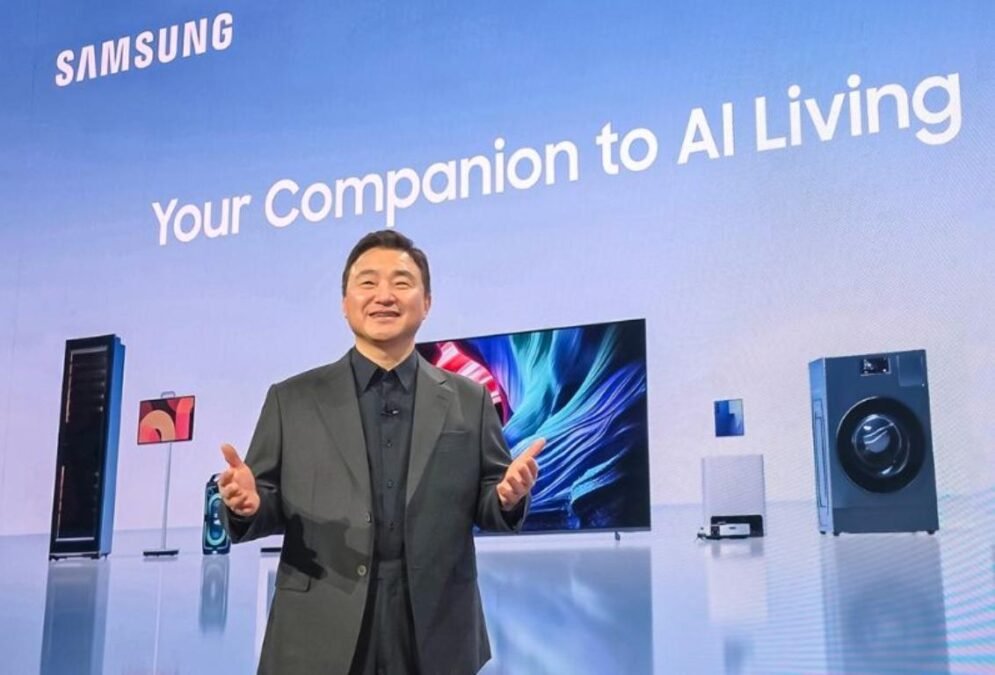
Samsung Electronics co-CEO T M Roh said the company would expand AI integration across its entire product portfolio. “We will apply AI to all products, all functions, and all services as quickly as possible,” Roh said, signaling a broad strategy that extends beyond smartphones to tablets, televisions, and home appliances.
Gemini AI at the Core of Samsung’s Strategy
Samsung had rolled out Gemini-backed AI features to around 400 million mobile products, including smartphones and tablets, by the end of last year. The plan to double this figure by 2026 positions Samsung as the largest hardware backer of Google’s Android ecosystem and a key distribution channel for Gemini AI at scale.
This expansion is expected to give Google a significant advantage in its competition with OpenAI and other AI model developers vying for consumer adoption. Alphabet’s Google launched the latest version of Gemini in November, highlighting Gemini 3’s strong performance across several industry benchmarks. In response, OpenAI reportedly accelerated its development roadmap and released its GPT-5.2 model weeks later, underscoring how rapidly the AI rivalry is escalating.
Integrated AI to Differentiate from Apple
Samsung aims to offer integrated AI services across consumer devices, widening its lead over Apple in on-device AI features. While Apple was set to reclaim the top spot in global smartphone shipments last year, according to Counterpoint, Samsung is betting that AI-driven differentiation will influence future buying decisions.
Consumer awareness of Samsung’s Galaxy AI brand has surged sharply, jumping to about 80 percent from roughly 30 percent within a year.
Consumers rely heavily on AI-powered search on smartphones, but Roh highlighted growing usage of generative AI tools for image editing, productivity, translation, and content summaries. These features are becoming central to how users interact with their devices, strengthening Samsung’s case for expanding AI across its ecosystem.
Memory Chip Shortage Poses Challenges
Despite optimism around AI, Samsung is navigating headwinds from a global memory chip shortage. While higher memory prices benefit Samsung’s semiconductor division, they pressure margins in the smartphone business, its second-largest revenue source.
Market researchers, including IDC and Counterpoint, have warned that the global smartphone market could shrink next year as rising component costs push up device prices.
IDC report indicated that global smartphone market will face a 1 percent decline in shipments in 2026 due to memory component shortages. Smartphone ASP will rise to $465 and smartphone market value will reach record high of $579 billion in 2026 due to memory component shortages.
Foldables and Future Growth
Samsung acknowledged that growth in the foldable smartphone segment, which it pioneered in 2019, has been slower than initially expected. Roh attributed this to engineering complexities and a shortage of applications optimized for foldable designs. However, he remains confident that foldables will enter the mainstream within the next two to three years.
Customer loyalty in the segment remains strong, with a very high proportion of foldable phone users opting for another foldable in their next purchase. Samsung controlled nearly two-thirds of the global foldable smartphone market in the third quarter of 2025, according to Counterpoint, but faces mounting competition from Chinese manufacturers such as Huawei and the expected entry of Apple into the foldable category.
Worldwide foldable smartphone shipments are forecast to grow 10 percent in 2025 to 20.6 million units, IDC said.
AI as Samsung’s Long-Term Differentiator
By doubling its AI-enabled device base and embedding Gemini-powered features across its product lineup, Samsung is positioning AI as a core differentiator in an increasingly saturated hardware market. As competition intensifies across smartphones, consumer electronics, and emerging form factors, Samsung’s ability to scale AI experiences to hundreds of millions of users could prove decisive in shaping the next phase of the global technology race.
BABURAJAN KIZHAKEDATH