
Qualcomm, MediaTek and Samsung Electronics are competing for leadership in the 5G smartphone chipset market through faster modems, improved power efficiency, satellite connectivity and smartphone design wins. Their strategies differ significantly: Qualcomm is advancing 5G-Advanced modem technology, MediaTek leads global smartphone chipset shipments, and Samsung is expanding Exynos adoption.
In Q2 2026, MediaTek captured 31 percent of global smartphone processor shipments, followed by Qualcomm at 23 percent and Samsung at 9 percent, according to Counterpoint Research.
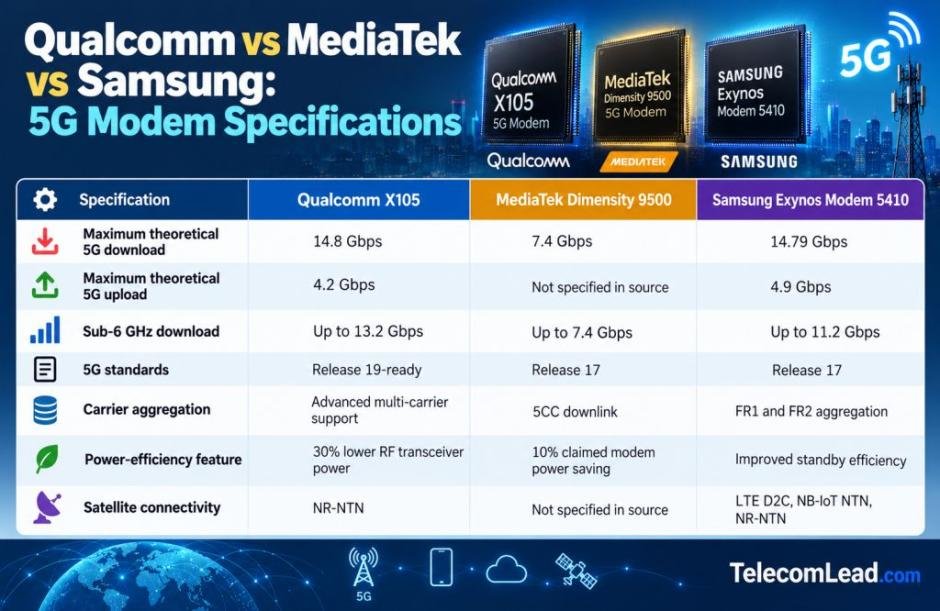
Meanwhile, Qualcomm’s X105 modem offers theoretical download speeds of 14.8 Gbps, compared with 14.79 Gbps for Samsung’s Exynos Modem 5410 and 7.4 Gbps for MediaTek’s Dimensity 9500.
However, these figures represent different modem configurations and should not be interpreted as directly comparable real-world smartphone speeds.
Qualcomm X105: 14.8 Gbps 5G-Advanced Modem
Qualcomm introduced its X105 5G Modem-RF system in March 2026, targeting premium smartphones and next-generation connected devices.
The platform supports theoretical peak downloads of 14.8 Gbps and uploads of 4.2 Gbps.
Its sub-6 GHz download capability reaches 13.2 Gbps, making the platform relevant to operators expanding advanced 5G capacity.
According to the Qualcomm X105 announcement, the platform incorporates a 6nm RF transceiver designed to reduce power consumption by up to 30 percent and board footprint by 15 percent compared with its predecessor.
Qualcomm also claims up to 60 percent higher throughput through enhanced dual-SIM dual-active technology under specified conditions.
Its fifth-generation AI processor supports traffic optimisation, congestion management and network transitions.
Integrated NR-NTN technology extends the platform’s capabilities toward satellite messaging, voice, video and data services.
Qualcomm began sampling X105 in March, with commercial devices expected during the second half of 2026.
MediaTek Dimensity 9500: Focus on Efficiency and Sub-6 GHz Networks
MediaTek’s Dimensity 9500 combines flagship smartphone processing with integrated 5G connectivity.
Its modem supports theoretical peak sub-6 GHz download speeds of 7.4 Gbps, five-component-carrier aggregation and 350 MHz of downlink bandwidth.
It also supports 200 MHz uplink carrier aggregation, 5G Standalone, Non-Standalone and dual-SIM dual-active operation.
According to the MediaTek Dimensity 9500 specifications, the company’s 5G UltraSave technology uses AI traffic prediction to reduce modem power consumption by a claimed 10 percent.
MediaTek also reports that its AI Network Suite can reduce latency by up to 50 percent under specified conditions through congestion prediction and intelligent handover management.
The chipset additionally supports Wi-Fi 7 with theoretical speeds reaching 7.3 Gbps.
MediaTek’s approach is particularly relevant to smartphone manufacturers competing on battery life, mobile data reliability and device cost.
However, the claimed improvements require independent device-level testing before conclusions can be drawn about superiority over competing modems.
Samsung Exynos Modem 5410: 14.79 Gbps and Satellite Connectivity
Samsung’s Exynos Modem 5410 supports theoretical peak 5G download speeds of 14.79 Gbps and uploads of 4.9 Gbps using simultaneous FR1 and FR2 connectivity.
The modem supports 11.2 Gbps downloads using FR1 frequencies alone, with up to 380 MHz of aggregated bandwidth.
Manufactured using 4nm EUV technology, the Exynos 5410 targets improved standby power efficiency.
The Samsung Exynos Modem 5410 specifications also highlight satellite communication capabilities.
These include LTE direct-to-cell, NB-IoT NTN and NR-NTN technologies supporting different communication requirements.
Potential applications include emergency messaging, location sharing and higher-bandwidth satellite connectivity.
Samsung’s Exynos 2600 processor separately uses 2nm gate-all-around manufacturing technology.
However, improvements in application processor efficiency should not be confused with measured modem power consumption.
5G Modem Power Efficiency: Which Supplier Performs Better?
Power efficiency is important because advanced 5G connectivity, carrier aggregation and AI workloads can increase smartphone energy consumption.
Qualcomm claims its X105 RF transceiver consumes up to 30 percent less power than the previous generation.
MediaTek reports a 10 percent modem power reduction through AI-assisted traffic prediction in Dimensity 9500.
Samsung highlights improved standby efficiency through its Exynos 5410 architecture and manufacturing technology.
These figures are not directly comparable.
Qualcomm’s improvement concerns its RF transceiver, MediaTek’s claim concerns a particular modem optimisation technique, and Samsung’s figures relate to its own architecture.
Actual battery life also depends on antenna efficiency, signal strength, carrier aggregation, smartphone software and network conditions.
A handset operating under weak coverage may consume more power than an equivalent device connected to a strong 5G signal.
Smartphone Chipset Market Share Q2 2026: MediaTek Leads
Counterpoint Research’s Q2 2026 data shows MediaTek maintaining its leadership in smartphone application processor shipments despite a decline in market share.
| Chipset supplier | Q2 2025 share | Q2 2026 share | Change |
| MediaTek | 36% | 31% | −5 pp |
| Qualcomm | 26% | 23% | −3 pp |
| Apple | — | 19% | — |
| UNISOC | — | 13% | — |
| Samsung | 6% | 9% | +3 pp |
| Huawei HiSilicon | — | 5% | — |
Source: Counterpoint Research. Prior-year figures are shown only where supplied. Market share measures application processor shipments, not standalone modem sales or revenue.
Global smartphone shipments declined 21 percent year over year in Q2 2026, while MediaTek and Qualcomm each experienced chipset shipment declines exceeding 30 percent.
Samsung increased its chipset share from 6 percent to 9 percent, supported by greater Exynos adoption.
The Counterpoint smartphone chipset market tracker provides the quarterly supplier comparison.
Smartphone Design Wins: Samsung, Xiaomi, OPPO, vivo and HONOR
Qualcomm retained an important position in premium Android smartphones.
Samsung Galaxy S26 Ultra uses Snapdragon 8 Elite Gen 5, while selected Galaxy S26 and S26+ models also incorporate Qualcomm processors.
Qualcomm platforms also feature in flagship smartphones from Xiaomi and other Android manufacturers.
MediaTek secured premium smartphone design wins through OPPO Find X9 and vivo X300 models powered by Dimensity 9500.
Its Dimensity 8500 also supported devices including Poco X8 Pro and HONOR Power 2.
MediaTek expanded its relationship with Samsung through Dimensity 9500 adoption in Galaxy Tab S12 Ultra and Galaxy Tab S12+ tablets.
Samsung’s Exynos 2600 appeared in selected Galaxy S26 models, while Exynos 1680 powered Galaxy A57 and Exynos 1480 supported Galaxy A37.
These deployments demonstrate how chipset competition spans premium smartphones, midrange devices and tablets.
Importantly, a smartphone using a particular application processor should not automatically be assumed to contain a separately announced modem such as Qualcomm X105 or Samsung Exynos 5410.
Telecom Operators and 5G-Advanced Opportunities
Qualcomm’s X105 ecosystem includes eight telecom operators: China Mobile, China Telecom, China Unicom, Deutsche Telekom, KDDI, Telstra, T-Mobile US and NTT Docomo.
Their involvement supports development and testing of advanced connectivity capabilities, including AI-assisted radio optimisation, uplink improvements and network evolution.
The X105 platform also targets fixed wireless access, connected vehicles, industrial IoT and mobile broadband equipment.
MediaTek’s sub-6 GHz modem portfolio is relevant to Android smartphones operating on large networks such as Reliance Jio, Bharti Airtel, Vodafone Idea and China Mobile.
Samsung’s Exynos modem strategy is relevant to operators distributing Galaxy devices and exploring satellite-enabled connectivity.
However, network compatibility does not necessarily indicate a specific commercial supply agreement or operator deployment.
Qualcomm vs MediaTek vs Samsung: Who Leads in 2026?
The competitive picture depends on the metric being evaluated.
Qualcomm leads this comparison in published 5G-Advanced modem capabilities, with X105 supporting 14.8 Gbps downloads, Release 19-ready features and a claimed 30 percent reduction in RF transceiver power consumption.
MediaTek leads global smartphone application processor shipment share, accounting for 31 percent of the market in Q2 2026. Its Dimensity portfolio emphasises sub-6 GHz connectivity, power efficiency and broad smartphone adoption.
Samsung recorded the strongest year-over-year market-share gain among the three suppliers, increasing its application processor share to 9 percent. Its Exynos 5410 also offers competitive theoretical 5G throughput and integrated satellite capabilities.
For smartphone manufacturers, the decision involves more than peak modem speed. Battery efficiency, antenna integration, component cost, software optimisation, satellite connectivity and operator certification all influence chipset selection.
For telecom operators, the next competitive phase will focus on how these technologies improve real-world 5G coverage, capacity, uplink performance and network reliability.
FASNA SHABEER


