
China’s smartphone market contracted sharply in the third quarter of 2026, with shipments declining 10 percent year over year, according to Counterpoint Research. Huawei and Apple strengthened their market positions while vivo, OPPO, Xiaomi and HONOR lost share amid rising memory prices, weaker consumer demand and longer smartphone replacement cycles.
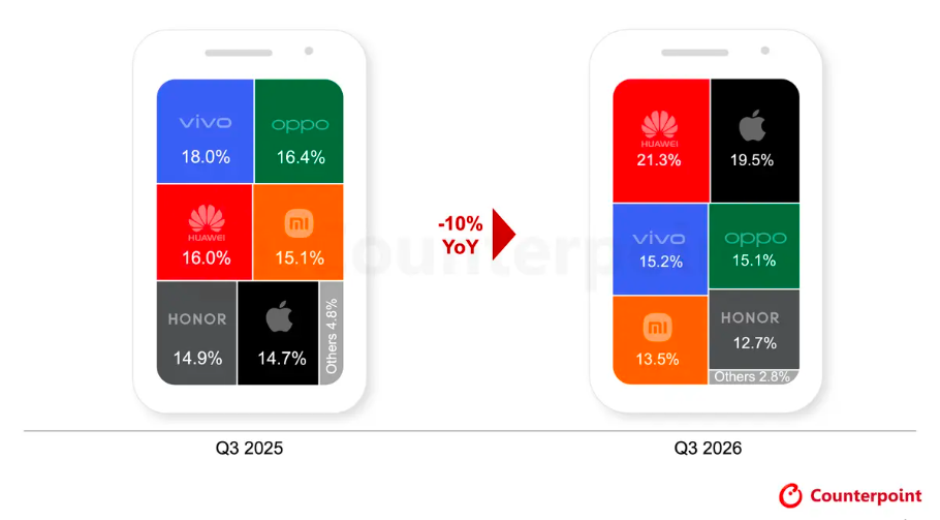
Huawei emerged as the largest smartphone brand with a 21.3 percent shipment share, followed by Apple at 19.5 percent. Together, the two companies controlled 40.8 percent of China’s smartphone market, compared with 30.7 percent a year earlier.
The results highlight a growing concentration of demand around Huawei’s HarmonyOS ecosystem and Apple’s premium iPhone portfolio.
China Smartphone Market Share Q3 2026: Top Six Brands
According to Counterpoint Research’s Q3 2026 smartphone market analysis, Huawei recorded the strongest market-share improvement among the six leading manufacturers.
Huawei and Apple gained a combined 10.1 percentage points, while the other four leading brands recorded declining shares.
Importantly, gaining market share does not necessarily indicate rising shipment volumes when the overall market is contracting.
Huawei Leads China Smartphone Market with 21.3% Share
Huawei strengthened its leadership with 19 percent year-over-year shipment growth, supported by demand for the Enjoy 90 Pro Max, Nova 16 and Mate 80 series.
Its portfolio covered affordable, mid-range and premium smartphone segments, helping the company reach customers with different budgets.
Huawei also benefited from HarmonyOS integration, foldable smartphones and connectivity with other Huawei devices.
The company’s 5.3-percentage-point market-share increase was the largest among the six leading vendors.
Huawei’s performance demonstrates how ecosystem differentiation and broad product coverage can support growth even during an industry downturn.
Apple Gains Share as iPhone 18 Pro Demand Strengthens
Apple increased its China smartphone market share from 14.7 percent to 19.5 percent, a gain of 4.8 percentage points.
The September launch of the iPhone 18 Pro contributed to its stronger position. Sales volumes during the first three weeks reportedly increased 23.5 percent compared with the corresponding launch period for the iPhone 17 Pro.
Apple’s decision to shift the standard iPhone 18 launch to 2027 also changed its product introduction schedule, placing greater emphasis on premium Pro devices during the quarter.
Strong demand for higher-priced iPhones contrasted with weaker replacement demand across much of the broader smartphone market.
vivo Falls to 15.2% Despite Premium Smartphone Expansion
vivo’s smartphone market share declined from 18 percent to 15.2 percent, representing a 2.8-percentage-point reduction.
The company continued investing in flagship imaging, AI photography and premium smartphone features.
Its iQOO portfolio targeted gaming consumers through high-refresh-rate displays, advanced processors and fast charging.
However, weaker promotional demand and rising component costs challenged sales performance.
The decline illustrates the difficulty of maintaining shipment momentum when manufacturers face both price-sensitive consumers and higher production expenses.
OPPO Market Share Declines to 15.1%
OPPO, including OnePlus and realme in Counterpoint’s reporting, recorded a 15.1 percent shipment share, compared with 16.4 percent a year earlier.
The company introduced the Find X10E as a more affordable flagship alternative and expanded its premium product portfolio.
OPPO also pursued greater integration across its smartphone brands, including software, product positioning and after-sales operations.
These measures were aimed at improving operating efficiency and strengthening competitiveness during a period of higher component costs.
Xiaomi Loses Share as Smartphone Prices Increase
Xiaomi’s China smartphone market share declined from 15.1 percent to 13.5 percent, a reduction of 1.6 percentage points.
The company faced pressure from higher manufacturing costs and weaker demand for smartphone replacements.
Xiaomi reportedly increased prices by CNY 300–500 across selected Xiaomi 17, REDMI K90 and Turbo 5 configurations during August.
The REDMI Note 17 Pro remained an important product, while Xiaomi adjusted its launch schedule and specifications to manage costs.
The company’s challenge is balancing premium smartphone ambitions with the price sensitivity of consumers in its traditional mass-market segments.
HONOR Drops to 12.7% Amid Intense Competition
HONOR’s market share declined from 14.9 percent to 12.7 percent.
The company expanded its Magic9 portfolio and introduced the Magic9 Super as a lower-priced flagship alternative.
Its X80 Pro Max, launched in late June, contributed to its Q3 product offering.
HONOR also promoted AI capabilities and its Robot Phone concept, featuring a gimbal-mounted camera.
These initiatives reflected its efforts to differentiate through imaging, hardware design and AI rather than competing solely on price.
Omdia Estimates China Smartphone Shipments at 59.3 Million
A separate Omdia Q3 2026 market report estimated that mainland China’s smartphone shipments declined 12 percent to 59.3 million units.
Omdia reported the following approximate vendor shipments:
| Smartphone vendor | Q3 2026 shipments |
| Huawei | 12.4 million |
| Apple | 11.6 million |
| vivo | 9 million |
| OPPO | 9 million |
| Xiaomi | 8 million |
Both reports indicate a significant market contraction and stronger competitive positioning for Huawei and Apple.
Memory Prices and AI Smartphones Reshape Competition
Rising DRAM and NAND memory prices increased smartphone production costs, putting pressure on manufacturers’ margins and retail pricing.
Vendors responded by reviewing memory configurations, specifications, product launches and pricing strategies.
Higher handset prices also encouraged some consumers to postpone upgrades or consider refurbished smartphones.
Meanwhile, AI features became important in product differentiation.
Omdia reported that 28 percent of Chinese consumers would consider changing smartphone brands for advanced AI capabilities.
This creates opportunities for manufacturers offering compelling AI photography, productivity, translation and device-assistant features, although consumer interest does not automatically translate into purchases.
China Smartphone Market Outlook for Q4 2026
Omdia forecast a roughly 7 percent decline in mainland China’s smartphone shipments for full-year 2026.
Huawei and Apple entered the fourth quarter with stronger market positions, while vivo, OPPO, Xiaomi and HONOR faced pressure to regain momentum through product launches and pricing strategies.
The key challenges remain component inflation, weaker replacement demand and increasing competition in premium smartphones.
China’s Q3 2026 results in the smartphone market show that market-share gains are concentrated among brands capable of combining strong product differentiation with consumer demand. Huawei’s ecosystem strategy and Apple’s premium positioning delivered gains, while competing Android manufacturers faced a more difficult environment for shipment growth.
FASNA SHABEER


