India’s smartphone market suffered a sharp slowdown in the second quarter of 2026 as the global memory chip shortage increased component costs, pushed prices to record levels and weakened demand among budget-conscious consumers.
Smartphone shipments declined 11.1 percent year over year to 33.2 million units in Q2 2026, according to the IDC Worldwide Quarterly Mobile Phone Tracker. Shipments during the first half of 2026 dropped 7.9 percent to 64.2 million units, marking India’s lowest first-half smartphone volume in five years.
Despite the shipment contraction, market value increased 1.7 percent in Q2 and 3.6 percent during H1 2026. IDC did not reveal the size of the Indian smartphone market in terms of revenue. The growth reflects a significant shift toward more expensive smartphones as vendors reduced discounts, scaled back entry-level launches and protected margins against rising memory costs, IDC report said.
India’s smartphone average selling price climbed 14.4 percent to a record $315 in Q2 2026. With lower-cost inventories expected to run out and limited scope for festive discounts, affordability pressures could intensify during the second half, Aditya Rampal, senior research analyst, Devices Research, IDC Asia Pacific, said.
Vivo Leads India Smartphone Market, Samsung Gains Share
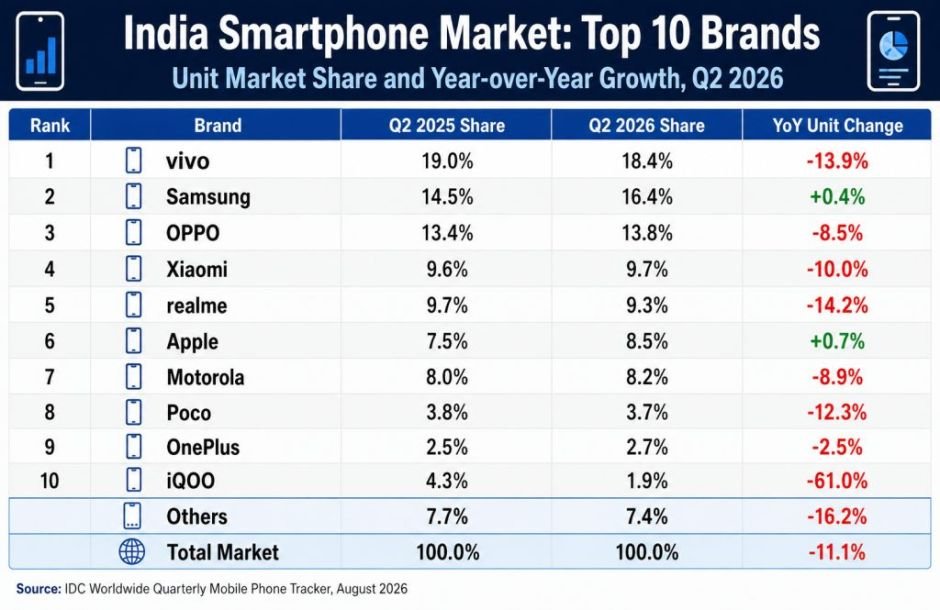
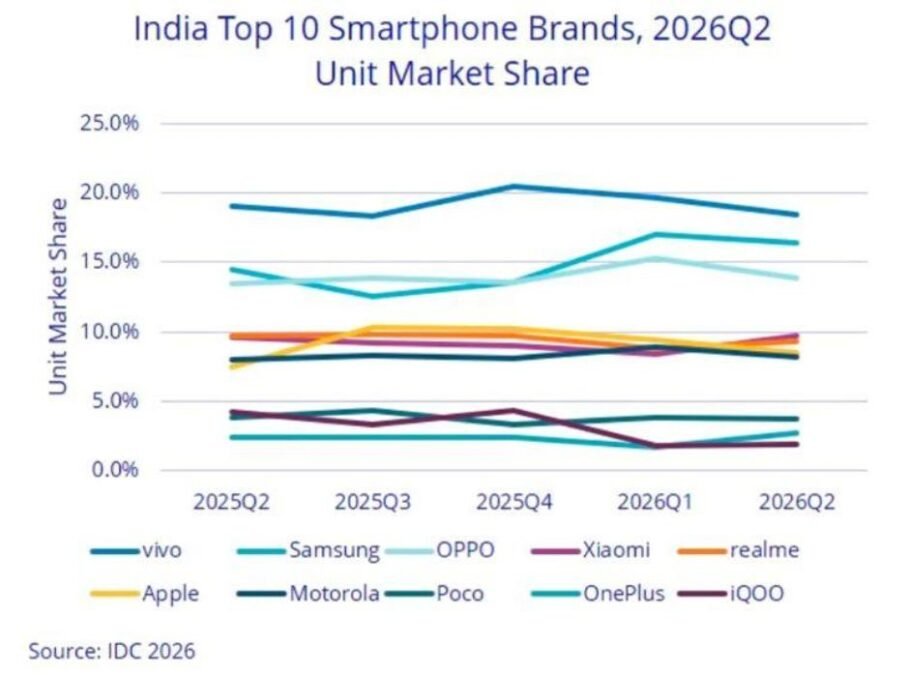
Vivo retained the number-one position despite its Q2 shipments declining 13.9 percent. Its market share decreased from 19 percent in Q2 2025 to 18.4 percent in Q2 2026.
Samsung was one of the few leading brands to record shipment growth. Its shipments increased 0.4 percent, while its market share expanded from 14.5 percent to 16.4 percent, strengthening its second-place position.
OPPO ranked third with a 13.8 percent share, up from 13.4 percent, although its shipments fell 8.5 percent. Xiaomi’s market share edged up from 9.6 percent to 9.7 percent despite a 10 percent shipment decline.
Realme remained fifth, but its share dropped from 9.7 percent to 9.3 percent as shipments contracted 14.2 percent.
Apple increased its market share from 7.5 percent to 8.5 percent, supported by shipment growth of 0.7 percent. Supply shortages affecting the iPhone 15, iPhone 16 and iPhone 17 limited stronger growth. However, the iPhone 17 remained India’s most-shipped smartphone for two consecutive quarters—Q1 and Q2 2026.
Motorola captured an 8.2 percent share, compared with 8 percent a year earlier, despite shipments falling 8.9 percent. Poco’s shipments declined 12.3 percent, reducing its share from 3.8 percent to 3.7 percent.
OnePlus recorded a comparatively moderate shipment decline of 2.5 percent and increased its market share from 2.5 percent to 2.7 percent.
IQOO experienced the steepest decline among the top 10 brands. Its shipments plunged 61 percent, and its market share dropped from 4.3 percent to 1.9 percent. Shipments from other brands declined 16.2 percent, reducing their combined market share from 7.7 percent to 7.4 percent.
Smartphones Below US$100 Collapse as Memory Costs Rise
The sub-US$100 smartphone segment was hit hardest by memory-related cost inflation. Shipments in the entry-level category plunged 74.3 percent year over year, while its share of the Indian market collapsed from 15.6 percent to only 4.5 percent.
Higher component costs have made it increasingly difficult for smartphone companies to generate sustainable margins from sub-US$100 devices. Vendors have consequently reduced new launches and channel support in this price band.
The steep entry-level decline particularly affected Chinese smartphone brands that traditionally relied on high volumes in the budget market. These companies are shifting their portfolios toward higher-margin devices but face the challenge of persuading price-sensitive customers to accept substantially higher prices.
4G Smartphone Share Rises to 11.1 Percent
The rising cost of entry-level 5G smartphones encouraged several brands to reintroduce or extend 4G models. This supply-led strategy increased the share of 4G smartphones to 11.1 percent during Q2 2026.
However, the 4G revival is expected to be temporary. Once available inventories are exhausted, entry-level consumers may have to purchase more expensive 5G smartphones, postpone upgrades or move toward second-hand devices.
US$400–600 Smartphone Segment Grows 60.3 Percent
India’s mid-premium smartphone category delivered the market’s strongest performance. Shipments of devices priced between US$400 and US$600 surged 60.3 percent year over year, while the segment’s market share nearly doubled from 4.8 percent to 8.6 percent.
The US$100–200 mass-budget segment remained India’s largest smartphone category, accounting for 46.8 percent of shipments. Volumes in this price band were flat, establishing it as the new value anchor for cost-conscious buyers displaced from the rapidly shrinking entry-level segment.
The US$200–400 category declined 8.1 percent, performing better than the overall market’s 11.1 percent contraction. Shipments in the US$600–800 segment were flat, while the premium US$800-plus category declined by a relatively modest 5 percent.
Both premium categories gained market share as smartphone demand moved away from the lowest price bands. Upgrade-focused and aspirational customers remained comparatively insulated from the affordability pressures affecting budget buyers.
Online Smartphone Shipments Drop 19.8 Percent
The decline was considerably more severe across online sales channels. Online smartphone shipments fell 19.8 percent year over year as e-commerce discounts and promotional offers became less attractive.
The online channel’s share dropped from 46.4 percent in Q2 2025 to 41.9 percent in Q2 2026. The absence of upfront flagship discounts and the erosion of entry-level smartphone availability weakened online volumes.
Offline smartphone shipments declined by only 3.6 percent. Physical retail’s share consequently increased from 53.6 percent to 58.1 percent as brands relied more heavily on stores to manage pricing pressures, offer financing and maintain consumer engagement.
Samsung and Apple Withstand Market Contraction
Samsung and Apple were the only top-10 smartphone brands to report shipment growth, at 0.4 percent and 0.7 percent, respectively.
Samsung’s scale, diversified product portfolio and supply-chain capabilities helped it maintain volumes while protecting margins. Apple’s core demand also remained resilient, although shortages affecting multiple iPhone generations and fewer affordability offers constrained shipments.
Chinese brands recorded more significant declines because of their greater exposure to entry-level and mass-budget smartphones. Financing schemes are also narrowing the effective price difference between categories, potentially encouraging consumers to choose brands with stronger premium positioning and supply stability.
Financing Could Replace Festive Smartphone Discounts
IDC said India’s record US$315 smartphone average selling price represents a reversal from Q2 2025, when brands introduced early festive discounts to generate demand.
Thinner margins have left smartphone companies and retailers with less capacity to use price reductions as a sales driver in 2026. Financing, EMI programmes and product differentiation within the fast-growing mid-premium category will therefore be critical during the festive season.
Early memory-price stabilisation, expanded financing availability and stronger festive footfall could support the market. However, a memory shortage extending into 2027, further macroeconomic pressure and purchase deferrals among entry-level consumers could deepen the downturn.
India Smartphone Shipments May Fall Below 130 Million in 2026
IDC expects India’s smartphone shipments to decline by more than 15 percent during the second half of 2026. Full-year shipments are projected to reach approximately 128 million to 130 million units.
Apple is likely to face similar supply-related challenges. Older iPhones could become more expensive, while the attractive festive discounts available in previous years are unlikely to return. IDC expects Apple’s India shipments to decline by a mid-single-digit percentage in 2026 after reaching 14.3 million units in 2025.
The major indicators to watch during the next quarter will be the availability of entry-level 4G inventory, the use of offline and financing-led sales channels, and whether the US$400–600 segment can sustain its 60.3 percent growth after the festive buying season.
India’s smartphone demand has not disappeared, but consumers are extending replacement cycles as prices increase. With component inflation spreading across every price band, buyers planning an upgrade may face even higher prices during the remainder of 2026.
BABURAJAN KIZHAKEDATH