Global smartphone shipments declined 4 percent year-on-year in the second quarter of 2026 (2Q26) as a prolonged memory chip crisis disrupted supply chains and sharply increased component costs, according to Omdia report.
The biggest impact was on the sub-$400 smartphone segment, where tight supply, thin profit margins, and price-sensitive consumers led to the steepest shipment declines, Runar Bjorhovde, Principal Analyst at Omdia. .
Omdia said some smartphone vendors are paying four to five times more for memory than a year earlier. Memory and storage now account for more than 60 percent of the bill of materials for budget smartphones and more than 30 percent for premium models, while additional semiconductor foundry bottlenecks continue to increase costs.
Omdia expects memory prices to begin easing no earlier than the second half of 2027, but not return to pre-2025 levels.
The research firm also forecasts the sharpest shipment declines over the next two quarters, prompting vendors to prioritize higher-priced devices during the 2026 sales season while many budget-conscious consumers delay purchases, seek financing, or buy refurbished smartphones.
Samsung and Apple Gain Smartphone Market Share in Q2 2026, Chinese Brands Decline
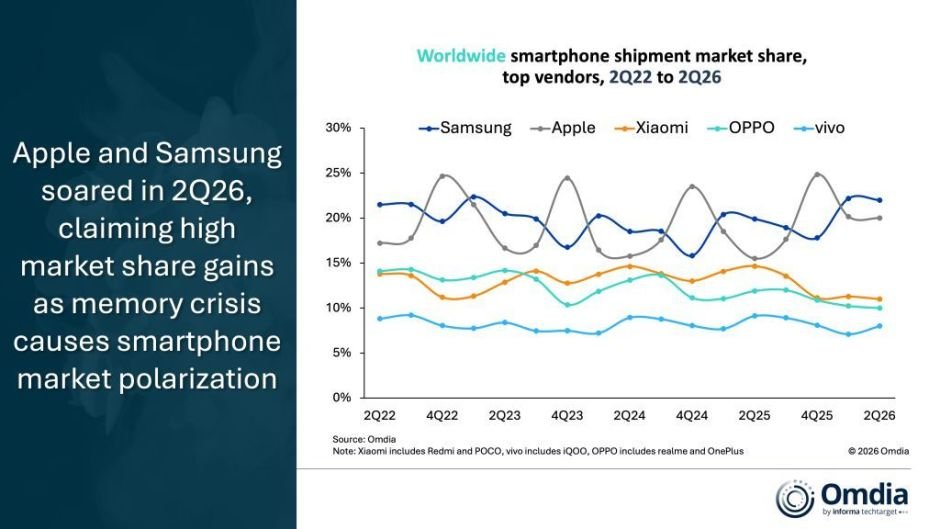
Omdia’s preliminary smartphone market share data for 2Q26 shows Samsung strengthening its leadership with a 22 percent market share, up from 20 percent in 2Q25.
Samsung retained its position as the world’s largest smartphone vendor in 2Q26 with a 22 percent market share, supported by resilient consumer demand and strong product availability. The delayed launch of the Galaxy S26 series shifted premium smartphone demand into the second quarter, while Samsung also expanded its presence in the budget segment as several Chinese competitors reduced product portfolios and increased device prices.
Apple recorded the biggest gain among the leading vendors, increasing its share to 20 percent from 16 percent a year earlier.
Apple recorded its strongest-ever second-quarter performance, achieving a record 20 percent market share during what is typically its weakest seasonal quarter. The iPhone 17 series delivered one of Apple’s strongest upgrade cycles, while stable iPhone pricing helped the company outperform rivals that were forced to raise prices. However, Omdia noted that Apple’s recent price increases across other product categories raise questions about whether iPhone prices could also increase later in 2026.
Chinese smartphone vendors lost market share during the quarter. Xiaomi declined to 11 percent from 15 percent, OPPO fell to 10 percent from 12 percent, and vivo slipped to 8 percent from 9 percent. The combined Others category remained unchanged at 29 percent, indicating that smaller smartphone brands collectively maintained their market position despite the industry’s overall challenges.
The market share changes suggest that Samsung and Apple strengthened their competitive positions during the supply-constrained quarter, while Xiaomi, OPPO, and vivo faced greater pressure amid rising component costs and weaker demand in the mass-market smartphone segment.
BABURAJAN KIZHAKEDATH