
The global smartphone replacement market is undergoing a major shift in 2026 as consumers keep their devices longer, memory costs increase and premium smartphones capture a larger share of spending. India and China offer substantial upgrade volumes, while the United States and Europe present opportunities for higher-value iPhone and Samsung Galaxy replacements.
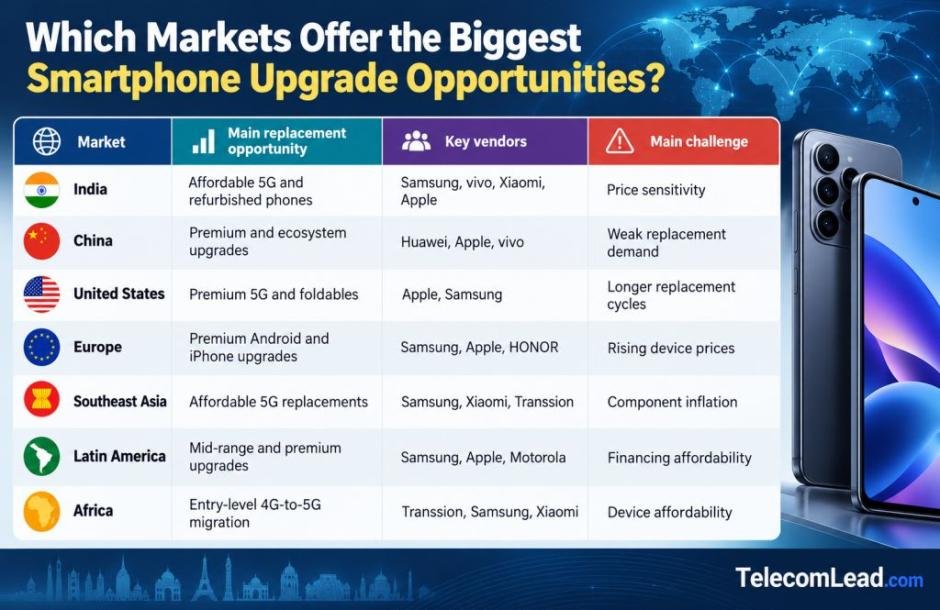
Southeast Asia, Latin America and Africa remain important markets for affordable 4G-to-5G upgrades, particularly through financing, trade-ins and refurbished smartphones.
According to IDC’s global smartphone market outlook, worldwide smartphone shipments are forecast to decline 16.7 percent to approximately 1 billion units in 2026. However, market value is projected to increase 6.3 percent to $613 billion as average selling prices rise 27.6 percent to $581.
This divergence between shipment volumes and revenue highlights an important industry trend: smartphone manufacturers depend on premium devices and higher selling prices rather than unit growth.
Smartphone Replacement Cycle Approaches Four Years
Consumers are extending smartphone replacement cycles toward four years as devices become more durable, software support improves and replacement costs increase.
Rising DRAM and NAND memory prices have intensified the pressure.
IDC estimates memory costs increased more than 300 percent year over year, making affordable smartphone production particularly challenging.
The sub-$100 smartphone category, which accounted for 173 million shipments in 2025, experienced a nearly 60 percent decline in Q2 2026.
According to Omdia’s Q3 2026 global smartphone report, worldwide shipments declined 20 percent year over year, following a 6 percent contraction in Q2.
Samsung secured 23 percent market share and Apple 22 percent, giving the two manufacturers a combined 45 percent.
The trend indicates growing concentration around manufacturers with stronger premium portfolios, supply chains and brand loyalty.
India: Major 4G-to-5G Upgrade Opportunity
India remains one of the largest potential markets for smartphone replacement because of its extensive mobile subscriber base and continuing transition toward 5G devices.
However, affordability is becoming a significant constraint.
Omdia’s India smartphone market report shows shipments declined 26 percent to 35.8 million units in Q3 2026, the lowest third-quarter volume since 2016.
| Smartphone brand | Q3 2026 shipments |
| Samsung | 6.7 million |
| vivo | 6.4 million |
| OPPO | 4.9 million |
| Xiaomi | 4.7 million |
| Apple | 3.9 million |
Samsung led with approximately 19 percent share, while Chinese brands collectively accounted for 68 percent, down from 75 percent a year earlier.
Reliance Jio, Bharti Airtel, Vodafone Idea and BSNL can stimulate replacement demand through affordable 5G devices, financing and trade-in programmes.
Samsung Galaxy A-series, Redmi, vivo and OPPO smartphones address mass-market upgrades, while Apple targets higher-value consumers.
India’s refurbished smartphone segment also offers opportunities. Counterpoint Research reported 13 percent growth in refurbished volumes during H1 2026, compared with an 11 percent decline in new smartphone shipments.
The opportunity is therefore shifting toward both affordable 5G replacements and refurbished premium devices.
China: Huawei and Apple Lead Premium Replacement Demand
China recorded 59.3 million smartphone shipments in Q3 2026, down 12 percent, according to Omdia.
Huawei shipped 12.4 million units, growing 18 percent, while Apple increased shipments 15 percent to 11.6 million.
| Smartphone brand | Q3 2026 shipments |
| Huawei | 12.4 million |
| Apple | 11.6 million |
| vivo | Approximately 9 million |
| OPPO | Approximately 9 million |
| Xiaomi | 8 million |
Huawei and Apple jointly controlled approximately 41 percent of the market.
Huawei benefits from its HarmonyOS ecosystem, foldable devices and premium Mate smartphones. Apple attracts buyers through its iPhone Pro portfolio and established ecosystem.
China Mobile, China Telecom and China Unicom can support upgrades through 5G packages and device financing.
China’s strongest opportunity lies in premium replacements rather than broad-based shipment expansion.
United States: High-Value iPhone and Samsung Upgrades
The United States offers a different replacement opportunity because of its substantial premium smartphone customer base.
Verizon, AT&T, T-Mobile, Xfinity Mobile and Spectrum Mobile support upgrades through installment plans, promotional credits and device trade-ins.
Apple iPhone 17 and iPhone 18 Pro models, alongside Samsung Galaxy S26 and Galaxy Z Fold8 devices, address premium replacement demand.
IDC forecasts a 6.3 percent smartphone shipment decline in North America during 2026.
However, devices priced above $800 represented approximately 60 percent of regional shipments in Q1.
This makes the United States particularly attractive for manufacturers seeking higher revenue per replacement.
For telecom operators, upgrade programmes can also support customer retention and premium postpaid subscriptions.
Europe: Samsung, Apple and HONOR Target Premium Buyers
Europe recorded 33 million smartphone shipments in Q1 2026, representing 2 percent annual growth.
Samsung shipped 12.6 million units, Apple 8.8 million and Xiaomi 4.5 million.
Motorola increased shipments 17 percent to 1.9 million, while HONOR recorded growth exceeding 60 percent.
Average smartphone selling prices reached €580, reflecting the growing importance of premium devices.
However, Omdia forecasts a 12 percent shipment decline for Europe in 2026.
Deutsche Telekom, Vodafone, Orange, Telefónica, EE and TIM can encourage upgrades through device financing, trade-ins and bundled connectivity plans.
Europe offers opportunities in premium Android smartphones, iPhones and foldables, although higher prices may lengthen replacement cycles.
Southeast Asia: Affordable 5G Devices Face Pricing Pressure
Southeast Asia remains a major market for affordable smartphone upgrades.
Omdia reported Q2 2026 shipments of 19.3 million units, down 23 percent year over year.
Market value reached $6.6 billion, while average selling prices increased 31 percent to $342.
The $100–199 segment represented 39 percent of shipments, compared with 32 percent previously.
Samsung increased its share of the $200–299 segment from 18 percent to 32 percent.
Meanwhile, Xiaomi’s shipments declined 21 percent despite a 43.5 percent increase in average selling price.
Telkomsel, Indosat, Globe, Smart, AIS, True and Viettel can stimulate upgrades through affordable 5G smartphones from Samsung, Xiaomi, TECNO and Infinix.
The principal challenge is maintaining affordability while component costs increase.
Latin America: Samsung Leads While Apple Expands Premium Share
Latin America’s smartphone shipments declined 10 percent in Q2 2026, according to Counterpoint Research.
Samsung increased shipments 6 percent and captured approximately 38 percent market share.
Apple recorded 5 percent growth and controlled 51 percent of smartphones priced above $600, compared with Samsung’s 40 percent.
Motorola shipments declined 14 percent.
Approximately 75 percent of regional smartphone sales remained concentrated in entry-level and mid-range categories.
Claro, Movistar, Vivo Brasil, TIM Brasil and Entel can support replacement demand through installment financing and trade-in programmes.
Samsung Galaxy A-series, Motorola Moto G and Redmi smartphones address affordability, while iPhones and premium Galaxy models target higher-spending consumers.
Africa: Affordable Smartphones and Financing Drive Upgrades
Africa presents substantial long-term opportunities for replacing older 3G and 4G devices with affordable 4G and 5G smartphones.
MTN, Airtel Africa, Vodacom, Orange and Safaricom can encourage upgrades through device financing, mobile-money-based payment arrangements and affordable data bundles.
Transsion’s TECNO, Infinix and itel brands compete alongside Samsung and Xiaomi in price-sensitive segments.
However, rising memory costs threaten the availability of entry-level smartphones.
Omdia forecasts the global sub-$200 smartphone segment will decline from 40.6 percent of shipments in 2025 to 25.6 percent in 2027.
The sub-$100 segment could shrink from 12.6 percent to 3 percent.
For African operators, affordable financing and refurbished devices may become important in expanding smartphone adoption.
Smartphone Replacement Market Outlook for 2027
The smartphone industry’s transition toward higher selling prices is expected to continue.
Omdia forecasts smartphones priced above $800 will increase their share of global shipments from 21.1 percent in 2025 to 28.4 percent in 2027.
For manufacturers, this creates opportunities to expand premium portfolios, AI capabilities, foldables and ecosystem services.
For telecom operators, financing, trade-ins, refurbished smartphones and bundled 5G plans can become important tools for encouraging replacements and retaining customers.
India and China offer substantial replacement-market scale, the United States and Europe provide premium revenue opportunities, and emerging markets depend more heavily on affordable financing and device availability.
The manufacturers and telecom operators that combine competitive pricing, differentiated products and accessible upgrade programmes will be better positioned to capture replacement demand as consumers retain smartphones for longer periods.
FASNA SHABEER


