
South Africa’s fixed broadband market in 2026 is undergoing one of the fastest digital transformations in Africa, driven by aggressive fiber expansion, 5G Fixed Wireless Access (FWA) growth, and rising consumer demand for reliable high-speed internet.
For internet customers searching for the best ISP in South Africa, the market offers a combination of open-access fiber networks, township-focused broadband expansion, gigabit connectivity, and increasingly competitive uncapped packages.
According to the latest ICASA State of the ICT Sector Report, South Africa’s telecommunications market reached approximately $11.21 billion in 2026. Data and internet services now contribute more than 55 percent of total industry revenue, highlighting the country’s shift from voice-centric telecom services toward a digital-first economy.
Fixed broadband connections increased by 19.3 percent year-on-year, reinforcing South Africa’s position as the leading broadband market in sub-Saharan Africa.
South Africa’s Open-Access Fiber Market Explained
South Africa’s broadband ecosystem operates differently from many global markets. The country uses an open-access model where Fiber Network Operators (FNOs) own the physical fiber infrastructure, while retail ISPs compete to provide internet services over those networks.
This structure has intensified competition among ISPs while accelerating broadband deployment into historically underserved communities.
Maziv (Vumatel and DFA)
Maziv remains the largest Fiber Network Operator in South Africa after Vodacom acquired a 30 percent stake in the business.
Vumatel, part of Maziv, now passes more than 2.05 million homes across South Africa. The company has expanded aggressively into township communities including Soweto, Khayelitsha, and Umlazi.
Maziv’s growth strategy includes:
Vuma Reach for households earning between 5,000 and 30,000 rand
Vuma Key prepaid broadband targeting households earning below 5,000 rand
A 9 billion rand investment plan focused on nationwide fiber expansion
The company is positioning itself as a major driver of digital inclusion by targeting underserved regions traditionally ignored by large telecom operators.
Openserve
Openserve, the wholesale fiber arm of Telkom, continues to lead South Africa’s market for network reliability and infrastructure consistency.
Openserve crossed 1.5 million homes passed in early 2026 while maintaining an industry-leading connectivity rate of 52.4 percent.
Key Openserve figures include:
Fiber-related data revenue growth of 8.7 percent
Fiber contributing 87 percent of operating income
Quarterly capital expenditure of 557 million rand
Modernization of 1,430 central offices
Expansion plans covering all 226 municipalities in South Africa
For broadband users prioritizing stable connectivity and strong infrastructure uptime, Openserve-backed ISPs continue to perform strongly across the country.
Frogfoot
Frogfoot plays a critical role in expanding broadband access beyond South Africa’s major metropolitan centers.
The company focuses heavily on smaller towns, agricultural regions, and coastal communities where broadband infrastructure has historically lagged behind Johannesburg, Cape Town, and Pretoria.
Although some consumers have reported peak-time congestion in remote regions, Frogfoot remains a major contributor to South Africa’s nationwide fiber rollout strategy.
Best ISPs in South Africa for Internet Customers
The retail broadband market is highly competitive, with ISPs differentiating themselves through customer support, latency performance, gaming optimization, and uncapped broadband offerings.
Afrihost
Afrihost was named ISP of the Year 2026 and currently leads the market with a customer satisfaction share of 72.7 percent.
Afrihost remains one of the most trusted ISPs for households seeking reliable broadband across multiple fiber networks including Vumatel, Openserve, and Frogfoot.
However, the company faced a major nationwide fiber outage in March 2026 caused by DHCP lease failures affecting multiple partner networks.
Consumers continue to praise Afrihost’s broadband reliability, though some users report frustration with automated WhatsApp-based support systems.
MWEB and Webafrica
MWEB and Webafrica now operate as a combined retail broadband powerhouse following operational integration.
The companies focus heavily on mainstream households seeking plug-and-play broadband simplicity and affordable uncapped fiber packages.
However, customers have reported administrative challenges during account migrations, including delayed responses and support communication gaps. Webafrica’s WhatsApp-only support model has also drawn criticism for long waiting times during outages.
Cool Ideas
Cool Ideas remains one of the top broadband choices for gamers, streamers, and power users.
The ISP consistently ranks highly for low-latency performance, stable international routing, and symmetrical fiber connectivity. By targeting premium users instead of mass-market consumers, Cool Ideas maintains strong evening-hour performance with minimal throttling.
For competitive gamers and hybrid workers requiring ultra-stable broadband, Cool Ideas continues to stand out in South Africa’s ISP market.
Supersonic
Supersonic has struggled with customer satisfaction in 2026, recording one of the industry’s lowest scores at 53.4 percent.
Customers have reported billing inaccuracies, payment disputes, installation delays, and poor communication. Some users also claim they were charged before services became active.
Despite integration with MTN’s wider ecosystem, Supersonic continues to face operational challenges.
What South African Broadband Customers Want in 2026
South African consumers are no longer looking only for basic internet access. Customers increasingly demand resilient digital ecosystems capable of supporting streaming, hybrid work, gaming, smart homes, and uninterrupted uptime during power outages.
Load-shedding resilience has become one of the country’s biggest broadband priorities. Many ISPs now bundle mini-UPS backup systems with fiber packages to keep routers operational during electricity outages.
The rise of prepaid fiber broadband is also transforming township connectivity. Flexible micro-voucher systems and no-contract models are becoming increasingly popular among consumers seeking affordable broadband without long-term commitments.
Consumers are also demanding direct access to human support agents instead of AI chatbots and automated support loops, creating an “anti-bot” sentiment across the industry.
Hybrid work has permanently increased demand for symmetrical upload and download speeds to support cloud backups, video conferencing, and remote collaboration.
South Africa Broadband Investment and Expansion
South Africa’s fixed broadband industry is seeing a major capital reallocation toward fiber and digital infrastructure.
Although total telecom investment declined by 2.3 percent year-on-year, spending on fixed infrastructure increased by 11.9 percent in 2026.
The Vodacom-Maziv partnership unlocked a 9 billion rand broadband expansion plan expected to:
Create 10,000 new jobs
Expand township fiber coverage
Deliver free internet access to public schools and clinics
Meanwhile, the government’s SA Connect Phase 2 initiative connected 6,343 government facilities using a 3 billion rand investment allocation.
Despite strong investment momentum, operators face mounting infrastructure security costs. Theft-related expenses surged by 189 percent recently, increasing pressure on operating margins.
South Africa is now targeting universal 100 Mbps broadband access by 2035 through a roadmap estimated to cost 142 billion rand, equivalent to roughly 14 billion rand annually through combined public and private investment.
Fiber vs 5G Fixed Wireless Access in South Africa
Fiber remains South Africa’s preferred broadband technology, but 5G Fixed Wireless Access is emerging as a major challenger.
The 5G FWA market is projected to reach $4.04 billion in revenue by 2030 with an extraordinary 40.9 percent compound annual growth rate.
ICASA approved a 3.2 percent increase in regulatory levies effective April 1, 2026, contributing to rising retail broadband prices.
Current broadband pricing includes:
30 Mbps to 50 Mbps packages: 497 to 727 rand monthly
100 Mbps to 200 Mbps packages: 897 to 1,167 rand monthly
1 Gbps premium fiber packages: 1,297 to 2,347 rand monthly
South Africa Broadband Speed Performance
South Africa currently leads sub-Saharan Africa in fixed broadband performance with a national median download speed of 48.4 Mbps.
Major cities including Johannesburg and Pretoria regularly exceed 88 Mbps median speeds.
Wi-Fi 7 routers and 2.5 Gbps Ethernet gateways are becoming mainstream among premium broadband packages, helping consumers overcome signal loss inside thick brick residential buildings common across South Africa.
The rise of uncapped fiber broadband has also accelerated streaming adoption. Traditional Pay-TV subscriptions declined by 9.6 percent as households increasingly shift toward internet-based entertainment platforms.
Group data revenue now contributes approximately 60 percent of total operator income, confirming South Africa’s transition into a fully data-driven broadband economy.
Which ISP is Best for Internet Customers in South Africa?
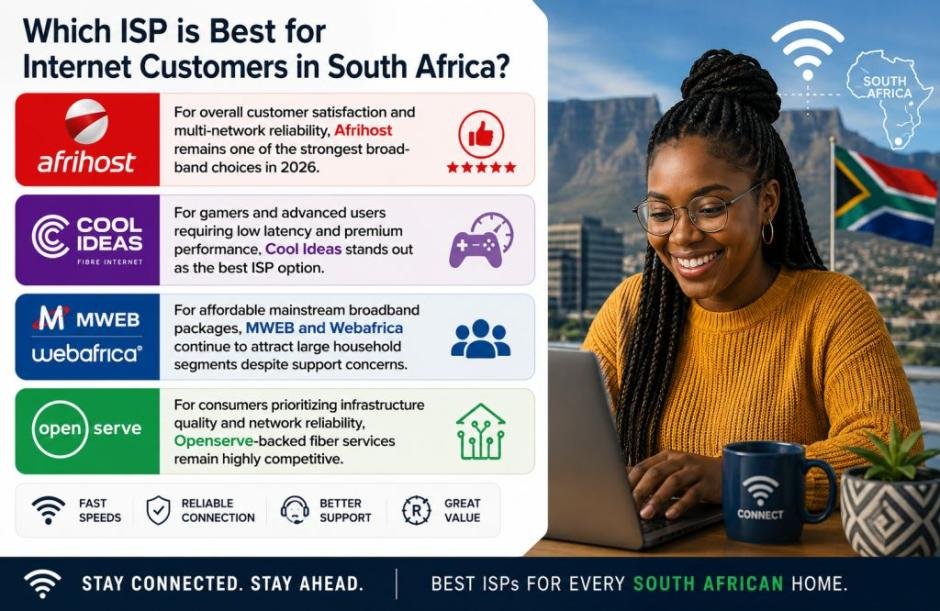
For overall customer satisfaction and multi-network reliability, Afrihost remains one of the strongest broadband choices in 2026.
For gamers and advanced users requiring low latency and premium performance, Cool Ideas stands out as the best ISP option.
For affordable mainstream broadband packages, MWEB and Webafrica continue to attract large household segments despite support concerns.
For consumers prioritizing infrastructure quality and network reliability, Openserve-backed fiber services remain highly competitive.
South Africa’s broadband market in 2026 demonstrates how fiber expansion, township connectivity, 5G wireless broadband, and open-access infrastructure are reshaping internet access across the African continent.
FASNA SHABEER

