
Wi-Fi performance across major airports in the Middle East and Turkiye shows wide disparities, according to Ookla’s analysis covering January to August 2025.
King Khalid International Airport in Riyadh (RUH) topped the list with the highest Wi-Fi download speed of 86.34 Mbps, while Dubai International Airport (DXB) and Hamad International Airport (DOH) recorded exceptional upload speeds of 101.86 Mbps and 96.45 Mbps, respectively.
Notably, DXB and DOH were the only airports where upload speeds surpassed download speeds. In contrast, Istanbul Airport (IST) and Sabiha Gokcen Airport (SAW) had the lowest overall Wi-Fi performance, with SAW recording just 9.69 Mbps download and 9.52 Mbps upload.
Airports in Abu Dhabi (AUH) and Kuwait (KWI) achieved mid-range results, whereas Sharjah (SHJ) and Muscat (MCT) lagged with sub-30 Mbps download speeds. The findings underscore significant variations in connectivity quality across the region’s airports, highlighting the need for consistent Wi-Fi infrastructure improvements to meet travelers’ growing digital expectations.
Wi-Fi quality in airport lounges across the Middle East and Turkiye generally surpasses that of public airport networks, though many still need upgrades to meet traveler expectations. As lounges gain popularity—especially among frequent and business travelers—reliable internet access has become a crucial factor in enhancing comfort and productivity.
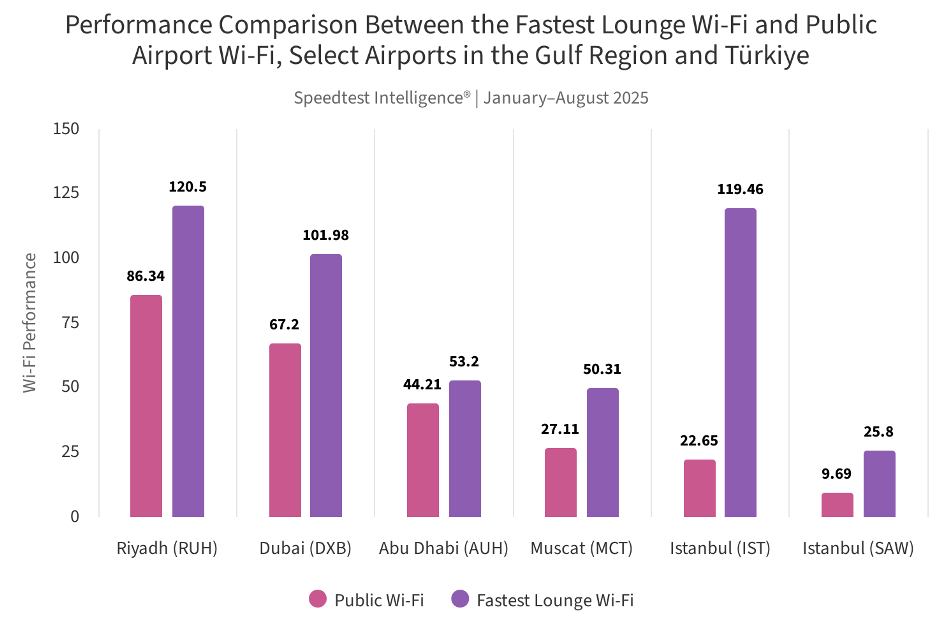
Ookla’s analysis using Speedtest Intelligence data found that lounge Wi-Fi typically delivers faster speeds than public networks. The largest performance gap was at Istanbul Airport (IST), where YOTEL lounge Wi-Fi reached 119.46 Mbps compared to the airport’s 22.65 Mbps public network.
Riyadh’s Al Fursan Lounge (120.5 Mbps) and Dubai’s Marhaba Lounge (101.98 Mbps) also offered significant improvements over free airport Wi-Fi.
In contrast, Abu Dhabi’s Pearl Lounge showed only a marginal advantage, while Sabiha Gökçen Airport (SAW) recorded the slowest lounge Wi-Fi at 25.8 Mbps. The findings highlight that while some lounges deliver premium connectivity, others must enhance their infrastructure to align with the expectations of today’s digitally connected travelers.
Wi-Fi performance varies widely even among lounges within the same airport, making the choice of lounge crucial for travelers seeking fast connectivity. In Riyadh’s King Khalid International Airport (RUH), the Al Fursan Lounge delivers impressive speeds of 120.5 Mbps, while the Plaza Premium and HAYYAK lounges lag behind with speeds below 22 Mbps.
At Istanbul Airport (IST), YOTEL lounges achieve more than double the speed of the iGA lounge, which records 48.32 Mbps. Dubai International Airport (DXB) also shows significant variation, with the Marhaba Lounge offering 101.98 Mbps compared to Emirates lounges at just over 60 Mbps and the Dubai International Hotel Lounge at 29.16 Mbps.
In contrast, Abu Dhabi (AUH) and Muscat (MCT) display more uniform but moderate speeds ranging between 40 and 55 Mbps. Overall, Ookla’s analysis reveals substantial disparities in Wi-Fi quality across and within airports in the Gulf region and Turkiye, emphasizing the urgent need for airport authorities and lounge operators to invest in stronger, more consistent Wi-Fi infrastructure. Enhancing network reliability can improve traveler satisfaction, strengthen customer loyalty, and give airports a competitive advantage as international travel continues to grow.
Baburajan Kizhakedath

