
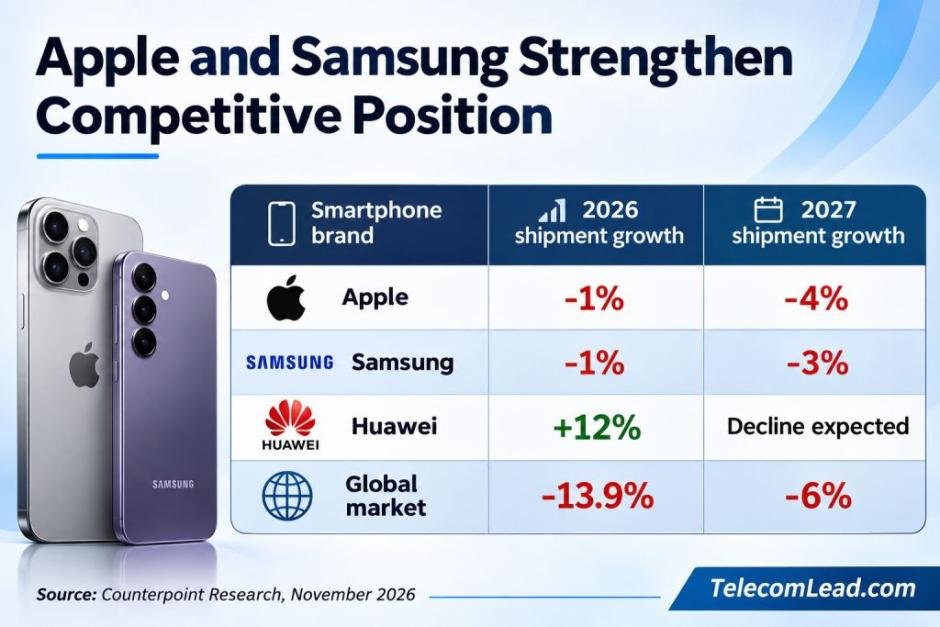
The global smartphone market is facing one of its most challenging periods, with shipments forecast to decline 13.9 percent in 2026 and a further 6 percent in 2027, according to Counterpoint Research’s Smartphone Market Outlook Tracker.
Rising memory chip prices, component shortages, weakening consumer affordability and competition from AI infrastructure companies for semiconductor supplies are reshaping the global smartphone industry.
Apple and Samsung are expected to outperform the smartphone market , while Xiaomi, OPPO, vivo, HONOR and other Android smartphone manufacturers face greater pressure because of their exposure to price-sensitive consumers and emerging markets.
Global smartphone shipments are forecast to recover by 6 percent in 2028 but are unlikely to return to 2025 levels even by 2030.
The forecast implies that global smartphone shipments will contract by approximately 19.1 percent between 2025 and 2027. Even after the projected recovery in 2028, shipment volumes will remain approximately 14.2 percent below 2025 levels.
AI infrastructure investment intensifies smartphone memory crisis
The expansion of AI data centers is altering semiconductor manufacturing priorities. Memory manufacturers are prioritizing high-bandwidth memory (HBM) and server DRAM, which offer attractive commercial opportunities compared with conventional mobile memory products.
Counterpoint Research expects further increases in LPDDR memory prices in early 2027, with limited prospects for immediate capacity expansion benefiting smartphone manufacturers.
According to IDC’s August 2026 smartphone market forecast, global smartphone shipments could decline 16.7 percent to just over one billion units in 2026. IDC estimates that:
Smartphone average selling prices will increase 27.6 percent to $581.
Global smartphone market value will grow 6.3 percent to $613 billion.
DRAM and NAND memory costs have increased by more than 300 percent year-on-year.
Smartphone shipments priced below $100 declined nearly 60 percent during Q2 2026.
Foldable smartphone shipments are forecast to increase 12.6 percent in 2026.
These projections highlight a structural transformation in the smartphone industry, where higher selling prices could support vendor revenue despite substantially lower shipment volumes.
Apple and Samsung strengthen competitive position
Apple is projected to retain its position as the world’s largest smartphone manufacturer by shipments in both 2026 and 2027, although its advantage over Samsung remains narrow.
Apple benefits from premium smartphone demand, customer loyalty, financing programs, supplier relationships and its integrated hardware and software ecosystem. However, increasing device prices and weakening replacement demand following the 2025–2026 upgrade cycle could restrict iPhone sales growth.
Samsung’s semiconductor manufacturing capabilities, diversified Galaxy portfolio and relationships with telecom operators and retailers provide greater flexibility in managing component shortages.
Samsung’s premium Galaxy S-series and foldable smartphones offer growth opportunities, but declining demand for affordable Galaxy A-series devices remains a significant challenge.
Both manufacturers are positioned to increase their market share despite experiencing shipment declines.
Xiaomi, OPPO, vivo and HONOR face pricing challenges
Chinese smartphone manufacturers face greater exposure to rising component costs because of their dependence on affordable Android devices and emerging markets.
Xiaomi, OPPO, vivo and HONOR are expected to experience another year of shipment pressure in 2027. Manufacturers are likely to reduce model launches, consolidate product portfolios, increase retail prices and prioritize markets offering stronger profitability.
The traditional strategy of offering higher RAM and storage configurations at competitive prices is becoming difficult to sustain.
Huawei represents a notable exception in 2026, with smartphone shipments forecast to increase 12 percent. Its domestic customer base, local semiconductor supply chain and HiSilicon processor development are supporting its competitive recovery in China.
However, Huawei is also expected to experience shipment contraction in 2027.
Affordable smartphones face structural decline
The smartphone market below $200 faces significant disruption as rising manufacturing costs undermine the commercial viability of entry-level devices.
According to Counterpoint Research’s earlier assessment of the smartphone memory crisis, LPDDR4 memory supply was tracking toward a decline exceeding 40 percent in 2026, threatening the availability of smartphones priced below $150 in some markets.
IDC estimates that approximately 173 million smartphones priced below $100 were shipped globally in 2025, representing a substantial market now facing severe affordability challenges.
Countries across India, Africa, Southeast Asia and Latin America remain particularly vulnerable because of their dependence on affordable Android smartphones.
Higher smartphone prices could also accelerate demand for refurbished devices, extend replacement cycles and delay migration from feature phones to smartphones.
For telecom operators, these developments could slow 5G smartphone adoption, constrain mobile data revenue growth and increase the importance of device financing, bundled subscriptions and handset trade-in programs.
Memory market shows early signs of adjustment
The TrendForce smartphone market bulletin published on November 26, 2026 identifies emerging pricing pressure on certain memory products amid weaker consumer electronics demand.
Production cuts for affordable smartphones are contributing to increasing LPDDR4X inventories at memory suppliers, including CXMT and SK hynix.
TrendForce expects NAND Flash pricing to weaken ahead of DRAM prices as Chinese memory manufacturer YMTC expands production capacity. However, semiconductor suppliers serving AI infrastructure customers and the HBM market continue to benefit from comparatively stronger pricing conditions.
This divergence suggests that relief for smartphone manufacturers could emerge unevenly across memory categories rather than through an immediate industry-wide reduction in component costs.
Smartphone manufacturing and supply chain impact
Declining handset orders are affecting original design manufacturers (ODMs), electronics manufacturing services (EMS) providers, semiconductor companies, display manufacturers and smartphone component suppliers.
Counterpoint Research reports substantially lower manufacturing capacity utilization as major Android smartphone vendors reduce procurement.
Companies across the smartphone supply chain face pressure to improve operational efficiency, consolidate manufacturing capacity and diversify into automotive electronics, industrial equipment, AI infrastructure and other emerging technology segments.
Smaller smartphone brands without substantial purchasing power, established distribution networks or sufficient financial resources face an increased risk of consolidation or market exit.
Smartphone market recovery expected in 2028
Counterpoint Research forecasts a 6 percent recovery in global smartphone shipments in 2028, supported by improving memory availability, component price stabilization and pent-up replacement demand.
Xiaomi, vivo, HONOR and OPPO are expected to register comparatively strong growth as Android smartphone affordability improves. Apple and Samsung are likely to experience more moderate recoveries from their relatively resilient shipment bases.
Emerging technologies such as foldable displays, on-device artificial intelligence, AI agents and advanced imaging systems will support premium smartphone sales and product differentiation.
The eventual commercialization of 6G smartphones could generate additional replacement demand toward the end of the decade. However, these technology developments are unlikely to trigger an immediate mass-market smartphone upgrade cycle.
The global smartphone industry’s recovery will ultimately depend on restoring consumer affordability rather than introducing additional premium features. With 2028 shipment volumes projected to remain approximately 14 percent below 2025 levels, smartphone manufacturers must prepare for a smaller, more concentrated and premium-oriented market.
BABURAJAN KIZHAKEDATH