
Chinese telecom equipment and technology giant Huawei faces fresh legal and regulatory challenges after a US federal jury convicted the company on 10 of 12 criminal charges involving its business operations in Iran, financial fraud, money laundering and the theft of American technology trade secrets.
The verdict, delivered on November 24, 2026, in Brooklyn, New York, marks a major development in an eight-year legal battle that has contributed to tensions between the United States and China over telecommunications infrastructure, intellectual property, semiconductor technology and national security.
Huawei was acquitted of two charges involving racketeering conspiracy and conspiracy to obstruct justice. The company disputed the legal basis of the convictions and indicated that it would pursue further legal action, Reuters reported.
Huawei faces financial penalties in 2027
The US Department of Justice confirmed that the convictions cover Huawei Technologies and three subsidiaries: Huawei Device, Futurewei Technologies and Huawei Device USA.
The sentencing hearing is scheduled for September 14, 2027. Huawei and its subsidiaries face potential criminal fines, asset forfeiture and restitution. The financial impact of the verdict remains uncertain because the court has not determined the penalties.
During the trial, prosecutors presented more than 60 witnesses, while Huawei’s defense team called 15 witnesses.
Huawei’s Iran business and global banking relationships
US prosecutors established that Huawei conducted business in Iran through Skycom while misrepresenting its relationship with the entity to international financial institutions.
The case involved Huawei’s banking relationships with HSBC, Standard Chartered and BNP Paribas. According to the Justice Department, Huawei’s misrepresentations enabled it to obtain billions of US dollars and access international dollar-clearing services.
Huawei’s operations in Iran included mobile network infrastructure, internet backbone technology and equipment that US authorities said supported government surveillance.
The defense maintained that international banks were aware of Huawei’s Iranian operations and continued competing for its business.
Technology theft allegations involving Cisco and T-Mobile
The criminal prosecution also examined Huawei’s acquisition of proprietary technology from American telecommunications and semiconductor companies.
Technology businesses involved in the case included Cisco Systems, T-Mobile, antenna manufacturer Quintel and semiconductor technology developer CNEX Labs.
The technologies examined during the trial included router source code, wireless antenna designs, touchscreen testing robotics and semiconductor-related hardware.
The Justice Department said Huawei obtained confidential antenna technology from Quintel under a non-disclosure agreement and subsequently incorporated confidential material into a patent application.
The verdict highlights the importance of intellectual property protection, patent ownership and technology-sharing agreements across the global telecommunications equipment industry.
Huawei generates $126 billion in revenue despite US technology restrictions
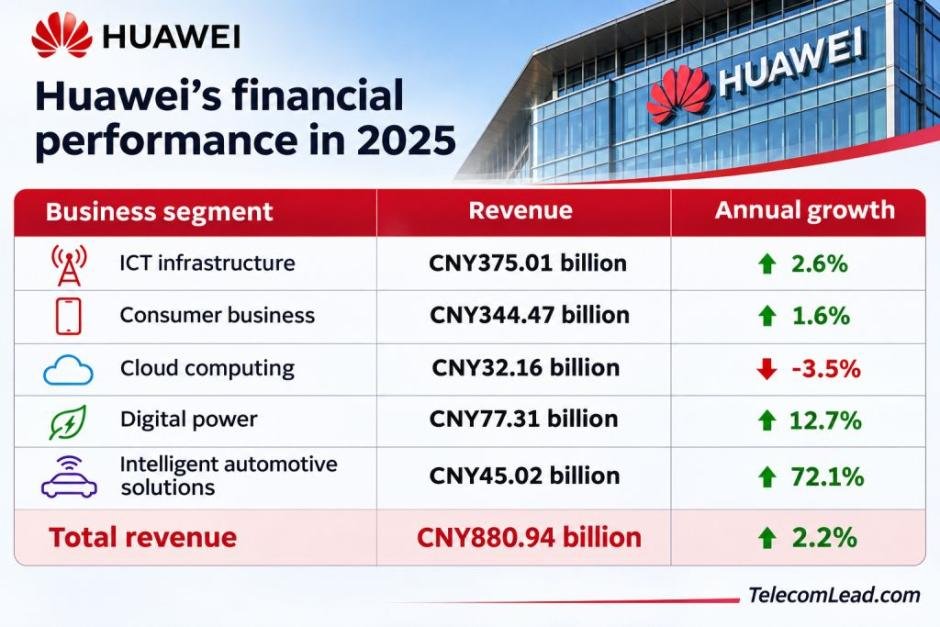
Despite years of American trade restrictions, Huawei has expanded its business across telecommunications infrastructure, artificial intelligence, cloud computing, smartphones, digital power and intelligent automotive solutions.
According to Huawei’s 2025 annual report, the technology company generated revenue of CNY880.9 billion ($126 billion), representing annual growth of 2.2 percent.
Huawei’s annual revenue increased by approximately 37 percent between 2022 and 2025, demonstrating its business resilience despite restrictions on access to advanced American technology.
China accounted for approximately 70 percent of Huawei’s global revenue in 2025, reducing its dependence on international markets.
Huawei generated CNY161.36 billion in Europe, the Middle East and Africa, representing growth of 8.8 percent, while Asia-Pacific revenue increased 15.7 percent to CNY50.11 billion.
Revenue from the Americas, which includes markets outside the United States, increased 2.4 percent to CNY37.18 billion.
Huawei’s $27.5 billion R&D investment strengthens technology independence
Huawei invested CNY192.3 billion ($27.5 billion) in research and development during 2025, equivalent to 21.8 percent of annual revenue.
According to Huawei’s corporate disclosures, the company’s cumulative R&D expenditure exceeded CNY1.382 trillion over a decade.
Huawei employs approximately 114,000 research and development professionals, representing 53.7 percent of its workforce, and held 165,000 active patents globally at the end of 2025.
The company’s investment strategy focuses on developing domestic alternatives to foreign technologies, particularly AI computing infrastructure, advanced telecom equipment, operating systems and enterprise cloud platforms.
Huawei reported more than 4 million developers within its Ascend AI computing ecosystem and 3.8 million developers within its Kunpeng computing ecosystem.
Huawei Cloud operated across 34 geographical regions and 101 availability zones at the end of 2025, with more than 1,800 customers using its AI Cluster Service.
US-China technology competition enters another phase
The US Bureau of Industry and Security added Huawei to its Entity List in May 2019, imposing licensing requirements on exports of controlled American technology. Another 46 Huawei affiliates were added in August 2019. The criminal conviction adds a distinct legal challenge to these existing export restrictions.
BABURAJAN KIZHAKEDATH