
Telecom operators in the Middle East and North Africa (MENA) are forecast to invest $88.9 billion between 2025 and 2030 in network infrastructure, 5G expansion and advanced connectivity, while mobile operator revenue is expected to increase from $79.5 billion in 2025 to $96.1 billion by 2030, according to the GSMA’s Mobile Economy Middle East and North Africa 2026 report.
GSMA’s Mobile Economy Middle East and North Africa 2026 report forecasts a 3.9 percent compound annual growth rate (CAGR) in telecom operator revenue, supported by expanding 5G adoption, network coverage, fixed wireless access (FWA), enterprise connectivity and digital services.
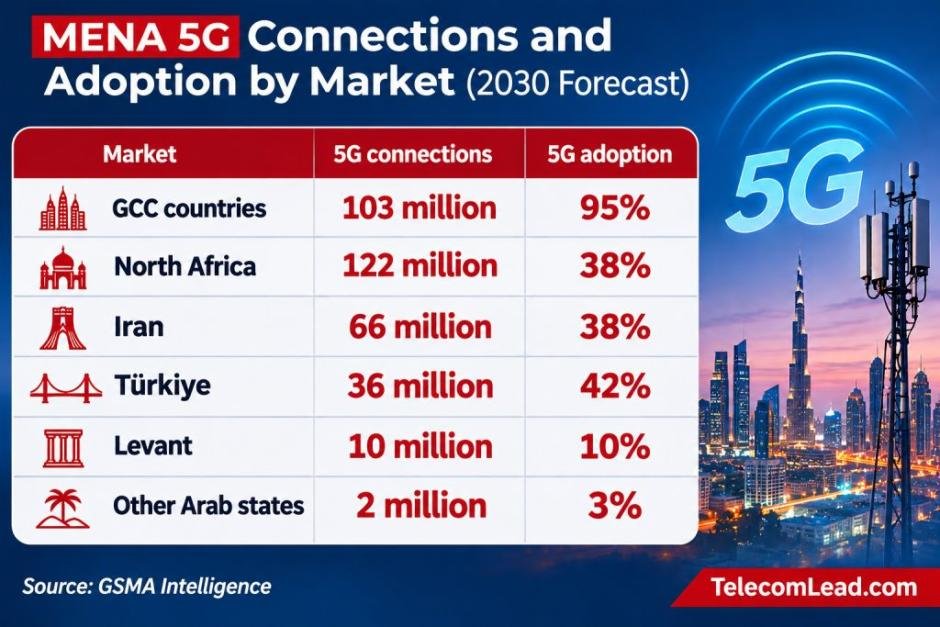
5G connections in MENA are projected to account for 40 percent of all mobile connections by 2030, compared with 9 percent in 2025. The Gulf Cooperation Council (GCC) markets are expected to lead regional adoption, reaching 95 percent by 2030.
5G Connections to Reach 414 Million in GCC Markets
The GSMA expects 5G adoption to accelerate across MENA as telecom operators expand coverage and migrate subscribers from 4G networks.
The GCC countries will remain the region’s most advanced 5G markets, with 103 million 5G connections forecast by 2030.
The GCC is expected to achieve substantially higher 5G adoption than the global forecast of 57 percent by 2030.
North Africa is projected to become a major contributor to regional 5G subscriber growth, with 122 million connections by 2030, although its adoption rate will remain below the GCC.
The UAE, Kuwait and Qatar are already among the region’s leading markets for 5G adoption, while Saudi Arabia, Bahrain and Oman continue expanding standalone 5G and 5G-Advanced capabilities.
Mobile Broadband Coverage Reaches 97% of MENA Population
Mobile broadband networks covered approximately 97 percent of MENA’s population in 2025, leaving a coverage gap of just 3 percent.
However, only 48 percent of the population used mobile internet, while another 49 percent lived within network coverage but remained offline.
The difference between network availability and subscriber adoption is particularly pronounced outside the GCC.
In high-income GCC markets, mobile internet penetration reached 91 percent of the population in 2025, compared with 43 percent in MENA’s low- and middle-income markets.
The GSMA identifies device affordability, digital skills and network migration as major factors affecting mobile internet subscriber growth.
Morocco, Algeria, Türkiye and Egypt Accelerate 5G Investment
New spectrum assignments and commercial network launches are expanding 5G coverage across MENA.
Morocco: Maroc Telecom, Orange Maroc and Inwi launched 5G in November 2025 following spectrum awards valued at approximately $213.9 million. Licence conditions require 45 percent population coverage by the end of 2026 and 85 percent by 2030. Orange Maroc has launched 5G in approximately 100 cities.
Algeria: Mobilis, Djezzy and Ooredoo launched commercial 5G in December 2025 after spectrum licences worth approximately $492 million were awarded. Initial deployments cover eight provinces, with nationwide coverage required by 2031.
Türkiye: Turkcell, Türk Telekom and Vodafone Türkiye launched 5G in April 2026 following a $3.53 billion spectrum auction covering 400 MHz in the 700 MHz and 3.5 GHz bands. Deployment covers all 81 provinces in phases, with a government target of full coverage within two years.
Egypt: Four telecom operators agreed to pay $3.5 billion for 410 MHz of spectrum in February 2026, doubling their spectrum holdings to support the next phase of network expansion.
Libya: Almadar Aljadid introduced commercial 5G in January 2026, initially covering central Tripoli, with broader citywide and nationwide deployment planned in phases.
GCC Operators Lead in 5G Coverage and Advanced Networks
GSMA Intelligence’s 5G Connectivity Index ranks Kuwait, the UAE and Qatar as the world’s top three markets overall.
Bahrain ranks 15th, Saudi Arabia 20th and Oman 33rd.
Saudi Arabia recorded average 5G download speeds of 314 Mbps in 2025, although its lower population coverage affected its position in the index.
GCC telecom operators are increasingly directing investment towards standalone 5G cores, 5G-Advanced networks and additional mid-band spectrum.
Outside the GCC, operators are prioritising the expansion of basic 5G coverage, migration of 4G subscribers and improved handset affordability.
Telecom Operators Target FWA, Enterprise and Digital Revenue
GSMA Intelligence forecasts 5G FWA household penetration in Saudi Arabia will reach 16.5 percent by 2030, while penetration in other MENA markets could reach up to 10 percent.
Zain Group reported that its new growth businesses, including B2B, fintech and network APIs, generated 12 percent of group revenue in the first quarter of 2026. Group revenue increased 6 percent to $1.86 billion.
Zain’s Dizlee API platform recorded 51 percent revenue growth in 2025 across 289 live services.
Meanwhile, e& reported consolidated revenue growth of 23 percent to AED72.9 billion ($19.85 billion) in 2025. Its enterprise business generated AED857 million in revenue during the second quarter of 2026, supported by cloud, cybersecurity and IoT services.
Approximately 86 percent of MENA telecom operators now offer IoT services, according to GSMA Intelligence.
MENA Telecom Investment Outlook Through 2030
The projected increase in operator revenue from $79.5 billion in 2025 to $96.1 billion by 2030 represents an additional $16.6 billion in annual revenue.
At the same time, the $88.9 billion cumulative capex forecast reflects continued spending on 5G coverage, network capacity, spectrum and infrastructure modernisation.
The region’s growth will be uneven. GCC operators will concentrate on monetising advanced 5G infrastructure, while operators in North Africa, Türkiye and other developing MENA markets will focus on expanding network coverage and increasing mobile internet subscriptions.
GSMA Intelligence expects investment conditions, spectrum affordability, infrastructure sharing and access to lower-cost 5G smartphones to influence the pace of telecom growth through 2030.
BABURAJAN KIZHAKEDATH

