Singapore and Japan lead the Asia Pacific Digital Nations Index 2026, while India ranks ninth among 22 economies, according to a new report from GSMA Intelligence. The report highlights significant progress in digital infrastructure, artificial intelligence (AI), cybersecurity, data governance and digital skills across the region.
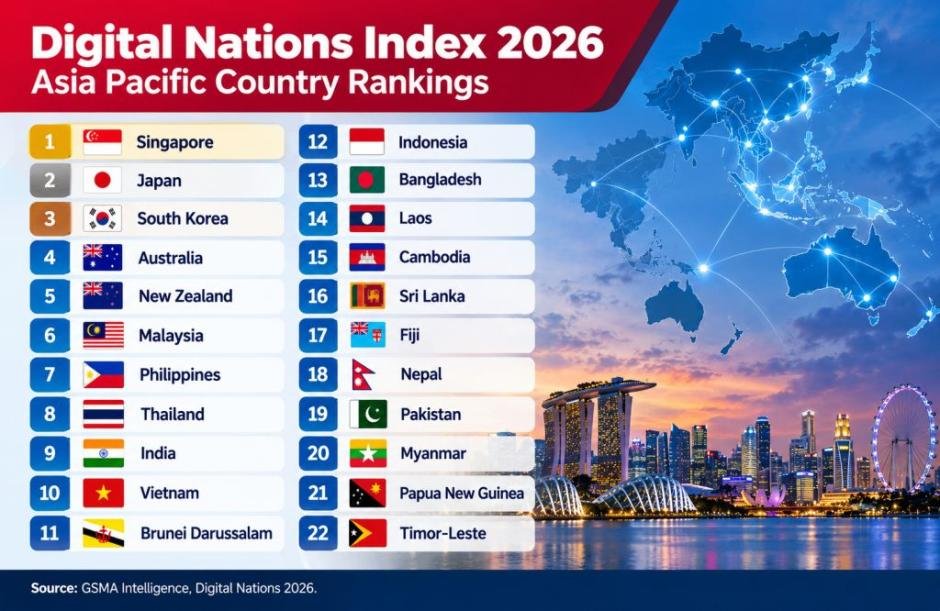
Singapore secured the highest overall score of 88, followed by Japan with 86. South Korea, Australia and New Zealand completed the top five, reflecting their advanced digital infrastructure, innovation ecosystems and cybersecurity capabilities.
India secured ninth position, ahead of Vietnam, Indonesia, Bangladesh and several other emerging digital economies.
The GSMA Digital Nations Index evaluates 22 Asia Pacific economies across five components: infrastructure, innovation, data governance, security and people.
The ranking follows the report’s presentation of aggregate scores. GSMA advises using the index primarily as a diagnostic assessment rather than a simple league table.
Singapore and Japan are the only countries explicitly identified in the report’s accompanying text as scoring 88 and 86, respectively.
Myanmar, Papua New Guinea and Timor-Leste recorded aggregate scores below 30, highlighting the substantial digital development gap between advanced and emerging economies.
India Leads Asia Pacific in Digital Security
India emerged as a significant performer in cybersecurity, achieving the highest possible score in the security component of the Digital Nations Index.
The report highlights India’s investments in cybersecurity capabilities, international cooperation and threat-intelligence sharing.
India has strengthened cybersecurity collaboration through the Australia-India Partnership on Cyber, Critical Technologies and Supply Chains.
The country also recorded one of the largest improvements in data governance, alongside Bangladesh.
India’s progress reflects the expansion of digital public infrastructure, regulatory frameworks and cybersecurity initiatives supporting digital payments, online services and enterprise technology adoption.
However, the GSMA cautions that stronger cybersecurity capabilities do not eliminate cyber risks. Countries must also improve incident detection, response times, infrastructure resilience and recovery capabilities.
India Expands AI Infrastructure With 20,000 Additional GPUs
India’s AI infrastructure investment is another major development highlighted in the report.
The IndiaAI Mission announced plans in February 2026 to expand national AI computing capacity through the addition of 20,000 GPUs, supplementing an existing base of 38,000 GPUs.
This represents a planned expansion to more than 58,000 GPUs, equivalent to an increase of at least 52.6% over the existing capacity.
The additional computing resources are intended to improve access to AI infrastructure for startups, researchers, enterprises and government institutions.
The report identifies India’s large population and digital public infrastructure as important advantages for developing, testing and deploying emerging technologies.
India is also expanding AI literacy through the YUVA AI for ALL programme, which provides free training to improve basic AI knowledge among citizens.
Nine Asia Pacific Markets Record Double-Digit Infrastructure Growth
Digital infrastructure recorded substantial improvement across Asia Pacific in 2026.
According to GSMA Intelligence, nine economies registered double-digit growth in their infrastructure component scores.
Seven of these economies started with infrastructure scores below 25 in 2025:
Bangladesh
Brunei Darussalam
Cambodia
Fiji
Laos
Nepal
Sri Lanka
Malaysia and Vietnam also recorded double-digit infrastructure improvements from higher starting levels.
The expansion of 5G networks contributed to infrastructure development across several emerging economies.
Bangladesh and Fiji launched commercial 5G services in September 2025, followed by Sri Lanka in December 2025 and Cambodia in January 2026.
These developments demonstrate how next-generation mobile connectivity is expanding beyond established digital leaders such as Singapore, Japan and South Korea.
However, the GSMA emphasises that infrastructure investment must also address network reliability, backup power, international connectivity and disaster recovery.
AI Innovation Improves in 14 of 22 Economies
Innovation performance improved in 14 of the 22 Asia Pacific economies assessed in the 2026 index.
The report identifies AI, semiconductor development, advanced computing and technology commercialisation as important drivers of digital competitiveness.
South Korea benefits from strengths in semiconductors, communications infrastructure, computing and manufacturing.
Japan is investing in domestic semiconductor production to strengthen technological independence and supply-chain resilience.
In February 2026, Japan’s Rapidus secured JPY267.6 billion, approximately $1.7 billion, in government and private-sector funding.
The investment supports plans to establish domestic production of advanced 2-nanometre semiconductors by 2027.
Singapore is concentrating on enterprise AI adoption and workforce development.
The country aims to develop 100,000 AI-bilingual workers by 2029, combining industry expertise with practical AI capabilities.
The GSMA notes that countries must move beyond research spending and technology development to measurable commercial adoption and productivity improvements.
Cybersecurity Scores Improve in Seven Economies
Seven Asia Pacific economies improved their security scores in the 2026 index.
The improvements included both emerging economies and advanced digital markets, including India and Japan.
The GSMA identifies cybersecurity resilience, fraud prevention, secure digital identity and coordinated incident response as increasingly important requirements.
The report also cites Interpol findings indicating that more than half of the surveyed economies in Asia and the South Pacific reported cybercrime accounting for approximately 30% of recorded crime nationally.
AI-enabled fraud is creating additional challenges.
According to figures cited in the GSMA report, synthetic personal data attacks increased 142% year on year in Asia Pacific, accounting for 15.7% of regional fraud attempts.
Deepfake-related attacks increased significantly in several markets:
| Country | Reported increase in deepfake attacks |
| Malaysia | 408% |
| Thailand | 199% |
| Sri Lanka | 194% |
| Singapore | 158% |
| South Korea | 137% |
These figures illustrate the increasing sophistication of digital fraud and the importance of stronger authentication technologies.
India and Bangladesh Record Major Data Governance Improvements
India and Bangladesh registered the largest improvements in the data governance component.
Six other economies also advanced: Cambodia, Indonesia, South Korea, Malaysia, Thailand and Vietnam.
The improvements reflect regulatory reforms covering personal data protection, digital identity, cross-border information sharing and accountability.
India advanced implementation of its Digital Personal Data Protection framework, including regulatory and institutional measures.
Bangladesh adopted its Personal Data Protection Act in April 2026, establishing a legal framework governing the collection and use of personal information.
Malaysia introduced additional guidance in April 2026 covering data protection impact assessments, privacy-by-design and automated decision-making.
The GSMA identifies trusted cross-border data flows as an increasingly important requirement for regional digital economic integration.
Digital Identity Adoption Accelerates Across Asia Pacific
India’s Aadhaar ecosystem is another example of large-scale digital infrastructure development.
The GSMA report states that India’s new Aadhaar application exceeded 31 million downloads by June 2026, less than five months after its launch.
The country is expanding offline identity verification, face authentication and digital KYC capabilities.
Thailand is also strengthening its digital identity infrastructure.
Nearly 1,800 government electronic services have been connected under the country’s digital identity development initiatives.
Thailand’s Digital ID Framework Phase 2, covering 2025–2027, focuses on digital wallets, verifiable credentials and interoperability.
These initiatives are intended to improve access to government services, financial transactions and digital commerce.
Digital Skills Remain a Major Challenge
Despite improvements in connectivity and digital infrastructure, the GSMA identifies digital skills as a continuing challenge.
Half of the 22 economies assessed achieved scores above 60 in the people component.
This indicates that 11 economies have reached relatively stronger levels of digital participation, literacy and readiness.
However, the growing adoption of generative AI introduces additional requirements for workforce training and digital inclusion.
Countries must develop skills that enable citizens to evaluate AI-generated information, identify online fraud and use digital tools productively.
Telecom Operators Become Critical to Digital Trust
The report identifies mobile operators as important participants in strengthening digital trust.
Telecom companies are increasingly responsible for capabilities extending beyond conventional connectivity.
These include secure digital identity, fraud prevention, network resilience and threat intelligence.
The GSMA identifies four foundations of digital trust: trusted identity, trusted communications, trusted resilient networks and trusted intelligence.
For telecom operators, the priorities include improving authentication services, combating scams, investing in resilient infrastructure and strengthening cybersecurity collaboration.
These requirements could influence future telecom capital expenditure, particularly investment in network redundancy, security platforms, digital identity services and AI-enabled fraud detection.
Outlook: Digital Trust Becomes Central to Asia Pacific’s Digital Economy
The GSMA Digital Nations Index 2026 shows that Asia Pacific’s digital transformation is progressing at different speeds.
Singapore and Japan retain leadership through strong digital capabilities, while India demonstrates notable strengths in cybersecurity, digital public infrastructure and AI investment.
The report’s key figures underline the scale of regional transformation: 22 economies assessed, nine recording double-digit infrastructure score growth, 14 improving innovation performance and seven strengthening cybersecurity scores.
For governments and telecom operators, the next challenge is to convert investments in 5G, cloud, AI and digital public infrastructure into secure, reliable and widely adopted digital services.
The report concludes that connectivity alone is no longer sufficient. Cybersecurity, trustworthy digital identity, resilient networks, data governance and digital skills will increasingly determine the success of Asia Pacific’s digital economies.
BABURAJAN KIZHAKEDATH